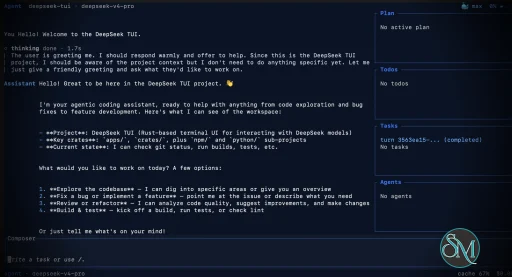
DeepSeek TUI is an open source terminal based coding agent designed for DeepSeek AI models. Unlike a simple chatbot, it can interact with your local workspace, execute shell commands, manage git operations, and assist with software development tasks directly from the command line.
The project is written in Rust and focuses on speed, low resource usage, and keyboard driven workflows. It is especially appealing for developers who spend most of their time in the terminal.
DeepSeek TUI is gaining attention among developers who prefer terminal based workflows and want direct access to AI powered coding tools without relying on heavy IDE integrations. Built around DeepSeek models, it transforms the terminal into an interactive coding assistant capable of editing files, running commands, and managing development workflows.
Download DeepSeek TUI v0.8.59 - Software Mirrors |
|---|
Download DeepSeek TUI v0.8.59 Windows 64bit Download DeepSeek TUI v0.8.59 Windows 64bit Download DeepSeek TUI v0.8.59 Windows 64bit Download DeepSeek TUI v0.8.59 Windows 64bit |
Download DeepSeek TUI v0.8.59 macOS arm64 Download DeepSeek TUI v0.8.59 macOS arm64 Download DeepSeek TUI v0.8.59 macOS arm64 |
Download DeepSeek TUI v0.8.59 macOS x64 Download DeepSeek TUI v0.8.59 macOS x64 Download DeepSeek TUI v0.8.59 macOS x64 |
Download DeepSeek TUI v0.8.59 macOS arm64 Download DeepSeek TUI v0.8.59 macOS arm64 Download DeepSeek TUI v0.8.59 macOS arm64 |
Download DeepSeek TUI v0.8.59 Linux x64 Download DeepSeek TUI v0.8.59 Linux x64 Download DeepSeek TUI v0.8.59 Linux x64 |
Download DeepSeek TUI v0.8.59 Linux arm64 Download DeepSeek TUI v0.8.59 Linux arm64 Download DeepSeek TUI v0.8.59 Linux arm64 |
DeepSeek TUI v0.8.59 Release Notes:CodeWhale is the canonical project, command, npm package, and release-asset name. The legacy npm package
deprecated and receives no further releases. Users coming from v0.8.x legacy with
InstallRecommended — npm (one command, both binaries)Docker / GHCRcodewhale dispatcher and codewhale-tui runtime. The latest tag is also updated on release.
Cargo (Linux / macOS)codewhale-cli produces the codewhale dispatcher and codewhale-tui produces the interactive runtime that the dispatcher delegates to. Installing only one binary will fail at runtime with a MISSING_COMPANION_BINARY error.
Manual download — platform archives (recommended)Each archive below contains both thecodewhale dispatcher and codewhale-tui runtime, plus an install script:
| Platform | Archive | Install script |
|---|---|---|
| Linux x64 | codewhale-linux-x64.tar.gz | install.sh |
| Linux ARM64 | codewhale-linux-arm64.tar.gz | install.sh |
| Linux RISC-V | codewhale-linux-riscv64.tar.gz | install.sh |
| macOS x64 | codewhale-macos-x64.tar.gz | install.sh |
| macOS ARM | codewhale-macos-arm64.tar.gz | install.sh |
| Windows x64 (installer) | CodeWhaleSetup.exe | NSIS setup |
| Windows x64 | codewhale-windows-x64.zip | install.bat |
| Windows x64 (portable) | codewhale-windows-x64-portable.zip | — |
Unix (Linux / macOS):
deepseek-tui is deprecated and is not republished. For migration from v0.8.x legacy binary names, see docs/REBRAND.md.
Verify (recommended)Download the checksum manifests from this Release and verify:What's in v0.8.59Added
kimi-k2.7-code, recognizes kimi/kimi-k2 aliases for that model, keeps
explicit kimi-k2.6 selectable, and adds the OpenRouter
moonshotai/kimi-k2.7-code registry row.
--verbosity, while interactive TUI launches remain normal by default.
Thanks @cyq1017 for the PR.
.codewhale/instructions.md.
initialize.authMethods, matching the
registry's validation requirement.
Paste; clickable sidebar rows now offer their row command as the first
context action.
Explored ... / Updated metadata
row, include short command-family labels for successful generic verifier
groups, and keep keyboard/mouse expansion and detail inspection intact.
0 running or dispatch is pending. Structured
provider-wait incidents log once per turn from the main tick loop (not on
every footer redraw).
[subagents] interactive_max_launch,
default 4) with a visible queued: waiting for an interactive fanout slot
reason before their first model step.
pause, resume, complete, blocked, and clear
controls while /hunt remains a compatibility alias.
thread/goal/set, thread/goal/get, and
thread/goal/clear, backed by the state store with Codex-style status and
token/time accounting fields.
commands/registry.rs, slash parsing in
commands/parse.rs, and handlers under group-owned command areas, preserving
the existing dispatch surface while reducing future commands/mod.rs churn.
approval.required events now include optional matched_rule metadata when
an execution-policy rule caused the prompt. Thanks @greyfreedom for the PR
and @Ram9199 for the audit-semantics discussion.
Alt+1-Alt+8 trigger
slots regardless of composer text and overlays keep key ownership. Thanks
@reidliu41 for the PR.
/voice-control now record through sox/rec/arecord, transcribe via the
active provider's chat-completions API, and insert transcripts at the
composer cursor. The voice.toggle hotbar action dispatches the real voice
command, with help and status text localized across all seven shipped
locales. Thanks @huqiantao for the PR.
POST /v1/threads/{id}/undo, /patch-undo, and /retry to fork, roll back,
or rerun recent thread turns, plus POST /v1/snapshots/{id}/restore to
restore a workspace snapshot by id. Thanks @bengao168 for the PR.
/provider fallback reset, including footer
visibility for fallback state. Thanks @idling11 for the PR.
huggingface/hugging-face/
hugging_face/hf aliases and HUGGINGFACE_/HF_ env fallbacks. Thanks
@mvanhorn for the PR.
Fixed
data: {...} and data:{...} SSE
frames, matching the spec and preventing providers that omit the optional
space from streaming empty output. Thanks @wgeeker for the PR.
[providers.siliconflow_cn] / [providers.siliconflow-CN]
table and falls back to [providers.siliconflow] only for unset
api_key/base_url/model fields. Thanks @Artenx for the report and
@idling11 for the PR.
deepseek update or deepseek-tui update from a pre-rebrand install now
returns copy-pasteable npm, Cargo, Homebrew, and manual-binary migration
steps instead of trying to spawn a missing codewhale binary. README and
rebrand docs now cover the same upgrade path. Thanks @jazzi and
@tiangangQiu for the reports, @cyq1017 for the update-path PR, and
@angus-guo for the README PR.
codewhale dispatcher installed next to it before
falling back to PATH, preventing fresh local builds or installs from
accidentally invoking an older global dispatcher.
--provider, environment,
or config. Config-sourced unsupported providers fall back to DeepSeek without
forwarding stale keyring secrets. Thanks @cyq1017 for the PR.
SUPER by macOS terminals now work for backgrounding tasks and
sidebar-focus chords without rewriting clipboard shortcuts. Thanks @idling11
for the PR.
use_mouse_capture is false, covering
orphaned terminal reporting state after crashes or focus races.
MailboxMessage::Interrupted, render terminal interrupted cards, and
reconcile stale running fanout counts from manager snapshots.
response.failed /
response.incomplete errors instead of unknown, and dense successful
in-flight tool bursts collapse into the same calm activity metadata row as
committed history.
low/medium/high/xhigh tiers. Startup, /config, and the model
picker now display Codex labels instead of leaking DeepSeek
off/max names, while Codex still reports as a Responses payload
provider. The Responses request builder also clamps legacy minimal input
to low and has regression coverage that Codex requests use
reasoning.effort, not DeepSeek thinking fields.
nvidia/nemotron-3-ultra-550b-a55b while keeping the old
Ultra aliases compatible.
update_goal can only mark goals complete or blocked.
Contributors
codex/v0.8.59-release-ready).
|
Key Features of DeepSeek TUI
Terminal Native Workflow
DeepSeek TUI operates entirely within the terminal, allowing developers to work without switching between browser windows or external interfaces.AI Assisted Coding
The assistant can read and edit files, generate code, explain logic, and help automate development tasks.Shell Command Execution
It supports running terminal commands directly through the interface, streamlining development workflows.Git Integration
Developers can manage repositories, review changes, and handle version control related tasks from inside the tool.Multiple Work Modes
DeepSeek TUI includes modes like Plan, Agent, and YOLO, offering different levels of automation and approval control.Large Context Handling
The tool is built around DeepSeek V4 capabilities, including support for extremely large context windows that help with understanding bigger codebases.
User Experience
DeepSeek TUI is designed for developers comfortable with terminal environments. The interface is keyboard focused and efficient, though beginners may need time to adapt.
The workflow feels closer to tools like Claude Code or Codex style assistants rather than traditional chat applications. Community feedback on Reddit and GitHub discussions highlights its speed and practical coding workflow.
Performance and Compatibility
Because it is written in Rust, DeepSeek TUI is lightweight and responsive. It supports Linux, macOS, and Windows, with installation available through npm, Cargo, or direct binaries.
Performance depends heavily on the connected DeepSeek models and API configuration, but the local interface itself remains fast and efficient.
Pros
Fast terminal native workflow
AI powered coding and automation
Lightweight Rust based architecture
Supports file editing and shell execution
Open source and actively developed
Cons
Requires familiarity with terminal workflows
Depends on external AI APIs
Advanced automation modes may feel risky for inexperienced users
DeepSeek TUI is ideal for developers, DevOps engineers, and terminal focused power users who want AI assistance integrated directly into their command line workflow. It is especially attractive for users seeking a lightweight alternative to browser based AI coding tools.
DeepSeek TUI combines AI coding assistance with the efficiency of terminal workflows. Its fast performance, flexible automation, and developer focused design make it one of the most interesting open source AI terminal tools currently gaining traction.
Developer:
Hunter Bown
Operating System:
Windows / macOS / Linux
Date Added:
2026-06-13T16:01:07.380Z
Categories:
Post a Comment/Report Broken Link: