DeepSeek TUI v0.9.2

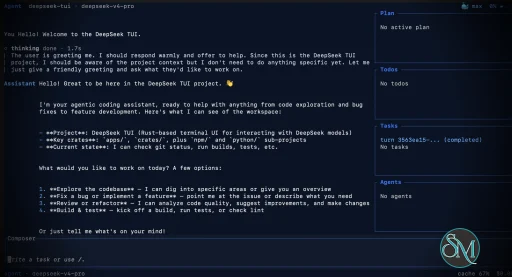
DeepSeek TUI is an open source terminal based coding agent designed for DeepSeek AI models. Unlike a simple chatbot, it can interact with your local workspace, execute shell commands, manage git operations, and assist with software development tasks directly from the command line.

The project is written in Rust and focuses on speed, low resource usage, and keyboard driven workflows. It is especially appealing for developers who spend most of their time in the terminal.

DeepSeek TUI is gaining attention among developers who prefer terminal based workflows and want direct access to AI powered coding tools without relying on heavy IDE integrations. Built around DeepSeek models, it transforms the terminal into an interactive coding assistant capable of editing files, running commands, and managing development workflows.

Download DeepSeek TUI v0.9.2 - Software Mirrors

Download DeepSeek TUI v0.9.2 Windows 64bit
codew-windows-arm64.exe | 202.5 kB

Download DeepSeek TUI v0.9.2 Windows 64bit
codew-windows-x64.exe | 217.5 kB

Download DeepSeek TUI v0.9.2 Windows 64bit
codewhale-tui-windows-arm64.exe | 55.85 MB

Download DeepSeek TUI v0.9.2 Windows 64bit
codewhale-tui-windows-x64.exe | 68.42 MB

Download DeepSeek TUI v0.9.2 Windows 64bit
codewhale-windows-arm64-portable.zip | 27.53 MB

Download DeepSeek TUI v0.9.2 Windows 64bit
codewhale-windows-arm64.exe | 11.32 MB

Download DeepSeek TUI v0.9.2 Windows 64bit
codewhale-windows-arm64.zip | 27.53 MB

Download DeepSeek TUI v0.9.2 Windows 64bit
codewhale-windows-x64-portable.zip | 29.66 MB

Download DeepSeek TUI v0.9.2 Windows 64bit
codewhale-windows-x64.exe | 13.89 MB

Download DeepSeek TUI v0.9.2 Windows 64bit
codewhale-windows-x64.zip | 29.66 MB

Download DeepSeek TUI v0.9.2 macOS arm64
codew-macos-arm64 | 329.75 kB

Download DeepSeek TUI v0.9.2 macOS arm64
codewhale-macos-arm64 | 9.94 MB

Download DeepSeek TUI v0.9.2 macOS arm64
codewhale-macos-arm64.tar.gz | 25.96 MB

Download DeepSeek TUI v0.9.2 macOS arm64
codewhale-tui-macos-arm64 | 46.83 MB

Download DeepSeek TUI v0.9.2 macOS x64
codew-macos-x64 | 331.34 kB

Download DeepSeek TUI v0.9.2 macOS x64
codewhale-macos-x64 | 11.05 MB

Download DeepSeek TUI v0.9.2 macOS x64
codewhale-macos-x64.tar.gz | 27.91 MB

Download DeepSeek TUI v0.9.2 macOS x64
codewhale-tui-macos-x64 | 51.77 MB

Download DeepSeek TUI v0.9.2 macOS arm64
codew-macos-arm64 | 329.75 kB

Download DeepSeek TUI v0.9.2 macOS arm64
codewhale-macos-arm64 | 9.94 MB

Download DeepSeek TUI v0.9.2 macOS arm64
codewhale-macos-arm64.tar.gz | 25.96 MB

Download DeepSeek TUI v0.9.2 macOS arm64
codewhale-tui-macos-arm64 | 46.83 MB

Download DeepSeek TUI v0.9.2 Linux x64
codew-linux-x64 | 448.55 kB

Download DeepSeek TUI v0.9.2 Linux x64
codewhale-linux-x64 | 12.13 MB

Download DeepSeek TUI v0.9.2 Linux x64
codewhale-linux-x64.tar.gz | 29.18 MB

Download DeepSeek TUI v0.9.2 Linux x64
codewhale-tui-linux-x64 | 56.79 MB

Download DeepSeek TUI v0.9.2 Linux arm64
codew-linux-arm64 | 324.6 kB

Download DeepSeek TUI v0.9.2 Linux arm64
codewhale-linux-arm64 | 10.9 MB

Download DeepSeek TUI v0.9.2 Linux arm64
codewhale-linux-arm64.tar.gz | 27.37 MB

Download DeepSeek TUI v0.9.2 Linux arm64
codewhale-tui-linux-arm64 | 49.32 MB

DeepSeek TUI v0.9.2 Release Notes:

Codewhale is the public product from Shannon Labs. The codewhale
command, npm package, and release-asset names remain lowercase technical
identifiers. The legacy npm package deepseek-tui is deprecated and
receives no further releases. Users coming from v0.8.x legacy deepseek /
deepseek-tui names should migrate with docs/REBRAND.md.

Install

Recommended — npm (one command, all three entrypoints)

bash
npm install -g codewhale
The wrapper downloads the matched codewhale, codew, and codewhale-tui binaries from this Release and places them in the same directory.

Docker / GHCR

bash
docker run --rm -it \
  -e DEEPSEEK_API_KEY="$DEEPSEEK_API_KEY" \
  -v codewhale-home:/home/codewhale/.codewhale \
  ghcr.io/hmbown/codewhale:v0.9.2
The image ships the codewhale dispatcher, codew shim, and codewhale-tui runtime. The latest tag is also updated on release.

Cargo (Linux / macOS)

bash
cargo install codewhale-cli codewhale-tui --locked
Both crates are required — codewhale-cli produces the codewhale dispatcher and codew shim, while codewhale-tui produces the interactive runtime that the dispatcher delegates to. Installing only one crate will fail at runtime with a MISSING_COMPANION_BINARY error.

Manual download — platform archives (recommended)

Each archive below contains the codewhale dispatcher, codew shim, and codewhale-tui runtime, plus an install script:
  • Linux x64: codewhale-linux-x64.tar.gz | install.sh
  • Linux ARM64: codewhale-linux-arm64.tar.gz | install.sh
  • Android ARM64 (Termux): codewhale-android-arm64.tar.gz | install.sh
  • macOS x64: codewhale-macos-x64.tar.gz | install.sh
  • macOS ARM: codewhale-macos-arm64.tar.gz | install.sh
  • Windows x64 (installer): CodeWhaleSetup.exe | NSIS setup
  • Windows x64: codewhale-windows-x64.zip | install.bat
  • Windows x64 (portable): codewhale-windows-x64-portable.zip | —
  • Windows ARM64: codewhale-windows-arm64.zip | install.bat
  • Windows ARM64 (portable): codewhale-windows-arm64-portable.zip | —
Unix (Linux / macOS):
bash
tar xzf codewhale-.tar.gz
cd codewhale-
./install.sh
Windows:
  • For the installer path, run CodeWhaleSetup.exe; it installs codewhale.exe, codew.exe, and codewhale-tui.exe under %LOCALAPPDATA%\Programs\CodeWhale\bin and adds that directory to the current-user PATH.
  • Extract the archive for your machine: codewhale-windows-x64.zip or
codewhale-windows-arm64.zip
  • Run install.bat (copies to %USERPROFILE%\bin)
  • Add %USERPROFILE%\bin to your PATH
The portable Windows archive skips the install script — extract and run from any directory. The NSIS installer is currently unsigned and may trigger Windows SmartScreen until a signing certificate is wired into the release pipeline. Each platform also has bare, unarchived binaries attached below (codewhale-, codew-, and codewhale-tui-) — the npm wrapper and the in-app codewhale update download the matched runtime binaries, whereas the .tar.gz / .zip archives above are the recommended manual download and additionally bundle an install script. The legacy npm package deepseek-tui is deprecated and is not republished. For migration from v0.8.x legacy binary names, see docs/REBRAND.md.

Verify (recommended)

Download the checksum manifests from this Release and verify:
bash

Linux — archive bundles

sha256sum -c codewhale-bundles-sha256.txt --ignore-missing

Linux — individual binaries

sha256sum -c codewhale-artifacts-sha256.txt --ignore-missing

macOS

shasum -a 256 -c codewhale-bundles-sha256.txt --ignore-missing shasum -a 256 -c codewhale-artifacts-sha256.txt --ignore-missing

What's in v0.9.2

This is the Codewhale v0.9.2 source candidate. It is not a published release until the matching tag, packages, checksums, and release assets exist.

Changed — behavior

  • Legacy model = auto no longer elects a network classifier on its own.
Holding a DeepSeek API key used to silently select deepseek-v4-flash as the classifier for every Auto turn — a per-turn cost on a route nobody asked for, and one provider privileged over the rest. Auto now stays local and free unless an explicit [auto.router] block names a provider and model. If you relied on the implicit default, restore it explicitly:
toml
  [auto.router]
  provider = "deepseek"
  model = "deepseek-v4-flash"
  
[auto.router] remains legacy model = auto configuration. It is unrelated to a Fleet's Adaptive Reasoning Router, which is a saved service referenced by name from a Fleet file and decides only how hard an already-frozen route thinks. Landed since v0.9.1, not yet released. A cluster of defects found by a read-through audit of the policy engine, the MCP proxy, the session index, and the app-server bridge — several of them cases where the wrong outcome was reached silently, behind a response or a log line that looked fine. The release also adds opt-in session, reasoning, localization, and inspectability surfaces; existing defaults remain stable unless an entry below explicitly says otherwise.

Added

  • /permissions now lists the active user permission-rule source, each rule's
effective matcher and global/repository scope, and whether that scope applies in the current workspace. /permissions remove previews deletion and requires a snapshot-bound confirmation token, so a concurrent edit cannot move a different rule under the confirmed index. Appends and removals share one adjacent lock, preserve unrelated TOML formatting and comments, atomically replace permissions.toml, and reload the live user ruleset without clearing session-only approvals. /config ask-rules remains a compatibility entry; rule creation, glob/directory rules, and deny persistence remain out of scope (#1186, PR #4960 by @greyfreedom).
  • /preview-request (aliases /dryrun and /preview_request) is a human-only,
provider-free inspection of the next primary turn. Production dispatch and preview share one prepared-request seam across Chat Completions, Anthropic Messages, and OpenAI Responses, so the manifest reads the final wire model, reasoning controls, tool choice, tool schemas, and body hash from the same value production sends. Route, tool, or body facts that require Auto's provider classifier, an MCP connection, mutable hooks, compaction, or queued runtime injections remain typed unavailable. The manifest reports exact primary role/lane identity, upstream route-source provenance, requested and effective reasoning, canonical JSON sizes, conservative offline estimates, and provider-reported usage as unavailable because no request ran. It never adds a model-visible tool, sends a provider call, or prints prompt, message, credential, endpoint-path, or workspace-path content. The explicit /preview-request base-prompt mode prints only the exact effective base prompt; effective system text remains protected behind its final hash. The exact body includes the same authoritative transient Work/To-do tail used by production, including graph-backed state newer than the legacy projection. Preflight preserves production's separately framed base-plus-Work estimate, and fails closed when the authoritative projection is unavailable. An exhausted active goal token budget also produces a typed unavailable result before any outbound request is built. (#1004, #3928; dry-run concept harvested from PR #1099 by @GTC2080 / TaoMu.)
  • Slash commands, hotbar actions, and CLI entrypoints for the same Lane/Fleet
lifecycle operation now share one typed control-plane contract (codewhale-lane::control): a stable . id, read-vs-write authority, persistence scope, exact-identity target selection, retryability, lifecycle outcome, and one bounded, sanitized receipt. docs/COMMAND_CONTROL_PLANE.md documents it (#1888).
  • /lane [list|status|interrupt|restart|resume] — durable Lane control from the
composer, backed by the same executor codewhale lane … calls. `codewhale lane interrupt|restart|resume are the matching CLI verbs; lane stop` stays as a compatibility spelling of lane interrupt. Appending @ to a lane id fences a write to the exact durable generation you observed, so a concurrent transition is rejected as a conflict rather than acted on (#1888).
  • codewhale fleet list and /fleet [list|status|interrupt|resume] — durable
Fleet run inspection and control from either surface, through shared DTOs that carry the exact provider, provider-table id, model, effective reasoning tier, and route source when the ledger records them, and a typed not_recorded / not_applicable / redacted reason when it does not. Requested-vs-effective reasoning is never back-filled: the ledger persists the effective tier only, so the requested tier reports not_recorded (#4022).
  • The bundled skill pack now ships a help skill (catalog generation 7). It is
invocation: explicit-only, so it never enters the model's ambient catalogue and costs no prompt budget. Its body is a routing card that points at the surfaces this build actually exposes — /help and /help , /skills and /skills inspect, /config, doctor, and the docs/ tree when the workspace is a Codewhale checkout — and explicitly forbids pasting a command list or settings table into context (#4698).
  • crates/tui/assets/skills-catalog-matrix.json: an authored, provider-free
expectation matrix covering every bundled skill (tier, invocation, aliases, ambient-catalogue eligibility, shadowed aliases). Contract tests in crates/tui/src/skills/catalog_matrix.rs assert a bijection between the fixture and the shipped bundle, so the starter pack cannot change without an explicit fixture update. The matrix covers positive eligibility and explicit load, non-activation negatives, alias resolution, explicit-only exclusion, alias-vs-canonical collision precedence, and prompt-budget invariants (no duplicate catalogue entries, no aliases as extra entries, and the shipped pack fitting inside the 12 000-char budget with no omitted-skills line). These are deterministic registry/catalog/resolver assertions and make no claim about semantic model routing (#4698).
  • Locale-routing coverage for the complete bundled catalog across every shipped
locale (en, ja, zh-Hans, zh-Hant, pt-BR, es-419, vi, ko). No bundled skill ships a localized routing description and none was invented; the tested contract is deterministic fallback to the canonical English description, with the rendered catalogue byte-identical across locales. Exact-tag match, primary-subtag fallback, and English fallback are covered against a synthetic authored fixture, and the parity test fails if a bundled skill ever gains localized metadata without source-backed coverage (#4698).
  • docs/LIVE_SMOKE.md: copy-pasteable, opt-in live-smoke instructions for Kimi
K3 and a second provider/model (DeepSeek). The runs are manual only — nothing in CI, tests, or skills invokes them. They use env -i plus a throwaway CODEWHALE_HOME; HOME is left unset rather than repurposed, and ambient provider variables are not forwarded. The operator names the credential variable explicitly, and the isolated child reads its value with echo off, restores the prior terminal state on exit or interruption, and never persists the value or puts it in a command argument. The page states the expected route/model/reasoning/tool receipt fields while treating provider errors as unclassified until provider configuration, authentication/entitlement, and harness behavior have been corroborated independently (#4698).
  • Approval cards can now remember eligible safe shell and file-write approvals
as exact allow rules scoped to the current repository. Remembered shell commands use complete-command matching, validated file and patch paths remain workspace-relative, and dangerous, critical, or repo-law-held requests stay ineligible and continue to require review.
  • tui.header_items (array of strings, optional, default []): an opt-in
header chip showing cumulative session token usage as input / cache-hit / output. Set header_items = ["tokens"] under [tui] to enable it. The chip is the only elidable element of the header — the git label, context meter, and version stamp keep their space, and narrow terminals drop the chip rather than the baseline chrome. Unknown entries are warned about and skipped so configs written by newer builds stay loadable by older ones (#4520 requested by @eugenicum; PR #4610 by @XhesicaFrost, harvested with co-authorship).
  • thinking_default_expanded lets reasoning blocks start open while keeping
Space as the per-block toggle. The setting is persisted, available through native and runtime configuration, and documented for SSH/tmux accessibility (issue #4925 and PR #4928 by @M-Maciej).
  • The transcript renders a conservative subset of LaTeX math as readable
Unicode without rewriting fenced/inline code, ordinary currency, escaped dollars, or unknown commands. The contribution from PR #4973 by @SparkofSpike was hardened and landed through PR #4974; reported by @antarikshraya in #4957.
  • Session control now includes a sessions rail, shared archive projection,
picker archive controls, and opt-in interactive auto-resume with explicit handoff behavior. The work closes the remaining session-browsing direction from #2934; thanks @cy2311 for the original report.
  • The bundled contributor-onboarding skill can sync contribution context,
select the appropriate gate, and prepare a digest without inflating the ambient skill catalog. It follows the contributor-navigation request in #4227 by @JayBeest.
  • Bahasa Indonesia now has a complete repository documentation suite and a
registered website dictionary alongside the shipped TUI locale (PRs #4962 and #4972 by @atmosuwiryo, closing #4789).
  • Reasoning content can keep its rail, italics, cursor, and expansion controls
while disabling only the warm background highlight. The independent setting is persisted and localized (#4089; reported by @elijahchan2019).
  • StepFun setup now asks whether a key belongs to PAYG or Step Plan, keeps the
two endpoint/billing routes distinct, and localizes the choice across the complete packs (#4526; reported by @whp233).
  • OpenCode Zen is a separate model-aware API-key provider. Its curated catalog
selects Responses, Anthropic Messages, or Chat Completions per model; unsupported Gemini and unknown models fail closed, and missing Zen credentials never fall through to ChatGPT/Codex OAuth guidance. The implementation from closed PR #4467 by @snail-vs (snailoniu) is preserved in the candidate.
  • Markdown exports correlate prompts with stable workspace restore-point ids
and say when correlation is unavailable or ambiguous, completing the remaining restoration/export direction from #2494 by @wywsoor.

Fixed

  • Permission setup now consistently presents the product postures Ask,
Auto-Review, and Full Access instead of leaking the internal never token. The same resolved sandbox policy now drives execution and UI receipts: Plan stays read-only, Ask and Auto-Review stay workspace-scoped, and Full Access is actually unsandboxed unless a stricter effective configuration wins.
  • Fleet setup no longer stalls when a user explicitly selects a configured
Codex or Grok external-consent route. The selected route is activated and validated before saving, roster roles open directly on their Model step, Review saves on the first Enter, and new profiles default to the personal profile directory that the roster loads on the next session.
  • Provider credential dialogs now share one wrapping, secret-safe API-key
surface across every non-OAuth provider. A key already present in durable storage is reported as configured without rendering it, typing or pasting is clearly framed as replacement, narrow help text remains visible, and Codex and Grok OAuth flows remain token-free in this modal.
  • Ctrl+O again opens the complete recorded reasoning detail for the selected,
active, or latest reasoning block. The whole-turn Turn Inspector moved to Ctrl+Alt+O and /turn inspect, removing the shortcut collision while keeping raw leaf detail and post-flush reasoning discoverable.
  • Failed child agents now deliver a distinct high-priority failure receipt to
their owning parent with a sanitized failure class, elapsed work, and a full transcript handle. Parent-to-child message, follow-up, and interrupt tools now use one hierarchy-checked mailbox path, and persisted nested completion envelopes remain safely restorable across instruction-text revisions.
  • Background-shell completion events now carry only bounded tails plus a
retrievable exact-evidence handle. Terminal foreground Bash results are acknowledged at the direct tool-result boundary and are no longer emitted a second time as background completion artifacts.
  • Providerless Fleet and child-agent fixed-model routes now reject only
high-confidence foreign-provider model ids before creating a worktree, while explicit provider/model pairs, custom and local endpoints, unknown ids, and aggregator wire-id resolution retain their intended behavior.
  • Manual compaction now preserves and reports the supplied provider failure
class instead of replacing it with an opaque generic error. This does not infer quota exhaustion when the recorded failure does not prove it.
  • The ambient jellyfish keep complete, readable silhouettes while animating,
and the website favicon now uses the Signal Current desktop tile instead of the legacy whale mark.
  • ACP JSON-RPC responses preserve numeric request ids for avante.nvim while
retaining the negotiated string-id exception for Zed (PR #4929 by @atmosuwiryo).
  • Restored shell cells whose job no longer exists stop displaying live
spinners and settle into a truthful stale/no-output state across transcript, phase strip, and sidebar (PR #4937 by @LI-Jialu, closing #4547).
  • Interrupted checkpoints and timed recovery snapshots remain checkpoints
instead of being promoted into orphan session files, preventing duplicate /resume entries (PR #4963 by @SparkofSpike).
  • Every shipped locale is admitted by the typed settings schema and native
chooser, with complete/partial status kept independent and tested (PR #4856 by @nightt5879, closing #4786). Context-menu hover hit-testing also accounts for its title row (PR #4897 by @XhesicaFrost; reported by @SparkofSpike in #4803).
  • OSC 52 and SSH/tmux clipboard transport run on one bounded background worker
rather than blocking input and rendering on the TUI loop; late transport failures still surface through the status path (PR #4896 by @nightt5879, closing #4159).
  • Non-streaming model calls receive a generation-length response budget rather
than the SSE header-open timeout, while actual SSE opens share the bounded cross-provider transport seam. The equivalent fix direction came from closed PR #4743 by @vibecoding-skills.
  • Resumed sessions diagnose a deleted inherited workspace before shell launch
instead of failing as an opaque Windows process error (report #4100 by @redjade75723). DeepSeek native tool-call wrapper tokens are also scrubbed from visible streaming and completed output as a grounded fail-soft follow-up to report #3880 by @hardy922; that report's exact emitted marker remained unconfirmed.
  • Auto model routing now preserves the user's requested reasoning effort
through startup, provider/model changes, session restore, the picker, Ctrl+T, and Hotbar actions. The tier is normalized only after the concrete provider route is known instead of being silently replaced by Auto (#4941, PR #4961 by @nightt5879).
  • Auto-compaction now defaults on for every known model context window,
including Kimi K3's 1,048,576-token routes. Persisting only an auto_compact_threshold or auto_compact_threshold_percent now counts as opt-in intent, while an explicit auto_compact = false remains authoritative. /config reports the effective state, percentage, and computed token trigger.
  • Per-provider context_window overrides are now documented and visible in
/config, provider setup help, diagnostics, and the example configuration. The effective override consistently drives preflight budgeting, the context meter, and compaction; this lets a user cap a 1M Kimi route to 256K when their Coding Plan tier has the smaller window.
  • Agent Details now projects status, model, elapsed time, and step counts from
the same row snapshot as the primary agents list, eliminating contradictory worker state between the two surfaces.
  • Composer submission and its hints now share one state machine. Portable
terminals use Enter to queue during a running turn and Enter again to steer; Ctrl/Cmd+Enter is accepted only when an enhanced terminal reports it and is no longer advertised as universally available.
  • edit_file now matches LF-only model search text against CRLF files,
preserves the file's line-ending style for replacement text, and still rejects newline-normalized duplicate matches as non-unique (#4764). Implemented in PR #4942 by @nightt5879; reported and root-caused by @LmeSzinc.
  • /fleet status read the current TUI session's sub-agents while `codewhale
fleet status read the durable .codewhale/fleet.jsonl` ledger — two different things wearing one name, so a run started by codewhale fleet run never appeared in the TUI. /fleet status now reads the durable ledger through the same code path as the CLI; the session view keeps its own name as /fleet workers (/subagents and n still work). When a workspace has no ledger, both surfaces report a typed no_fleet_ledger reason instead of an empty-looking "all clear", and neither creates the ledger as a side effect of reading it (#4022).
  • codewhale fleet status (and list/interrupt/resume) created
.codewhale/fleet.jsonl as a side effect of opening the manager, then reported no_fleet_ledger for the file it had just made — so the second invocation showed an empty Fleet where none existed. The CLI now refuses those verbs before the manager is constructed, matching /fleet (#4022).
  • fleet resume accepted any string. An id absent from the ledger
reconciled nothing but still wrote a run-status record keyed by whatever was typed, and reported no_change. Unknown ids are now refused as not_found before any durable write (#4022).
  • lane interrupt reported transitioned even when it changed nothing —
another process's stop looked like our own. The Runtime backend now reports whether this call performed the transition, and a no-op is no_change. The @ fence is also evaluated inside the registry's per-Lane lock rather than before it, so a stale fence refuses without running Runtime teardown instead of racing between the check and the stop (#1888).
  • /lane no longer runs Runtime teardown on the TUI composer thread. Reads on
the slash surface skip reconciliation (which probes tmux and takes a lock) and say so on the receipt instead of implying freshness; lane interrupt is CLI-only until that work runs off-thread, and reports surface_not_supported naming codewhale lane interrupt (#4022).
  • The hotbar is no longer modelled as a third control surface. A slot binds a
slash command and fires it with no argument, so it runs as the slash surface; the contract now declares which verb a bare press actually reaches (hotbar_bare_dispatch, true only for lane.list) instead of advertising target-taking verbs as hotbar-reachable (#1888).
  • codewhale lane list --json and lane status --json keep emitting the
LaneRecord shape they always have — the receipt did not replace it. The human lane status output also regained branch, session, socket, attach, and log, which the first cut of the shared DTO had dropped (#1888).
  • No surface advertises a backend it does not have. lane restart and
lane resume have no implementation — a Lane is re-created by codewhale lane start, and a stopped Lane's Runtime session is gone — so all three surfaces refuse them with backend_not_implemented and say why. fleet restart drives the manager loop to completion, which only the CLI runs, so /fleet restart reports surface_not_supported and names the CLI command rather than quietly doing a smaller thing (#1888).
  • Deny rules in permissions.toml no longer miss a command because of an
intervening flag: deny matching is token-based with flag-skipping and backtracking, so a git push rule still catches git -c foo=bar push. Path matching folds case only on platforms whose filesystems are case-insensitive, and the default approval branch no longer proposes the working directory as a network host.
  • MCP tool calls run once. A failed call is no longer retried as if it
were a failed lookup, qualified-name resolution collects every match and reports an ambiguity instead of taking whichever the hash map yielded first, and registering a server whose name collides with an existing one after sanitization is now an error rather than a silent overwrite. The equivalent call-once fix direction came from closed PR #4756 by @adity982.
  • The session index survives a torn line: an unparseable entry is skipped
rather than aborting the whole read, appends carry their data through to disk, and appends and compaction share a lock so a compaction can no longer race an append into a lost record.
  • Edit counts as a write tool for workflow elevation, and the TUI's
write/shell classification now delegates to one shared allowlist rather than keeping a second copy that could drift.
  • A rejected app/config/set stays a no-op. Previously an invalid value
still tore down the cached runtime bridge, killing the child runtime and orphaning every other in-flight stdio thread behind a response that correctly reported failure.
  • A malformed project config.toml is no longer indistinguishable from
having no project config. Because a project config may only tighten approval and sandbox policy, silently discarding a broken one dropped a repository's restrictions back to the looser user defaults; the setup wizard now says so, naming the file but never quoting its contents.
  • An expired lane worktree no longer leaves its branch behind, which made
reusing the same lane name fail with "branch already exists". A branch still carrying unmerged commits is kept — a TTL lapsing is not consent to delete someone's work.
  • An in-flight thread/message turn can be stopped. The stdio loop keeps
reading while a turn streams, so the new thread/interrupt request (and shutdown) can reach a runaway turn instead of waiting on the very turn they were meant to stop.
  • Precedence is stated only in the constitution's "Whose word wins" section.
Memory hygiene no longer ships an inverted Tier list that put the constitution above the user's current request; approval, compaction, and personality overlays describe behavior without rank vocabulary; and the authority recap points at the single source rather than restating a second ladder.
  • carries facts (mode, posture, model, workspace), not mode
doctrine or permission-question essays re-asserted every user message.
  • The project context pack (pretty-printed workspace tree) is off by default
and opt-in via [context] project_pack = true. Language law is compressed while keeping the English-constitution / user-language-reply contract.
  • Modal lists and config pickers wrap selection at both ends (Down past the
last row returns to the top). Home-directory resolution prefers HOME/USERPROFILE via effective_home_dir across remaining call sites so Windows tests that fake the home env vars match production paths. The equivalent home-directory sweep came from closed PR #4760 by @EvanProgramming.

Changed

  • Prefix-cache tool catalog entries store only the SHA-256 digest, not the
joined catalog string. Unused plan-transition validation helpers are removed.
  • Settings sections now hold only what they claim (#4751). Fleet keeps
Fleet/member concerns; /goal moved to a Session section and Workflow orchestration to its own Workflow section. The inert DeepSeek-only default_model fallback moved out of Model settings into an explicit Legacy section — exact-Fleet users switch Fleets, not fallback models; the config field is retained because the runtime still reads it. This is presentation only: the persisted keys (goal_command, workflow, default_model), their values, scopes, and runtime behavior are unchanged.
  • Auto model routing is scoped to the active provider. The classifier
inventory no longer discloses other providers' runnable routes (or the fact that their credentials exist), a classifier reply naming another provider is refused, the local heuristic no longer falls back to a different provider when the active one is unusable, and the implicit DeepSeek-flash classifier is skipped for non-DeepSeek sessions. Auto receipts and the model picker hint report the active-provider-only scope instead of "runnable providers". Cross-provider Auto is available only through the persisted `[auto] cross_provider = true opt-in (an explicit [auto.router]` route remains its own opt-in for the classifier call). Same-provider strong/fast selection and [auto] cost_saving are unchanged.
  • The QA pseudo-terminal acceptance harness now parses frames with rio-vt
behind its existing neutral frame/color surface, retaining the assertions while removing the vt100 dependency (PR #4931 by @raphamorim).
  • Anthropic Messages and OpenAI Responses stream opening now share the
client/stream_entry.rs seam already used by Chat Completions: one bounded response-header wait, shared dual/HTTP-1.1 policy selection, at most one HTTP/1.1 fallback on a classified HTTP/2 header stall, and common idle-timeout diagnostics. Wire-specific authentication, headers, endpoints, decoding, and rate-limit behavior remain at each adapter edge. The timeout-placement diagnosis and fix direction came from closed PR #4743 by @vibecoding-skills.

Security

  • Release containers now publish an SBOM attestation and pin maximum-mode
provenance explicitly so supply-chain metadata cannot silently weaken with a builder-default change (PR #4958 by @kobihikri).

Contributors

Thank you to the contributors whose code, reports, and reviews shaped v0.9.2: allow grants and cross-platform path semantics (PR #4761), plus safe permission-rule listing and snapshot-bound removal (PR #4960). writes (PR #4896), complete locale exposure in settings (PR #4856), CRLF-safe edits (PR #4942), and reasoning-effort preservation across automatic model routing (PR #4961). session-token header (PR #4610) and context-menu hover alignment (PR #4897).
  • @cyq1017 — the hooks configuration/executor
split from PR #4087. model-aware routes, authentication, documentation, and test isolation from closed PR #4467, whose contributor commits are preserved in the candidate. quality review harvested from PR #4908, duplicate-session fix in PR #4963, LaTeX implementation from PR #4973 landed through #4974, and the context-menu reproduction in #4803.
  • @GTC2080 — the request-preview concept from
PR #1099. decoding direction from PR #4909.
  • @fleitz — required source-candidate credit for
the canonical Bash no-cwd workspace fix and regression in PR #4673 (issue #4674). reproduction, root-cause analysis, and affected-code anchors in issue #4764. (PR #4929) and the Indonesian documentation and website locale (PRs #4962 and #4972).
  • @M-Maciej — the expanded-by-default reasoning
setting and its original report (PR #4928, issue #4925). parser to rio-vt (PR #4931).
  • @LI-Jialu — truthful finalization of restored
stale shell cells (PR #4937). explicit provenance mode (PR #4958). @adity982, and @vibecoding-skills — equivalent fix direction for the effective-home sweep (#4760), MCP call-once behavior (#4756), and streaming/non-streaming timeout split (#4743). rendering report in #4957. output-presentation measurements in #4520 and #4468.
  • @whp233 — the StepFun/OpenCode subscription-route
request in #4526. @hardy922, @JayBeest, @elijahchan2019, @cy2311, and @wywsoor — reports and product direction behind the stale-workspace diagnosis (#4100), native-tool-token filtering (#3880), contributor onboarding (#4227), optional reasoning highlight (#4089), session control (#2934), and export/restore correlation (#2494). See CHANGELOG.md for full notes and docs/CHANGELOG_ARCHIVE.md for older releases.

Key Features of DeepSeek TUI

  • Terminal Native Workflow
    DeepSeek TUI operates entirely within the terminal, allowing developers to work without switching between browser windows or external interfaces.

  • AI Assisted Coding
    The assistant can read and edit files, generate code, explain logic, and help automate development tasks.

  • Shell Command Execution
    It supports running terminal commands directly through the interface, streamlining development workflows.

  • Git Integration
    Developers can manage repositories, review changes, and handle version control related tasks from inside the tool.

  • Multiple Work Modes
    DeepSeek TUI includes modes like Plan, Agent, and YOLO, offering different levels of automation and approval control.

  • Large Context Handling
    The tool is built around DeepSeek V4 capabilities, including support for extremely large context windows that help with understanding bigger codebases.

User Experience

DeepSeek TUI is designed for developers comfortable with terminal environments. The interface is keyboard focused and efficient, though beginners may need time to adapt.

The workflow feels closer to tools like Claude Code or Codex style assistants rather than traditional chat applications. Community feedback on Reddit and GitHub discussions highlights its speed and practical coding workflow.

Performance and Compatibility

Because it is written in Rust, DeepSeek TUI is lightweight and responsive. It supports Linux, macOS, and Windows, with installation available through npm, Cargo, or direct binaries.

Performance depends heavily on the connected DeepSeek models and API configuration, but the local interface itself remains fast and efficient.

Pros

  • Fast terminal native workflow

  • AI powered coding and automation

  • Lightweight Rust based architecture

  • Supports file editing and shell execution

  • Open source and actively developed

Cons

  • Requires familiarity with terminal workflows

  • Depends on external AI APIs

  • Advanced automation modes may feel risky for inexperienced users

DeepSeek TUI is ideal for developers, DevOps engineers, and terminal focused power users who want AI assistance integrated directly into their command line workflow. It is especially attractive for users seeking a lightweight alternative to browser based AI coding tools.

DeepSeek TUI combines AI coding assistance with the efficiency of terminal workflows. Its fast performance, flexible automation, and developer focused design make it one of the most interesting open source AI terminal tools currently gaining traction.
DeepSeek TUI v0.9.2
Free
Software Informations:
Developer:

Operating System:
Windows / macOS / Linux
Date Added:
2026-07-30T16:02:27.352Z
Categories:

Post a Comment/Report Broken Link: