Codewhale v0.9.12 (Formerly DeepSeek TUI)

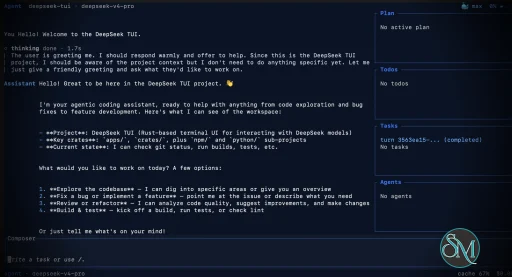
DeepSeek TUI is an open source terminal based coding agent designed for DeepSeek AI models. Unlike a simple chatbot, it can interact with your local workspace, execute shell commands, manage git operations, and assist with software development tasks directly from the command line.

The project is written in Rust and focuses on speed, low resource usage, and keyboard driven workflows. It is especially appealing for developers who spend most of their time in the terminal.

DeepSeek TUI is gaining attention among developers who prefer terminal based workflows and want direct access to AI powered coding tools without relying on heavy IDE integrations. Built around DeepSeek models, it transforms the terminal into an interactive coding assistant capable of editing files, running commands, and managing development workflows.

Download Codewhale v0.9.12 (Formerly DeepSeek TUI) - Software Mirrors

Codewhale v0.9.12 (Formerly DeepSeek TUI) for Windows

CodeWhaleSetup.exe | 29.44 MB

codewhale.bat | 196 B

codewhale-windows-x64.zip | 59.15 MB

codewhale-windows-x64.exe | 83 MB

codewhale-windows-x64-portable.zip | 59.15 MB

codewhale-windows-arm64.zip | 55.26 MB

codewhale-windows-arm64.exe | 66.99 MB

codewhale-windows-arm64-portable.zip | 55.26 MB

codewhale-tui-windows-x64.exe | 83 MB

codewhale-tui-windows-arm64.exe | 66.99 MB

codew-windows-x64.exe | 83 MB

codew-windows-arm64.exe | 66.99 MB

Codewhale v0.9.12 (Formerly DeepSeek TUI) for macOS

codewhale-tui-macos-x64 | 62.18 MB

codewhale-tui-macos-arm64 | 55.64 MB

codewhale-macos-x64.tar.gz | 55.51 MB

codewhale-macos-x64 | 62.18 MB

codewhale-macos-arm64.tar.gz | 51.9 MB

codewhale-macos-arm64 | 55.64 MB

codew-macos-x64 | 62.18 MB

codew-macos-arm64 | 55.64 MB

Codewhale v0.9.12 (Formerly DeepSeek TUI) for Linux

codewhale-tui-linux-x64 | 66.32 MB

codewhale-tui-linux-arm64 | 54.94 MB

codewhale-linux-x64.tar.gz | 56.71 MB

codewhale-linux-x64 | 66.32 MB

codewhale-linux-arm64.tar.gz | 52.64 MB

codewhale-linux-arm64 | 54.94 MB

codew-linux-x64 | 66.32 MB

codew-linux-arm64 | 54.94 MB

Codewhale v0.9.12 (Formerly DeepSeek TUI) for Android

codewhale-tui-android-arm64 | 56.49 MB

codewhale-android-arm64.tar.gz | 52.87 MB

codewhale-android-arm64 | 56.49 MB

codew-android-arm64 | 56.49 MB

Others Download related to Codewhale v0.9.12 (Formerly DeepSeek TUI)

codewhale-bundles-sha256.txt | 863 B

codewhale-artifacts-sha256.txt | 2.92 kB

Codewhale v0.9.12 (Formerly DeepSeek TUI) Source Code

Codewhale v0.9.12 (Formerly DeepSeek TUI) Source code (zip)

Codewhale v0.9.12 (Formerly DeepSeek TUI) Source code (tar.gz)

Codewhale v0.9.12 (Formerly DeepSeek TUI) Release Notes:

Codewhale is the public product from Shannon Labs. The codewhale
command, npm package, and release-asset names remain lowercase technical
identifiers. The legacy npm package deepseek-tui is deprecated and
receives no further releases. Users coming from v0.8.x legacy deepseek /
deepseek-tui names should migrate with docs/REBRAND.md.

Install

Recommended — official GitHub release

New macOS/Linux install (checksummed binaries from this release):
bash
curl -fsSL https://codewhale.net/install.sh | CODEWHALE_VERSION="v0.9.12" sh
"$HOME/.local/bin/codewhale" --version
For Windows, use the matching installer or archive below. For an existing direct install, run codewhale update; it prints the executable path and keeps newer builds. If the install directory is occupied by a different build, use the fresh-directory migration in the installation guide.

Secondary packaging — npm and Cargo

bash
npm install -g codewhale

or build from source

cargo install codewhale-cli --locked
The wrapper downloads the matched codewhale and codew command assets from this Release. Both contain the same compiled runtime.

Docker / GHCR

bash
docker run --rm -it \
  -e DEEPSEEK_API_KEY="$DEEPSEEK_API_KEY" \
  -v codewhale-home:/home/codewhale/.codewhale \
  ghcr.io/hmbown/codewhale:v0.9.12
The image exposes the same runtime as both codewhale and codew. The latest tag is also updated on release.

Cargo (Linux / macOS)

bash
cargo install codewhale-cli --locked
The Cargo package installs codewhale. Cargo cannot create a second command alias from one binary target; users who want the shorter spelling can add a codew symlink to that installed executable. The npm, Homebrew, archive, shell-installer, and container channels install both command names directly.

Manual download — platform archives (recommended)

Each archive below contains the same runtime under the codewhale and codew command names, plus an install script:
  • Linux x64: codewhale-linux-x64.tar.gz | install.sh
  • Linux ARM64: codewhale-linux-arm64.tar.gz | install.sh
  • Android ARM64 (Termux): codewhale-android-arm64.tar.gz | install.sh
  • macOS x64: codewhale-macos-x64.tar.gz | install.sh
  • macOS ARM: codewhale-macos-arm64.tar.gz | install.sh
  • Windows x64 (installer): CodeWhaleSetup.exe | NSIS setup
  • Windows x64: codewhale-windows-x64.zip | install.bat
  • Windows x64 (portable): codewhale-windows-x64-portable.zip | —
  • Windows ARM64: codewhale-windows-arm64.zip | install.bat
  • Windows ARM64 (portable): codewhale-windows-arm64-portable.zip | —
Unix (Linux / macOS):
bash
tar xzf codewhale-.tar.gz
cd codewhale-
./install.sh
Windows:
  • For the installer path, run CodeWhaleSetup.exe; it installs
codewhale.exe, codew.exe, and codewhale.bat under %LOCALAPPDATA%\Programs\CodeWhale\bin, adds that directory to the current-user PATH, and creates a Start Menu shortcut that prefers Windows Terminal (wt.exe) when it is installed.
  • Extract the archive for your machine: codewhale-windows-x64.zip or
codewhale-windows-arm64.zip
  • Double-click codewhale.bat (not the raw .exe) to launch
  • Run install.bat to copy the binaries and launcher to %USERPROFILE%\bin
  • Add %USERPROFILE%\bin to your PATH
The portable Windows archive skips the install script — extract and run codewhale.bat from any directory. The NSIS installer is currently unsigned and may trigger Windows SmartScreen until a signing certificate is wired into the release pipeline. Each platform also has bare, unarchived codewhale- and codew- assets. The seven codewhale-tui- filenames attached to v0.9.5 are byte-identical compatibility copies used only to let already-installed v0.9.4 clients discover and cross this single-binary transition; current installers do not expose a third runtime. The legacy npm package deepseek-tui is deprecated and is not republished. For migration from v0.8.x legacy binary names, see docs/REBRAND.md.

Verify (recommended)

Download the checksum manifests from this Release and verify:
bash

Linux — archive bundles

sha256sum -c codewhale-bundles-sha256.txt --ignore-missing

Linux — individual binaries

sha256sum -c codewhale-artifacts-sha256.txt --ignore-missing

macOS

shasum -a 256 -c codewhale-bundles-sha256.txt --ignore-missing shasum -a 256 -c codewhale-artifacts-sha256.txt --ignore-missing

What's in v0.9.12

Codewhale v0.9.12 puts computer use in the binary, opens two new routes — Alibaba Model Studio through the data-driven provider table and Concentrate as an opt-in BYOK Responses gateway — and adds cloud dispatch plus a config-gated per-session control socket. The shell is the other half of the release: a new launch card, the work surface docked under the composer, one focus owner for Tab, tool cells that carry their own state, and fleet as the public word for the live collective. The complete item-level change record is retained below the categorized release highlights.

Added

  • Computer use ships with the binary. The computer-use plugin — 38 tools
across macOS, Windows, Linux and HarmonyOS, accessibility-first observation with pixel fallback, screenshots, zoom, screen recording, and registered remote computers over ssh and hdc — is embedded in Codewhale and written to $CODEWHALE_HOME/builtin-plugins on first run, so every install channel carries it. It lists as builtin · not-reviewed and stays disabled until you review and enable it: shipping it is not consenting to it. The stdlib-Python computer-use server it replaces is gone.
  • Alibaba Model Studio joins the data-driven provider table as an
openai-compatible descriptor: international compatible-mode endpoint, DASHSCOPE_API_KEY credential, live /v1/models discovery. Qwen 3.8 Flash and Qwen 3.8 Max arrive through the catalog authority — never a hard-coded id.
  • Concentrate: first-class opt-in BYOK Responses gateway with live models
discovery and typed SSE streaming (#5725).
  • Cloud dispatch: remote runner offloads coding agent tasks to isolated
cloud sandboxes with machine token auth and structured job tracking (#5701, #5712).
  • Per-session control socket: config-gated [control_socket] table binds
//control.sock per running session, exposing message, interrupt, relaunch, and status JSON-RPC verbs (#5533, #5831).

Changed

  • Anonymous usage counting is on by default. The 0.9.11 release asked
first; 0.9.12 counts the same aggregate version/platform, session, feature and error totals unless you turn it off, and says so once at first launch (policy notice version 5, schema 3, notice_version replacing consent_version). Every recorded opt-out stays off: a durable telemetry = false, a decline recorded under the old opt-in notice, unreadable privacy state, and the CODEWHALE_TELEMETRY=0 / `--telemetry false` kill switches. Showing the disclosure records only that it was shown, never an acceptance. codewhale config set telemetry false turns it off and wipes queued counts; codewhale config set telemetry true deliberately re-enables it. Nothing new is collected: no conversations, code, prompts, files, names, model content, credentials, or IP.
  • The launch screen is our own card take: a thin top line
⑂ branch path; a centred bordered card with the whale mark, Codewhale + version, one announcement line only when it is true (the no-model warning, or MCP news), and the menu New worktree / Resume session / Changelog / Quit with their real chords right-aligned. Enter runs the highlighted entry, Up/Down move it, and typing goes straight to the composer. The card dissolves on the first keystroke or command (≤240 ms, instant under reduced motion) (#5826, #5801, #5815, #5286).
  • The work surface sits under the composer by default, keeping history
readable and leaving the stage unencumbered (#5809).
  • Skills command shapes: FEAT-022 command shapes and retained-host
validation (#5825, #5829).
  • After the card dissolves, the working screen shows ⑂ branch path with
⋮ MCP n/m on the right, the transcript starts with the ◆ session_start receipt (naming the configured session-start hooks), and the composer's bottom rule carries model (effort) · permission — the route's one launch reading. The posture bar and metrics line appear only once a session exists.
  • Vocabulary: fleet is the public term and Pod is retired from copy —
roster, setup, detail, worker-runtime and managed-API messages now say Fleet (/fleet canonical, /pod alias). The workflow wire accepts the canonical role spellings (general/explore/planner/reviewer/implement/ test/advisor) with the pre-rename ones kept as load-time aliases, and serializes canonical names.
  • The Operate mode-picker hint is shortened to fit 80 columns.
  • The footer always shows the permission posture; when only one chip
fits, the permission chip outranks the mode word (#5796).
  • Local Ollama: the header names a model only when the local catalog can
serve it, and says unknown until it knows. The startup mark, web and app icon carry the new side-view prompt-eye whale (#5795).
  • One focus owner: Tab and Shift+Tab work regardless of what is in the
composer; Alt shortcuts survive mid-draft; Ctrl+Tab no longer cycles the mode by accident (#5798).
  • Tool cells carry their own state: a running, failed or warned tool
reads as such in the transcript itself, with per-entry rail dots and family-coloured glyphs (#5799).
  • Web: docs hub with task search, shared empty/loading/error states, an
offline-to-back-online banner, /changelog in every locale, and real 404s with correct metadata (#5743).
  • Web: the app's colours come from one file generated from the TUI whale
palette; re-typing a colour by hand fails web CI (#5797).
  • Web: a one-way ceiling on isZh branching outside the i18n spine —
the count may only go down (#5805).
  • An internal agent handoff doc was removed from the public tree and
.playwright-mcp/ is now ignored (#5800).
  • First run paints the composer immediately: the Welcome/language/provider/
trust gates no longer precede the first keystroke. Missing-key and workspace-trust recovery stay for returning users; language and provider remain in /setup.
  • The canonical whale-tile mark propagates beyond web to the exact-raster
surfaces that can carry it (#5738).
  • Dead-code sweep: delete proven-unreferenced helpers (unused builders,
wrappers, and leftover identifiers) and drop stale #[allow(dead_code)] where the item is production-called or test-exercised. No runtime behavior change (#5791, #5587).
  • Remote-control recovery gives every fresh pre-dispatch attempt a new lease
generation while preserving that generation across its typed start (#5605).
  • Public roster language is Pod. /pod is the customer surface; fleet remains
the internal wire, storage, and migration name (#5776).
  • Compaction replacement history keeps a bounded last user round (assistant +
tool results) instead of dropping them behind a summary. /context names the compaction path and /anchor survival. Failed compact still does not replace live history (#4394).
  • Provider catalogs: compatible hosts (Baseten, Groq, Cerebras, SenseNova,
Command Code) no longer compile a frozen model roster. Descriptors name the wire, URL, and env; live GET /v1/models and a Codewhale-owned catalog layer are the offering list. Command Code is a catalog/descriptor row, not a ProviderKind. Catalog presence is not an availability, entitlement, or provider-acceptance claim (#5783).
  • Provider selection no longer probes or adopts an external CLI credential on
ordinary picker use. Reuse requires an explicit "Use external CLI credentials" choice, exact-path confirmation, and Codewhale-owned revoke (#5772).
  • TUI: startup no longer presents an approximate ASCII or block-glyph whale as
the product mark. It keeps the direct Tideline prompt while exact-raster surfaces remain responsible for the canonical asset.
  • TUI: the active-session composer paints the same three-cell [↑] send
target as Startup and clicks it through the existing Enter submit dispatcher (#5771). Compact/quiet composers still omit the control.
  • TUI/CLI: Pod is the public roster surface. User-facing Fleet wording
moves to Pod; durable receipt keys stay compatible (#5776).

Added

  • Native ChatGPT sign-in for the openai-codex route: `codewhale auth
chatgpt` opens a browser PKCE flow and stores refreshable tokens in Codewhale-owned credentials — no Codex CLI install required. /auth chatgpt-revoke clears them off the event loop (#5784, #5778).
  • MCP servers and plugins can be connected self-serve from the session: a
unified auth flow with rotation-safe token handling, a spoken authorization URL, and catalog refresh when stored credentials stop working (#5747).
  • /operate reads match the landed CWC OperateRecord contract: fetching an
absent record returns a truthful not-found view instead of a fabricated operation, and an empty evidence path is rejected rather than resolving to the workspace directory (#5703).
  • TUI: scheduled automations project into the top strip
(⏱ N scheduled · M running, compact ⏱ N·M) with typed HistoryCell::Automation receipts when a run this session watched settle. /automation acknowledges failures. The merged footer does not carry the work fact (#5748).
  • The app-server can listen on a unix domain socket and advertise a
daemon/attach handshake, so a local client can attach to an already-running engine instead of spawning its own. The socket is created with owner-only permissions and stale sockets are reclaimed on start. Non-unix hosts return a typed unsupported-platform refusal; the Windows named-pipe endpoint is named but not yet implemented (#5749).
  • The engine's internal Op/Event types and the wire protocol's Op/
EventMsg now carry a compile-enforced twin for every variant: adding an engine variant without a protocol counterpart fails the build instead of drifting silently. Internal durability work — no user-visible surface change yet (#5751).
  • Machine tokens: with CODEWHALE_API_KEY set, the CLI authenticates as the
Codewhale account with no local session file and no browser — the CI authentication path, with a typed token shape and redaction (#5721).
  • Compaction publishes a structured survival contract for session-tree
journal entry types (crates/tui/src/compaction/SURVIVAL_CONTRACT.md) and fails closed when the last user round, tool results, /anchor text, or checkpoint receipt would vanish (#4394, #5782).
  • Internal: codewhale-config gains RouteAuthoritySnapshot, one immutable
authority that owns a compiled provider catalog together with the route resolver projected from it, so a picker, a readiness view, and an execution path can no longer resolve against different catalog snapshots without a type-level signal. Resolution still goes through the sole resolver; the returned receipt distinguishes an exact catalog row, a custom-endpoint route whose provider facts are deliberately not reused, and an allowed pass-through route with no catalog row. All state is secret-free. No call site changed and no user-visible behaviour changed yet (#5766).
  • Computer session records now count only time a provider actually accepted the
session as active, at per-second granularity. Idle, queued, stopped, and teardown time are excluded, and a session whose allocation does not match a standard profile is refused rather than recorded approximately. Covered by hermetic fixtures; no live provider call and no deploy (#5781).
  • Website: the public site moves to the Tideline deep-ocean design language
(dark by default with an opt-in light documentation sheet, palette grounded in the TUI's WHALE_* tokens) and the new whale brand mark across the favicon, app icons, web manifest, nav wordmark, and social card (#5573).
  • Add codewhale dispatch / /dispatch so a local session can propose a
Codewhale cloud agent against an explicit github, cnb, or gitee remote. Confirmation is required; missing credentials fail closed; cloud jobs share the existing /jobs surface as kind=cloud. See DAYTONA_CLOUD_DISPATCH.md.
  • /login reports the Codewhale account session and provider-key next
steps. The internal cloud-agent credential is not user surface: there is no auth set-slot/auth clear-slot command, no hint, and no completion entry for it — signing in with codewhale login is the only door.
  • Add the Tideline component family from the ratatui translation spec
(#5698's screens, riding the #5699 work-strip layout): hero startup surface with quick actions and option strip, notifications inbox, merged footer band, pod ledger, receipt stream, theme list with motion toggles, live preview, settings rail, and the left rail — each a standalone render module pinned by 28 new byte-exact golden buffers. Frame wiring follows the Tideline acceptance gate; NO_COLOR is now honored by palette depth detection.
  • Route Contract Phase 1: RouteResolver is the runtime path for
resolve_runtime_options; codewhale providers export --json ships the owned descriptor catalog; CLI --provider accepts any catalog route id (the closed ProviderArg enum is deleted). Catalog layers are bundled → models.dev → provider /v1/models → config.toml → user, with policy DENY last and never overridden.
  • Add provider-native web search for documented Xiaomi MiMo 2.5 Pro and 2.5
chat routes while keeping neighboring models and custom gateways fail-closed.
  • Add structured provider-native web search for exact Z.AI global and Zhipu
China general API routes, using each site's documented search engine value. Existing open.bigmodel.cn configurations now share Z.AI's official model namespace and credential scope; unknown model IDs still pass through.
  • Add provider-native web search for documented Qwen models on ModelStudio
Token Plan's Responses Harness, without enabling Coding Plan or Anthropic routes.
  • Added /copy to place the latest completed assistant response on the
clipboard without copying tools, system messages, hidden reasoning, or active partial output (#5668).
  • Add provider-native web search for documented DeepSeek V4 routes through the
Responses API, with fail-closed capability gating for compatible custom endpoints.
  • Add provider-native search for exact Moonshot K3 Formula, legacy K2.6
built-in search, and Kimi Code membership /search routes. Treat the exact Moonshot China endpoint as a first-party direct route.
  • Z.ai GLM-5.3-Flash and OpenRouter z-ai/glm-5.3-flash are first-class
picker rows (/model GLM-5.3-Flash). Flash is the faster/explore sibling of GLM-5.3; the Z.ai default stays GLM-5.3. List price is $0.15/$0.50 per 1M (durable; the 50% promo through 2026-09-09 is not the catalog row).
  • Baseten, Groq, and Cerebras are bundled OpenAI-compatible setup templates
([providers.] kind = "openai-compatible"), not new ProviderKind variants. /provider fills URL, model, and env from one catalog row.
  • MCP manager copy now names the server, the failure, and one recovery
command (The X MCP server requires OAuth reauthentication. Run /mcp login X).
  • Settings Advanced exposes clickable MCP Connect, Reconnect, and Diagnose
actions, while Extensions and Problems route recovery through the existing /mcp login, /mcp reload, /mcp validate, and /plugin validate commands (#5643, #5655).
  • Plugin prompt matching (#5579): sending a task can toast the next review
step when the prompt strongly matches an installed-but-idle plugin or a marketplace catalog you added (for example a Supabase prompt suggesting /plugin trust supabase). A live composer CTA offers the same review command while you type, matching turns append a bounded user block, and request_plugin_install surfaces review without installing. /plugin suggest now ranks manifest keywords and catalog candidates, never auto-installs, and on-disk plugin changes also nudge /plugin reload between turns.
  • Added /import-claude (#5557): reads ~/.claude.json and
~/.claude/settings.json read-only and renders an explicit, reviewable migration plan plus a written report. MCP servers route through the existing /mcp import --approve consent flow, allowlisted env keys become an unapplied portable bundle for codewhale config import, and permissions/hooks map to manual follow-ups; secret-shaped values are named but never echoed or imported.
  • Added the managed Chat relay: account-owned Chat commands now execute on the
native runtime thread engine through a new runtime_chat_relay module instead of a second execution path. Each Chat thread is a dedicated, isolated runtime thread with an empty model-visible tool allowlist, a chat-only system prompt, and no workspace, memory, skill, credential, or local-path context; the active interactive TUI thread is never reused. The relay keeps one durable state file per scope behind a session-wide owner lock, binds a saved session permanently to its first remote target, replays exact duplicate commands from retained results instead of starting a second inference turn, terminalizes orphaned reservations on restart, and rejects (never queues into) a busy local Work turn with an immediate retryable result. Stop commands require the exact run and turn identity, and a worker aborts on any account or target mismatch during token refresh.
  • Added a verified Omarchy/AUR packaging path: packaging/aur now carries a
PKGBUILD template, .SRCINFO renderer and tests, release-candidate render step, and docs; the live AUR compatibility alias `codewhale-tui -> codewhale` is preserved, AUR dependencies match the live package, and the self-updater refuses to fight an Omarchy/package-manager installation.
  • Added a Fleet run-wide cost/token usage ceiling (R6, #5567): an accumulator
plus admission gate and alert bound a whole run's spend across workers.
  • Added the real provider cache hit rate to /context (C3, DSH #3): the
token-weighted provider-reported rate from the same telemetry /cache aggregates, plus an honest "no cache telemetry yet" state when nothing is recorded.
  • Added per-step cost movement: TurnUsage receipts are priced as they land
so the live cost surface moves during long agentic turns instead of only at TurnComplete (#5578), and the footer now honestly shows cost: unknown when nothing can be priced instead of hiding the line.
  • Added the underwater session surface: the ambient water reads session state
from across the room, its animation shape follows live agent activity, and attention tints are steady (no breathing) with a distinct reading treatment and no mid-water seam on tall windows.
  • Added @path:START-END ranged line mentions (#5550, picker half to follow),
a predictable last-copy backup file for clipboard exports with the path named when the clipboard fails (#5555), wait on multiple background shell tasks with until=any|all (#5549, named-kill half to follow), and composer double-click word / triple-click line selection.
  • Added workflow parallel-schema slot partial success (#5583): a slot that
produces a schema-valid partial result no longer fails the whole parallel branch.
  • Added plugin load-failure startup hints (#5579) and OpenRouter app
attribution headers on outbound requests.
  • Added codewhale doctor --fix (with --yes for non-interactive consent):
the doctor now computes a concrete repair plan — delete stale .tmp* leftovers from interrupted atomic writes, tighten secret-store file permissions to 0600, disable structurally broken (Error-status) MCP entries through the atomic MCP save path, and scaffold missing user-global skills/tools/plugins directories — shows it, and applies it only after explicit consent. Every action is narrowly scoped and idempotent; JSON and context-JSON modes stay read-only and conflict with --fix (#5552, v1).
  • Added /context reporting of the real provider prompt-cache hit rate (C3)
alongside token pressure.

Changed

  • Provider-native web search now applies domain constraints before accepting an
attempt, discards generated answers when returned citations violate those constraints, and preserves the caller's configured/local timeout as an independent fallback budget (#5681).
  • Idle session metrics omit zero facts (0 turns, LLM 0s) until the
runtime has evidence. Working chrome says in the current instead of a generic working.
  • Deleted nine uncompiled runtime_contract/ staging files. Live contracts
remain model.rs and termination.rs.
  • The first #5587 dead-code sweep converts audited test-only helpers to
#[cfg(test)], keeping production builds free of test-only APIs without changing runtime behavior.
  • /plugin reload is now discoverable when on-disk plugin bundles change: the
next send and /plugin list nudge once with Run /plugin reload to apply instead of silently keeping the stale catalog (#5579). Trust is unchanged; this does not auto-reload.
  • Context-pressure warnings and critical alerts now remain visible in sticky UI
status until compaction or explicit dismissal, instead of disappearing into scrolling turn metadata (#5620).
  • The Runtime thread store defaults to a per-session root
($CODEWHALE_HOME/sessions//runtime) so multiple Codewhale processes on one machine no longer share one owner lock (#5630). The exclusive lock is unchanged; CODEWHALE_RUNTIME_DIR still selects a shared root when that is intended.
  • Session token totals now include display-only per-model-call deltas while a
turn is running, including input/output and cache-class counters; the authoritative TurnComplete totals still reconcile exactly once (#5581).
  • Transcript focus now exposes per-block actions: y copies content, Y
copies the rendered metadata view, Enter opens a fullscreen block pager, and r opens raw detail; the existing Tasks rail shortcuts remain unchanged (#5551).
  • Provider neutrality (#5588): model resolution of omitted/aliased models is
now provider-relative, OpenAI-native defaults no longer route through another provider's table, CLI credentials stay provider-scoped, and NVIDIA credentials no longer leak into the DeepSeek keychain. Neutrality test matrices exercise several providers instead of standing in with one.
  • The workflow engine module was decomposed out of its 3k-line mega-file into
journal, usage, and report modules plus a module directory (#5586 slices 1a/B/C/D), a semantic-free move verified by normalized-content hash.
  • Compaction refusals are now always named (#5577): silent holds under context
pressure are gone, the context meter honors the same provider-billed prompt the trigger uses (T1), and prune outcomes are projected without cloning the transcript.
  • Step budgets now end honestly: an ~80% soft landing nudges the model to
write its final report, and exhaustion grants exactly one bounded report-on-exhaustion turn instead of dying silently (A1/A2).
  • Contributor credit: recognized agent contributors (e.g. Codewhale Agent)
may now carry Co-authored-by trailers; unknown bot/tool trailers are still rejected by the credit gate.

Fixed

  • Fast typing no longer corrupts the composer. The paste-burst heuristic ran
on every session until a real bracketed paste arrived, holding, buffering, retro-grabbing, and absorbing Enter on timing guesses; it is now fallback-only (gated off when the terminal provides bracketed paste), the retro-grab is deleted, and Enter on held command text flushes and submits.
  • Ctrl+C works on the pre-session launch menu and speaks everywhere: the
first press arms the two-second exit window with a visible localized "Press Ctrl+C again to quit" hint (previously silent), the second exits. The worktree name input keeps Ctrl+C as cancel-input.
  • Fresh interactive sessions no longer leave a phantom one-message duplicate
behind. The TUI claimed one session id (Runtime store lock, turn-start crash checkpoint) while the engine minted a second one; the first SessionUpdated re-keyed the App, the completion commit cleared only the engine id's checkpoint, and codewhale --continue later "recovered" the orphaned checkpoint as a duplicate session instead of the real one. The engine now adopts the host-owned id at spawn (EngineConfig::session_id) and /clear mints the next id in the App like /new. A non-TTY --continue no longer promotes and consumes the crash checkpoint before failing the terminal check, and the root codewhale --resume / --session-id flags documented in the operations runbook now parse instead of being swallowed as a prompt.
  • Website: /signin, /signup, and /auth/callback are locale-aware public
routes instead of localized 404s. Sign-in and create-account send the person to the CWC app; OAuth callbacks hop to app.codewhale.net with the query intact; /login and /register are aliases. Local CLI use is not presented as requiring an account (#5767).
  • The sandbox read deny-list matches a rule's resolved path as well as its
literal spelling. On macOS /etc and /var are symlinks into /private, so a read of /private/etc/sudoers walked around the /etc/sudoers rule, and a rule written against a symlinked directory never fired for the real path that canonicalize and the process cwd hand back.
  • Background shells are first-class work-strip rows (▾ Shells N) you can
open, watch, and cancel by the shell_* id on the row. /jobs cancel all cancels running shells; it no longer looks up a task named all. The composer hourglass crumb no longer stands in for a shell surface.
  • codewhale logout and /logout now clear the Codewhale account session
and the Daytona secret slot, not only provider API keys. The TUI crate's leftover login --api-key path no longer claims to save a key.
  • Account sessions no longer read the macOS Keychain. Unsigned or rebuilt
codewhale binaries were a new Keychain ACL principal every time, so codewhale web and the TUI popped a password dialog on start. Sessions now use ~/.codewhale/secrets/secrets.json (mode 0600), the same store as provider keys. Extracted from the Keychain-retirement half of #5632.
  • Hardened the dispatcher-side config parse the same way: ConfigStore
loads and project-config parsing now deserialize ConfigToml on a dedicated 16 MiB-stack thread (the guided-setup save path could overflow a 2 MiB worker stack the same way the TUI's ConfigFile parse did), and the #5585 setup-confirm toast test runs its runtime on an equally sized thread instead of overflowing the default libtest stack.
  • Fixed detached interactive agents reporting worker usage after the parent
turn ends with the usage missing from the session/live /cost total (#5597): interactive turns acquire an owner-scoped runtime usage lease, late usage enters the session cost pool without reopening the sealed mailbox, and worker/session/reload accounting share one hashed response identity so retried deliveries stay exactly-once.
  • Fixed the sub-agent fiasco class: in-workspace absolute git -C no longer
trips the read-only child shell gate with a coherent bounded gate (#5595), turn end parks turn-owned children resumably instead of silently cancelling them (#5596), stale write-claims are released by liveness with coordinate release (#5562), and the verifier role description matches its real surface (#5562).
  • Fixed workflow responseSchema failure handling (#5583): bounded repair with
typed receipts (kind + attempt), raw-output receipts persisted as artifacts that survive reload, and failures surfaced instead of null success (#5528). Degraded owner snapshots no longer project as ordinary Completed runs (#5582), typed task error kinds enable fail-fast parallel/pipeline (R9), and /workflow confirm finds the draft despite interleaved messages.
  • Fixed the DeepSeek session that never auto-compacted at 842k/1M (#5577): the
exact billed_842k_on_a_1m_window_compacts_despite_a_small_estimate regression pins the trigger.
  • Fixed sandbox escapes and authority gaps: workspace-write tools resolve
hard-linked files before writing (S2, #5569), an opt-in read deny-list bounds full-disk reads in any posture (S1, #5568), and session grants match the command family instead of widening the whole tool (R2).
  • Fixed provider-transport robustness: non-streaming HTTP requests are bounded
by a read timeout (R4), and Chat-Completions mid-stream error frames surface instead of hanging (R3). MCP OAuth expiry now reacts to 401/403 with a named recovery path and login hint instead of looking like a broken server (T4, #5572).
  • Fixed Fleet lifecycle gaps: detached workers are reaped when their manager
dies (R7) and the per-task wall-clock timeout is enforced (R5); the local Fleet host compiles on non-Unix targets; detached schema repair stays within the runtime budget.
  • Fixed prompt-cache correctness: the tool catalog is fingerprinted in
provider wire order (C1), prefix changes between requests are always declared (C5) — including the newly named mid-turn change:tool_surface reasons for deferred-tool admission, tool-search activation, and runtime MCP tool arrival — and a reasoning-only response stopped at the output limit now fails the turn honestly instead of re-issuing a request that can only reproduce the stop.
  • Fixed docs/public-surface drift: REBRAND.md no longer presents
api.deepseeki.com as a China fallback (#5564), and the web facts/tool counts match the repository.
  • Heavy pull requests now run the real Linux workspace nextest, doctest, and
lockfile lanes directly on GitHub Actions instead of reporting a green placeholder while waiting for a branch-specific CNB mirror (#5547).
  • Fleet roster members in a selected Fleet now expose a visible edit affordance
and a direct m model-picker shortcut, while the coordinator row remains read-only (#5604, covers #5589).
  • The context inspector now attributes bounded tool-schema cost to the built-in
catalog and each discovered MCP server without changing prompt assembly or cache behavior (#5553).
  • The goal-continuation quiet period ([goal] continuation_delay_seconds,
added in #5508) now applies on every dispatch path. Previously the within-turn dispatch hook fired the next continuation prompt immediately whenever a model step ended with the goal still active, so CLI-resumed and host-managed sessions never observed the configured delay (measured end-to-start gaps of ~9 s with a 300 s delay configured). The wait now runs unconditionally inside goal_continuation_message_if_needed, remains cancellable, and pause/clear/terminal update_goal calls still cancel a pending pass (#5534).
  • Two unit tests no longer depend on process-global environment state that
sibling tests mutate concurrently. route_budget::tests::v4_trigger_uses_window_percent_when_it_fits_spendable_input asserted no-override output-budget values while reading CODEWHALE_MAX_OUTPUT_TOKENS / DEEPSEEK_MAX_OUTPUT_TOKENS without holding lock_test_env(), so a concurrent writer could flip the value mid-assertion (the order-dependent full-suite flake). prompts::tests::system_prompt_prefix_never_leaks_private_content read the real home via HOME/USERPROFILE, so a machine with ~/.codewhale/instructions.md leaked its absolute path into the prompt and failed the no-private-paths assertion unless a sibling's temporary HOME guard happened to be live. Both tests now hold the env barrier and pin the variables (the route-budget test removes the overrides; the prompts test points HOME/USERPROFILE at a scratch dir). Assertions unchanged.
  • TUI sessions now apply a subtle OSC 12 cursor accent only on explicitly
supported terminals and restore the terminal default through normal, panic, and signal cleanup paths (#5554).

Contributors

search across four routes (#5682, #5683, #5685, #5687), authoritative edit-last-turn boundaries (#5621), Kimi Code k3-256k (#5622), post-compaction input-token reporting (#5623), and preserving the scheduled model selection in automations (#5650). edit-last-turn boundary fix (#5621), Kimi Code k3-256k support (#5622), and post-compaction input-token reporting (#5623). session token totals (#5624), persisted context-pressure warnings (#5629), discoverable Fleet roster editing (#5604), the capability-gated cursor accent (#5599), and /copy for the latest completed response (#5692). Windows verbatim-path operands preserved through POSIX word splitting (#5610), the plugins group moved onto the command shapes (#5657), FEAT-022 skills command shapes with retained-host validation (#5825), and FEAT-020 plugin command shapes re-landed on main (#5865). DeepSeek heading in the configured-view model picker, keeping every official catalog model for the active provider visible (#5689).
  • @gaord — the GET /v1/fleet/profiles
runtime API endpoint, reusing the FleetManager validation path (#5688). English documentation inaccuracies and the first zh_hans translations for the Tier-2 docs (#5613). (#5591) and the per-session control socket (#5533, #5831). (#5669).
  • @whp233wire = responses|anthropic for
openai-compatible custom routes and opencode-zen muse-spark (#5716, landed as #5719). found the reasoning-only retry gap and built the first fix; landed as the [reasoning_only] retry ceiling with a request-scoped nudge (#5867). x-opencode-session header for OpenCode Go and Zen gateways (#5868).
  • @zhuowp — task origin preserved in job
snapshots (#5869). performance pass: a zero-copy LaTeX fast path for streaming render, single-pass token accounting on the per-turn pressure paths, memoized provider resolution in the catalog cutline, parsing the bundled and on-disk models.dev catalogs once per process (interactive boot -70%), adaptive poll cadence for foreground shell completion, and worker caps across the read-only diagnostic family. recovery lease generations (#5790). transcript snapshots so a rewritten todo list renders its current tasks (#5871, #5873). incompatible tool definitions per request instead of failing the turn. docs/subagents and docs/mcp onto the dictionary spine (#5337), with the metaTitle probe that keeps them there. Reports and reproductions that shaped this release: budget collapsing to 1,024 tokens on 32K local models (#5820). after recoverable network errors, with the reproduction that pinned the discarded approval (#5769). configuration of mode and model (#5863). lacked session/list and session/load (#5864). See CHANGELOG.md for full notes and docs/CHANGELOG_ARCHIVE.md for older releases.

Key Features of DeepSeek TUI

  • Terminal Native Workflow
    DeepSeek TUI operates entirely within the terminal, allowing developers to work without switching between browser windows or external interfaces.

  • AI Assisted Coding
    The assistant can read and edit files, generate code, explain logic, and help automate development tasks.

  • Shell Command Execution
    It supports running terminal commands directly through the interface, streamlining development workflows.

  • Git Integration
    Developers can manage repositories, review changes, and handle version control related tasks from inside the tool.

  • Multiple Work Modes
    DeepSeek TUI includes modes like Plan, Agent, and YOLO, offering different levels of automation and approval control.

  • Large Context Handling
    The tool is built around DeepSeek V4 capabilities, including support for extremely large context windows that help with understanding bigger codebases.

User Experience

DeepSeek TUI is designed for developers comfortable with terminal environments. The interface is keyboard focused and efficient, though beginners may need time to adapt.

The workflow feels closer to tools like Claude Code or Codex style assistants rather than traditional chat applications. Community feedback on Reddit and GitHub discussions highlights its speed and practical coding workflow.

Performance and Compatibility

Because it is written in Rust, DeepSeek TUI is lightweight and responsive. It supports Linux, macOS, and Windows, with installation available through npm, Cargo, or direct binaries.

Performance depends heavily on the connected DeepSeek models and API configuration, but the local interface itself remains fast and efficient.

Pros

  • Fast terminal native workflow

  • AI powered coding and automation

  • Lightweight Rust based architecture

  • Supports file editing and shell execution

  • Open source and actively developed

Cons

  • Requires familiarity with terminal workflows

  • Depends on external AI APIs

  • Advanced automation modes may feel risky for inexperienced users

DeepSeek TUI is ideal for developers, DevOps engineers, and terminal focused power users who want AI assistance integrated directly into their command line workflow. It is especially attractive for users seeking a lightweight alternative to browser based AI coding tools.

DeepSeek TUI combines AI coding assistance with the efficiency of terminal workflows. Its fast performance, flexible automation, and developer focused design make it one of the most interesting open source AI terminal tools currently gaining traction.
Codewhale v0.9.12 (Formerly DeepSeek TUI)
Free
Software Informations:
Developer:

Operating System:
Windows / macOS / Linux
Date Added:
2026-09-05T16:01:20.947Z
Categories:

Post a Comment/Report Broken Link: