Plannotator is an open-source platform designed to review and validate plans and code generated by AI coding agents.
The platform provides a centralized interface where developers can:
Review AI-generated plans
Annotate proposed actions
Approve or reject tasks
Inspect code changes
Provide structured feedback
Improve agent outputs
Maintain human oversight
Rather than replacing developers, Plannotator aims to keep humans involved in critical decision-making during AI-assisted development.
As AI coding agents become increasingly capable, developers face a growing challenge: ensuring that AI-generated plans and code changes align with project requirements before they are executed. Plannotator addresses this problem by acting as a review layer between developers and AI coding agents.
Instead of generating code itself, Plannotator focuses on making AI-driven development more transparent and controllable. It allows teams to review, annotate, approve, reject, and refine agent-generated plans and code changes before they affect a project.
Download Plannotator v0.27.7 - Software Mirrors |
|---|
Plannotator v0.27.7 for Windowsplannotator-paste-win32-arm64.exe | 90.2 MB plannotator-paste-win32-x64.exe | 93.92 MB |
Plannotator v0.27.7 for macOSplannotator-darwin-arm64 | 114.13 MB plannotator-darwin-x64 | 119.17 MB |
Plannotator v0.27.7 for Linuxplannotator-linux-arm64 | 142.54 MB plannotator-linux-x64 | 143.42 MB |
Plannotator v0.27.7 for Other |
Plannotator v0.27.7 Release Notes:Follow @plannotator on X for updatesMissed recent releases?
What's New in v0.27.7A patch release led by a crash fix for Pi on Windows: a broken provider pipe could take down the entire Pi host mid plan review. Five PRs, three from returning community contributors, plus a new top-level knowledge skill that also powers plannotator.ai/llms.txt.Pi no longer crashes when a provider pipe breaksOn Windows, opening a plan review from Pi could kill the whole Pi host with an unhandled EPIPE error. The provider child process's stdin pipe broke, nothing was listening for the failure, and the host process died with it. This is fixed as a class, not a symptom. Every provider child process (Pi and the Codex app-server transport) now routes its pipe writes through a shared guard: a broken pipe fails that provider's query cleanly, the provider is marked dead and restartable, and the host keeps running. The regression test reproduces the exact pre-fix crash in a real Node child process. Thanks @Kaelenx for the detailed report and for verifying the fix on the original machine within the hour.Call Flow stops failing on normal reviewsCall Flow rejected any analysis producing more than 100 call trees, and languages that emit many small per-function trees (Swift, TypeScript) hit that ceiling on ordinary branch reviews. @sergdort's measurements in #1351 showed a normal 161-file review producing 470 valid trees, computed in under 800ms, rejected whole. The tree cap is now 2,000, and a result that still exceeds it degrades instead of failing: the first 2,000 trees render and a visible warning in the panel says how many were truncated. The caps that guard against genuinely unbounded output (total nodes, tree depth, raw length) still reject exactly as before.jj reviews start from where your work actually beganThe jj Line of work view always diffed againsttrunk(). If your work branched off a staging or development line instead, the review included every commit from that line too, burying your changes in unrelated ones.
Plannotator now asks jj where the current line of work forked from shared history and starts the review there. The base is named by its remote bookmark when one exists, then its local bookmark, then the commit ID, and jj's internal push-* bookmarks are never used as names. Older jj versions that cannot answer the fork-point query fall back to trunk() instead of failing the review.
A knowledge skill for every agent, and llms.txtAgents had launcher skills for opening reviews but no reference for everything else Plannotator can do. The new top-levelplannotator skill is that reference: every subcommand, flag, and workflow, installed for Claude Code, Codex, OpenCode, Pi, Kiro, and Gemini through their own install paths. A CI freshness guard ties the skill to the CLI source, so it cannot silently drift from what the binary actually accepts.
The same document is now served at plannotator.ai/llms.txt following the llmstxt.org convention, generated from the identical source at build time.
oh-my-pi is its own agent originSessions launched from the oh-my-pi harness were detected as Claude Code, because OMP exports Claude Code's environment markers into its shells. OMP is now detected as its own origin, ordered so nested runtimes still detect correctly, and sessions report the agent you are actually using.
Install / UpdatemacOS / Linux:/plugin in Claude Code, find plannotator, and click "Update now".
Pi: Update @plannotator/pi-extension to 0.27.7 and restart Pi.
OpenCode: Clear cache and restart:
What's Changed
ContributorsThree returning contributors landed code in this release. @graemefolk continues to own Plannotator's jj support end to end, this time replacing the assumedtrunk() base with real fork-point detection. @ashish921998 turned @sergdort's Call Flow measurements into the fix that stops normal reviews from failing. @FNDEVVE made oh-my-pi a first-class agent origin.
Community reports that shaped this release:
|
Key Features of Plannotator
Plan Review System
One of Plannotator's core capabilities is reviewing plans generated by AI agents before execution.
Developers can examine:
Proposed tasks
Implementation strategies
Agent reasoning
Planned file modifications
Workflow sequences
This visibility helps reduce unintended changes and costly mistakes.
Annotation Tools
The platform allows users to add comments, notes, and guidance directly to AI-generated plans.
These annotations can be used to:
Clarify requirements
Correct misunderstandings
Provide context
Guide future agent actions
AI Code Review
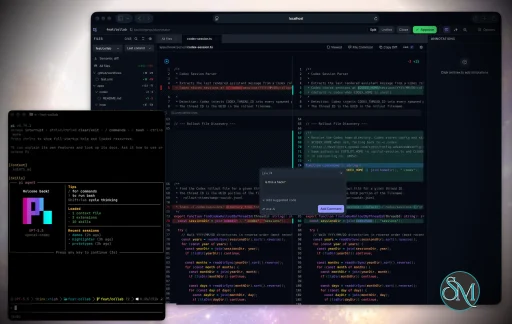
Plannotator extends the review process beyond planning by supporting inspection of generated code.
Developers can:
Review modifications
Analyze diffs
Leave comments
Request revisions
Validate implementation details
This workflow resembles modern pull-request review systems.
Human-in-the-Loop Workflows
A major design goal is ensuring that AI actions remain subject to human approval.
Organizations can establish review processes where important actions require validation before execution.
Open Source Foundation
Plannotator is open source, allowing teams to inspect, modify, and self-host the platform according to their needs.
This transparency is particularly valuable for organizations adopting AI-assisted software development.
User Experience
The interface is designed around review workflows rather than direct code generation.
Instead of interacting with a chatbot, users primarily:
Receive agent-generated plans
Review proposed actions
Add feedback
Approve or reject changes
Monitor execution results
The workflow feels familiar to developers accustomed to pull requests, code reviews, and project planning tools.
Productivity Benefits
As AI coding tools become more autonomous, review processes become increasingly important.
Plannotator helps organizations:
Reduce risky AI actions
Improve code quality
Increase accountability
Preserve architectural consistency
Encourage collaboration between developers and AI agents
For teams adopting AI-driven development, these safeguards can be as valuable as the coding agents themselves.
Collaboration Features
The platform supports collaborative review workflows where multiple team members can participate in evaluating AI-generated outputs.
This allows:
Peer review
Team approval processes
Shared annotations
Collective decision-making
Such features are especially useful for larger engineering teams.
Performance
Because Plannotator focuses on workflow management and review rather than model inference, performance largely depends on the connected AI agents and integrations.
The platform itself is lightweight and primarily serves as an orchestration and review layer.
Open Source Advantages
Being open source provides several benefits:
Transparent development
Self-hosting capabilities
Custom integrations
Community contributions
Vendor independence
Organizations concerned about compliance, security, or proprietary workflows may find these advantages particularly appealing.
Limitations
Plannotator is designed as a companion tool rather than a complete AI development platform.
Common limitations include:
Requires external AI coding agents
Best suited for teams already using AI-assisted development
Smaller ecosystem than mature developer platforms
Additional review steps may slow rapid prototyping
Some users may prefer fully autonomous workflows
The software delivers the most value in environments where oversight and quality control are priorities.
Pros
Improves transparency of AI-generated plans
Supports structured review workflows
Human-in-the-loop design
Useful annotation system
Open source
Self-hosting support
Familiar review experience for developers
Helps reduce AI-generated mistakes
Cons
Not a standalone coding agent
Requires integration with AI development tools
Smaller community than established developer platforms
Adds review overhead to workflows
Best suited for teams rather than casual users
Who Should Use Plannotator?
Plannotator is ideal for:
Software development teams
Engineering managers
AI-assisted development workflows
Organizations adopting coding agents
Open-source projects
Teams prioritizing code quality and governance
It is particularly valuable for environments where AI-generated code requires oversight before reaching production systems.
Plannotator fills an increasingly important role in the AI development ecosystem by providing visibility and control over AI-generated plans and code changes. Its focus on human oversight, structured reviews, and collaborative workflows makes it a useful companion for modern coding agents. While it is not a replacement for AI coding tools themselves, it offers a practical solution for teams seeking greater confidence and accountability in AI-assisted software development.
Developer:
backnotprop
Operating System:
Windows / macOS / Linux
Date Added:
2026-08-23T20:19:19.242Z
Categories:
Post a Comment/Report Broken Link: