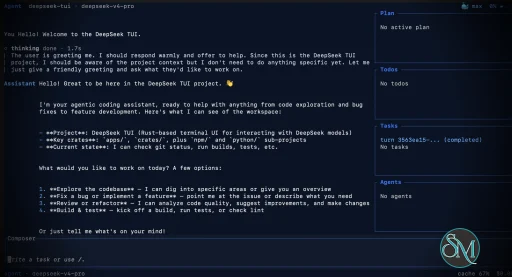
DeepSeek TUI is an open source terminal based coding agent designed for DeepSeek AI models. Unlike a simple chatbot, it can interact with your local workspace, execute shell commands, manage git operations, and assist with software development tasks directly from the command line.
The project is written in Rust and focuses on speed, low resource usage, and keyboard driven workflows. It is especially appealing for developers who spend most of their time in the terminal.
DeepSeek TUI is gaining attention among developers who prefer terminal based workflows and want direct access to AI powered coding tools without relying on heavy IDE integrations. Built around DeepSeek models, it transforms the terminal into an interactive coding assistant capable of editing files, running commands, and managing development workflows.
Download Codewhale v0.9.9 (Formerly DeepSeek TUI) - Software Mirrors |
|---|
Codewhale v0.9.9 (Formerly DeepSeek TUI) for Windowscodewhale-windows-x64.zip | 53.3 MB codewhale-windows-x64.exe | 74.53 MB codewhale-windows-x64-portable.zip | 53.3 MB codewhale-windows-arm64.zip | 49.71 MB codewhale-windows-arm64.exe | 59.94 MB codewhale-windows-arm64-portable.zip | 49.71 MB codewhale-tui-windows-x64.exe | 74.53 MB codewhale-tui-windows-arm64.exe | 59.94 MB |
Codewhale v0.9.9 (Formerly DeepSeek TUI) for macOScodewhale-tui-macos-x64 | 55.18 MB codewhale-tui-macos-arm64 | 49.43 MB codewhale-macos-x64.tar.gz | 49.6 MB codewhale-macos-x64 | 55.18 MB codewhale-macos-arm64.tar.gz | 46.29 MB |
Codewhale v0.9.9 (Formerly DeepSeek TUI) for Linuxcodewhale-tui-linux-x64 | 59.48 MB codewhale-tui-linux-arm64 | 49.19 MB codewhale-linux-x64.tar.gz | 51.15 MB codewhale-linux-x64 | 59.48 MB codewhale-linux-arm64.tar.gz | 47.32 MB |
Codewhale v0.9.9 (Formerly DeepSeek TUI) for Androidcodewhale-tui-android-arm64 | 49.9 MB codewhale-android-arm64.tar.gz | 46.81 MB |
Others Download related to Codewhale v0.9.9 (Formerly DeepSeek TUI) |
Codewhale v0.9.9 (Formerly DeepSeek TUI) Source CodeCodewhale v0.9.9 (Formerly DeepSeek TUI) Source code (zip) Codewhale v0.9.9 (Formerly DeepSeek TUI) Source code (tar.gz) |
Codewhale v0.9.9 (Formerly DeepSeek TUI) Release Notes:Codewhale is the public product from Shannon Labs. The
command, npm package, and release-asset names remain lowercase technical identifiers. The legacy npm package
receives no further releases. Users coming from v0.8.x legacy
InstallRecommended — npm (one command, both entrypoints)codewhale and codew command assets
from this Release. Both contain the same compiled runtime.
Docker / GHCRcodewhale and codew. The
latest tag is also updated on release.
Cargo (Linux / macOS)codewhale. Cargo cannot create a second command
alias from one binary target; users who want the shorter spelling can add a
codew symlink to that installed executable. The npm, Homebrew, archive,
shell-installer, and container channels install both command names directly.
Manual download — platform archives (recommended)Each archive below contains the same runtime under thecodewhale and
codew command names, plus an install script:
codewhale.exe and codew.exe under
%LOCALAPPDATA%\Programs\CodeWhale\bin and adds that directory to the
current-user PATH.
codewhale-windows-arm64.zip
codewhale- and
codew- assets. The seven codewhale-tui- filenames
attached to v0.9.5 are byte-identical compatibility copies used only to let
already-installed v0.9.4 clients discover and cross this single-binary
transition; current installers do not expose a third runtime. The legacy npm
package deepseek-tui is deprecated and is not republished. For migration
from v0.8.x legacy binary names, see docs/REBRAND.md.
Verify (recommended)Download the checksum manifests from this Release and verify:What's in v0.9.9Codewhale v0.9.9 is a truth-and-resilience release: the shell tool can no longer wedge a session when the host runs out of disk or descriptors, unverified context windows and output ceilings are labeled honestly at every surface, DeepSeek V4 is priced on the published peak/off-peak tiers, SSE UTF-8 fails closed in every dialect, Fleet shadowing is visible, bwrap gets container essentials and extra roots, thedsh skin rides the bundle
profile, the agent tool schema is down to 12 fields, and README/website
locales grow to 18 and 8.
Fixed
echo ok included — with the harness-internal
"Failed to create streaming shell output" and never recover until the
host was cleaned up. The spill is now best-effort (the bounded tail is
still returned and the truncation notice says why the full-output path is
missing), and any remaining spawn/stream failure names the exhausted
resource — disk, file descriptors, memory — and says the next call is safe
to retry (#5465; the wedge that took out the owner's own 0.9.9 session).
model-name hint and fallback rungs of the context-window ladder are
guesses, and every surface that renders one now says so — the status line,
/status, /config, the context-pressure message, the model picker chips,
and the auto-router inventory. Unverified windows still drive real budgets
(compaction trigger, context meter, output reservation); they just stop
reading as capabilities anyone checked. A window parsed from an _Nk
model-name suffix (qwen3-32b-256k → 256K) is now its own
model-name hint rung below catalog, because it is optimistic rather
than conservative — a catalog or provider-reported value beats it. The
[providers. override remains the hard fix and
renders as configured with no marker.
OutputCeilingSource gained an
unverified rung for both, so exec-stream receipts and the model picker
label them unverified/"assumed floor" instead of documented. Clamp
values are unchanged.
telemetry=on (default)-style row with
the source that decided it (cli | env | config | default), and
codewhale config get telemetry reports the resolved consent with its
source instead of key not found on a machine whose batches ship. Truth
change only; resolution and behavior are untouched.
git log, find | head,
npm view and the other bounded read-only commands run in-place instead
of being refused as "Executes" (#5426). Delegation still never widens
authority: the role-isolation test and docs/SUBAGENTS.md pin that a child
cannot exceed its parent's posture (#5426, #5435).
deepseek-v4-flash); Responses and
Anthropic-Messages routes are carried through pi-ai
openai-responses / anthropic-messages instead of being approximated
or refused; only credentialed base URLs are still refused, with an error
that names provider and model (#5434).
kimi-k3 stays unpriced until a
published rate exists (#5241; harvested from #5402).
started_at, so job-level reruns of the npm step are no
longer poisoned by earlier uploads (#5429).
deepseek-v4-flash and deepseek-v4-pro in USD and CNY, resolved from
each turn's recorded time; the stale single-tier rows understated cost up
to ~4×. Because every direct DeepSeek first-party rate is now
time-windowed, the scorecard fails closed (missing_recorded_time) on an
undated DeepSeek turn instead of guessing a tier (#5470; #5241 follow-up,
verified against api-docs.deepseek.com on 2026-08-17).
decode_failed propagation (InvalidSseUtf8) replace the per-dialect
approximations, with byte-chunk decoder tests (#5374; supersedes draft
#5404).
fetch_url) now uses the noisy-result soft limit, so large fetches are
compacted like shell output instead of consuming the ordinary hard limit
(#5474, thanks @h3c-hexin).
claude-sonnet-5 keeps
$2/$10 (the announced September increase was withdrawn), claude-opus-5
added, kimi-k3 and kimi-k2.7-code-highspeed, MiniMax-M2.7-highspeed,
Mistral first-party rows, xAI grok-4.5 / grok-4.3 with long-context
tiers, Gemini and Qwen limits, and RedNote's dots3-note preview as an
OpenRouter row (no first-party API exists yet) — every number carries its
source and a pinned test (#5485).
Changed
prompt, type, profile, name, agent_id, message, until,
detached, worktree, write_roots, resume_from — down from 33
(#5324, refs #5123). Budgets (max_steps, wall_time_secs, max_depth),
routing overrides (model, model_strength, thinking), worktree-path
knobs, the deliberate/spawn-contract fields and the wait/status/interrupt
extras moved off the advertised schema. Every removed field stays
parse-accepted and honored unchanged (same contract as token_budget), so
saved transcripts, ACP/MCP clients and Fleet configs replay as-is; the
#5426/#5435 containment clamps are untouched. Child budgets now resolve
from role defaults (60/120 turns, 1800 s wall time, unchanged clamps) and
new [subagents] keys default_max_steps / default_wall_time_secs.
Because the tool catalog is part of the session-pinned prompt prefix
(docs/CACHE.md), upgrading re-fills the KV prefix once per session.
/. The skills prompt is also 50 bytes
leaner without raising a runtime-contract ceiling (#5492, #5473).
Added
0 or absent keeps the full width; negative or
non-integer values are rejected with a clear config error. Tool, diff,
and status cells never inherit the cap (#5436).
dir="rtl" plumbing) as partial locales (#5453).
overrideTokens (on by default;
codewhale integrations dsh update --skin false turns it off), replacing
the 0.9.8 exported-CSS skin that dsh's inline body variables overrode
(docs/design/DSH_BUNDLE_SKIN.md, docs/INTEGRATIONS_DSH.md) (#5469).
><> glyph fish, bubbles — drawn on a
canvas under a translucent veil of the Codewhale palette, plus an explicit
responsive WHALE BROTHERS / CODEWHALE × DEEPSEEK HARNESS lockup; light
and dark, ~30 fps capped, paused when hidden, a static frame under
prefers-reduced-motion; on by default with the skin,
codewhale integrations dsh update --ocean false turns it off (#5484).
doctor "Fleet roster layers" section (JSON
operate_fleet.roster.multi_layer), in all 15 TUI locales. Layer collapse
and [fleet.profiles] migration stay for 0.9.10 (#5098).
bwrap_ro_roots / bwrap_dev_roots) so
toolchains that live outside the workspace stay reachable read-only
(#5410).
Removed
overrideTokens skin, #5469).
Contributors
|
Key Features of DeepSeek TUI
Terminal Native Workflow
DeepSeek TUI operates entirely within the terminal, allowing developers to work without switching between browser windows or external interfaces.AI Assisted Coding
The assistant can read and edit files, generate code, explain logic, and help automate development tasks.Shell Command Execution
It supports running terminal commands directly through the interface, streamlining development workflows.Git Integration
Developers can manage repositories, review changes, and handle version control related tasks from inside the tool.Multiple Work Modes
DeepSeek TUI includes modes like Plan, Agent, and YOLO, offering different levels of automation and approval control.Large Context Handling
The tool is built around DeepSeek V4 capabilities, including support for extremely large context windows that help with understanding bigger codebases.
User Experience
DeepSeek TUI is designed for developers comfortable with terminal environments. The interface is keyboard focused and efficient, though beginners may need time to adapt.
The workflow feels closer to tools like Claude Code or Codex style assistants rather than traditional chat applications. Community feedback on Reddit and GitHub discussions highlights its speed and practical coding workflow.
Performance and Compatibility
Because it is written in Rust, DeepSeek TUI is lightweight and responsive. It supports Linux, macOS, and Windows, with installation available through npm, Cargo, or direct binaries.
Performance depends heavily on the connected DeepSeek models and API configuration, but the local interface itself remains fast and efficient.
Pros
Fast terminal native workflow
AI powered coding and automation
Lightweight Rust based architecture
Supports file editing and shell execution
Open source and actively developed
Cons
Requires familiarity with terminal workflows
Depends on external AI APIs
Advanced automation modes may feel risky for inexperienced users
DeepSeek TUI is ideal for developers, DevOps engineers, and terminal focused power users who want AI assistance integrated directly into their command line workflow. It is especially attractive for users seeking a lightweight alternative to browser based AI coding tools.
DeepSeek TUI combines AI coding assistance with the efficiency of terminal workflows. Its fast performance, flexible automation, and developer focused design make it one of the most interesting open source AI terminal tools currently gaining traction.
Developer:
Hunter Bown
Operating System:
Windows / macOS / Linux
Date Added:
2026-08-18T16:06:25.120Z
Categories:
Post a Comment/Report Broken Link: