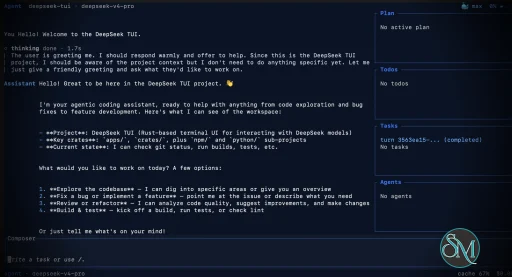
DeepSeek TUI is an open source terminal based coding agent designed for DeepSeek AI models. Unlike a simple chatbot, it can interact with your local workspace, execute shell commands, manage git operations, and assist with software development tasks directly from the command line.
The project is written in Rust and focuses on speed, low resource usage, and keyboard driven workflows. It is especially appealing for developers who spend most of their time in the terminal.
DeepSeek TUI is gaining attention among developers who prefer terminal based workflows and want direct access to AI powered coding tools without relying on heavy IDE integrations. Built around DeepSeek models, it transforms the terminal into an interactive coding assistant capable of editing files, running commands, and managing development workflows.
Download Codewhale v0.9.8 (Formerly DeepSeek TUI) - Software Mirrors |
|---|
Codewhale v0.9.8 (Formerly DeepSeek TUI) for Windowscodewhale-windows-x64.zip | 53.12 MB codewhale-windows-x64.exe | 74.26 MB codewhale-windows-x64-portable.zip | 53.12 MB codewhale-windows-arm64.zip | 49.54 MB codewhale-windows-arm64.exe | 59.72 MB codewhale-windows-arm64-portable.zip | 49.54 MB codewhale-tui-windows-x64.exe | 74.26 MB codewhale-tui-windows-arm64.exe | 59.72 MB |
Codewhale v0.9.8 (Formerly DeepSeek TUI) for macOScodewhale-tui-macos-x64 | 54.97 MB codewhale-tui-macos-arm64 | 49.25 MB codewhale-macos-x64.tar.gz | 49.41 MB codewhale-macos-x64 | 54.97 MB codewhale-macos-arm64.tar.gz | 46.11 MB |
Codewhale v0.9.8 (Formerly DeepSeek TUI) for Linuxcodewhale-tui-linux-x64 | 59.25 MB codewhale-tui-linux-arm64 | 49 MB codewhale-linux-x64.tar.gz | 50.94 MB codewhale-linux-x64 | 59.25 MB |
Codewhale v0.9.8 (Formerly DeepSeek TUI) for Androidcodewhale-tui-android-arm64 | 49.71 MB codewhale-android-arm64.tar.gz | 46.63 MB |
Others Download related to Codewhale v0.9.8 (Formerly DeepSeek TUI) |
Codewhale v0.9.8 (Formerly DeepSeek TUI) Source CodeCodewhale v0.9.8 (Formerly DeepSeek TUI) Source code (zip) Codewhale v0.9.8 (Formerly DeepSeek TUI) Source code (tar.gz) |
Codewhale v0.9.8 (Formerly DeepSeek TUI) Release Notes:Codewhale is the public product from Shannon Labs. The
command, npm package, and release-asset names remain lowercase technical identifiers. The legacy npm package
receives no further releases. Users coming from v0.8.x legacy
InstallRecommended — npm (one command, both entrypoints)codewhale and codew command assets
from this Release. Both contain the same compiled runtime.
Docker / GHCRcodewhale and codew. The
latest tag is also updated on release.
Cargo (Linux / macOS)codewhale. Cargo cannot create a second command
alias from one binary target; users who want the shorter spelling can add a
codew symlink to that installed executable. The npm, Homebrew, archive,
shell-installer, and container channels install both command names directly.
Manual download — platform archives (recommended)Each archive below contains the same runtime under thecodewhale and
codew command names, plus an install script:
codewhale.exe and codew.exe under
%LOCALAPPDATA%\Programs\CodeWhale\bin and adds that directory to the
current-user PATH.
codewhale-windows-arm64.zip
codewhale- and
codew- assets. The seven codewhale-tui- filenames
attached to v0.9.5 are byte-identical compatibility copies used only to let
already-installed v0.9.4 clients discover and cross this single-binary
transition; current installers do not expose a third runtime. The legacy npm
package deepseek-tui is deprecated and is not republished. For migration
from v0.8.x legacy binary names, see docs/REBRAND.md.
Verify (recommended)Download the checksum manifests from this Release and verify:What's in v0.9.8Codewhale v0.9.8 ships the remaining assigned finish. Remaining web settings polish moves to v0.9.9. Prefab third-party templates that have a published OpenAI-compatible host ship here (#5350).Fixed
PR_SET_NO_NEW_PRIVS flag — inherited by every child process —
is now skippable with CODEWHALE_NO_NEW_PRIVS=0 (#5413). The flag stays on
by default; the no-ptrace and no-core-dump measures are never skipped.
~/.codewhale/crashes/last-fatal-signal.log
before re-raising, keeping the honest 128+signal wait status. A SIGKILL
(OOM killer) remains uninterceptable by design.
Changed
/model, mode, goal, session resume), which re-pins under a logged
reason; an undeclared change is reported as drift and the original pin is
kept instead of silently becoming the new baseline. Workspace, AGENTS.md,
skills, memory, and goal drift now reaches the model as one bounded
/cache stats shows the pin reason, the last-miss
reason, the undeclared-drift count, and the context-update count. See
docs/CACHE.md.
full /
partial / unsupported). All-unsupported bundles still cannot be enabled.
The capability hash is now v2 and binds this build's activation policy, so
older v1 receipts and any later adapter-enablement change fail closed as
needs-review. Skills and each MCP transport re-request their own capability
at the consumption boundary.
Added
add reads one LOCAL catalog
document in the real published schemas (Kimi, Claude, Codex, or
Codewhale native) — no network, regular files only — and persists it
beside the plugin state with the same hardened, fail-closed store.
list/show render every candidate with per-entry diagnostics,
display-only tiers, and honest install plans that say when Codewhale
cannot fetch a source; install routes through the existing reviewed
installer, so installed bundles still enter disabled and untrusted.
Foreign auto-install policy (Codex INSTALLED_BY_DEFAULT) is visibly
ignored; nothing is auto-installed, auto-trusted, or granted vendor
trust.
DEFAULT_ZAI_MODEL resolves to GLM-5.3 in both
codewhale-tui and codewhale-config, and it is the first /model row
after /provider zai. Explicit GLM-5.2 selections (model = "GLM-5.2"
and its glm-5.2 aliases) keep their own id — only the default moved.
Limits and reasoning options still inherit from GLM-5.2 until Z.ai
publishes distinct 5.3 numbers. No USD price is claimed. A live call
can still 429 with entitlement code 1311 on accounts that are not
provisioned for 5.3.
https://ollama.com/v1 route. Local
Ollama stays keyless. The exact released ollama + Cloud URL tuple keeps
a bounded compatibility path across saved sessions, Fleet, and nested
subagents; neighboring remotes stay custom and fail closed against
inherited official credentials.
is the install path; brew upgrade codewhale`
updates it. The legacy deepseek-tui formula remains a deprecated alias
for one overlap release.
Codewhale, reasoning…, using tool…, done), so parallel
sessions are identifiable at a glance without a second title setting.
/title is a discoverable alias for /rename; both update the one
session name shown in the picker, composer, and terminal tab. Control,
bidi, and zero-width format characters are stripped from the saved name
itself, so /title, /rename, the picker, the Runtime API,
codewhale sessions, and the OSC 0 tab title all carry the same
escape-free text (#5419, Sh1Zuku).
eden-ai / eden_ai) with EDENAI_API_KEY, global and EU base-URL
overrides, a live provider-scoped model catalog, and
deepseek/deepseek-v4-pro as the verified default. Generic reasoning fields
stay omitted because Eden AI routes multiple upstream model families
(#5422, Kai Nacke).
planner may run read-only
shell probes; custom inherits the parent's write/network/shell posture
and is narrowed only by its explicit tool list or the spawning call.
Read-only roles (scout, reviewer, planner, verifier,
consultant) still never write the workspace. The focused worker's
header states its effective posture from the runtime snapshot.
/workflow help are answered by Codewhale itself from the run journal and
live run state — no model turn — and /workflow run launches a
checked-in workflow as-is. /config workflow and /config goal explain
the effective tables. The workflow tool now honors the session [workflow]
table (automatic, auto_start_read_only, require_approval_for_writes,
limits) instead of product defaults.
Goal set receipt with how to pause
or clear it. Bare /goal shows plain progress (and how to continue when no
turn is running), prints usage on an empty session instead of asking the
model, and /goal help|status are reserved words.
/fleet
roster rows and worker rows, with an identity portrait in the roster detail
pane and a six-state word (Resting, Thinking, Working, Waiting for you,
Blocked, Offline) derived only from the child's real runtime status. Colors
come from the theme tokens, every glyph has an ASCII fallback, and the
working wake animates only under full motion. See
docs/design/WHALE_TEAMS_TUI.md.
), on by default as the session_metrics` footer item
(/statusline, [tui].status_items). Every value comes from engine
receipts — turn starts, per-model-call usage with stream time,
time-to-first-token and whole-call time, tool start/complete edges, and
provider-reported cache and input tokens. Cells without evidence are
omitted, never estimated. /status prints the untrimmed line; the phase
row sheds its lowest-value groups to fit the columns it actually has.
/permissions
ends with the active posture, what it decides on its own versus never,
and the audit-log path. The footer's Esc to interrupt hint is
localized. See docs/design/AUTO_MODE_PARITY.md for the Claude Code /
Kimi Code parity ledger and follow-ups.
dsh 0.1.0-rc.6, verified)
through Codewhale using only its documented seams: a --patch overlay that
pins the exact Codewhale provider/model/endpoint identity (native
deepseek-official route, or a hand-declared openai-completions route
named codewhale- for OpenAI-compatible providers), the
Codewhale permission posture exported as DSH_PERMISSION_MODE, and an
append-only receipt. Codewhale writes only under
$CODEWHALE_HOME/integrations/dsh/, never copies API keys or edits DSH
files, never broadens permissions (--allow-full-access only mirrors an
existing Codewhale full-access posture), and reports not-installed /
offline / incompatible / detected / connected / stale-config /
stale-version / disabled honestly. Anthropic Messages and OpenAI Responses
routes are refused as not carriable. The documented DSH plugin path is an
explicit opt-in: install-bundle materializes a Codewhale bundle package
(codewhale-dsh-bundle, MIT notice retained) and installs it with
dsh plugin --profile codewhale add into a dedicated codewhale
profile (pnpm required, reported truthfully when missing; web/headless
untouched), so dsh --profile codewhale alone carries the identity;
update regenerates the bundle patch and remove-bundle reverses it,
leaving the DSH-owned profile directory in place. /setup tools and codewhale doctor
show the read-only detection state; doctor also lists the DSH read-only
credential consent alongside Codex and Grok. The optional --skin export
writes a Codewhale token stylesheet generated from the TUI palette
(Blue Stage dark/light, ombre water column, mode/permission/state colors,
reduced-motion fallbacks); DSH exposes no custom-theme API, so the sheet is
labeled an unsupported overlay and is never injected. See
docs/INTEGRATIONS_DSH.md.
Fixed
antigravity declared OAuth
acquisition; those gates now key off the OAuth acquisition class
instead of a hard-coded provider identity.
low tier.
/effort persists and receipts through the same path as Ctrl+T.
agy 1.1.13) is
a separate provider: consent-gated read-only import of the official
CLI's login, then a text-only cloud-code stream
(/v1internal:streamGenerateContent). Tools, images, and unknown SSE
shapes fail closed. Gemini 3.7 Flash is not advertised until a live
turn succeeds on this wire. The website 44-count still excludes
Antigravity.
unverified_live_pricing (#5241). kimi-k3 stays
unpriced until a published rate exists.
https://token.sensenova.cn/v1 host (#5350). OpenCode
Zen/Go stay first-class rows. Agnes has no published URL, so it has
no preset.
ultracode alias, instead of being
silently dropped (#5303, #5409, buiducnhat).
rustc shim, so the TUI suite no longer depends
on $HOME or holds the process-wide test environment lock across an
async wait (#5056, #5423, Isabel Wu).
Removed
dsh) after
codewhale auth external-consent --provider deepseek --mode read-only.
Codewhale reads only DEEPSEEK_API_KEY from the exact granted
$DSH_HOME/.credentials.yaml and never writes or refreshes that file.
> content inside a longer
fence stays literal code instead of escaping into a quote.
Contributors
EDENAI_API_KEY, and the global/EU endpoints (#5422).
$HOME (#5423, slice of #5056).
See CHANGELOG.md for full notes and docs/CHANGELOG_ARCHIVE.md for older releases. |
Key Features of DeepSeek TUI
Terminal Native Workflow
DeepSeek TUI operates entirely within the terminal, allowing developers to work without switching between browser windows or external interfaces.AI Assisted Coding
The assistant can read and edit files, generate code, explain logic, and help automate development tasks.Shell Command Execution
It supports running terminal commands directly through the interface, streamlining development workflows.Git Integration
Developers can manage repositories, review changes, and handle version control related tasks from inside the tool.Multiple Work Modes
DeepSeek TUI includes modes like Plan, Agent, and YOLO, offering different levels of automation and approval control.Large Context Handling
The tool is built around DeepSeek V4 capabilities, including support for extremely large context windows that help with understanding bigger codebases.
User Experience
DeepSeek TUI is designed for developers comfortable with terminal environments. The interface is keyboard focused and efficient, though beginners may need time to adapt.
The workflow feels closer to tools like Claude Code or Codex style assistants rather than traditional chat applications. Community feedback on Reddit and GitHub discussions highlights its speed and practical coding workflow.
Performance and Compatibility
Because it is written in Rust, DeepSeek TUI is lightweight and responsive. It supports Linux, macOS, and Windows, with installation available through npm, Cargo, or direct binaries.
Performance depends heavily on the connected DeepSeek models and API configuration, but the local interface itself remains fast and efficient.
Pros
Fast terminal native workflow
AI powered coding and automation
Lightweight Rust based architecture
Supports file editing and shell execution
Open source and actively developed
Cons
Requires familiarity with terminal workflows
Depends on external AI APIs
Advanced automation modes may feel risky for inexperienced users
DeepSeek TUI is ideal for developers, DevOps engineers, and terminal focused power users who want AI assistance integrated directly into their command line workflow. It is especially attractive for users seeking a lightweight alternative to browser based AI coding tools.
DeepSeek TUI combines AI coding assistance with the efficiency of terminal workflows. Its fast performance, flexible automation, and developer focused design make it one of the most interesting open source AI terminal tools currently gaining traction.
Developer:
Hunter Bown
Operating System:
Windows / macOS / Linux
Date Added:
2026-08-17T16:06:29.118Z
Categories:
Post a Comment/Report Broken Link: