Codewhale v0.9.10 (Formerly DeepSeek TUI)

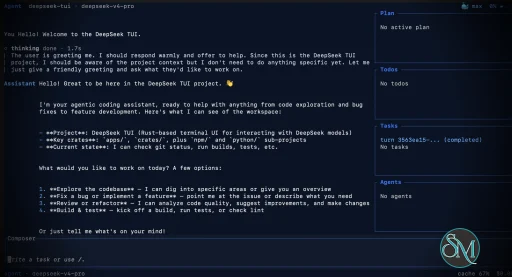
DeepSeek TUI is an open source terminal based coding agent designed for DeepSeek AI models. Unlike a simple chatbot, it can interact with your local workspace, execute shell commands, manage git operations, and assist with software development tasks directly from the command line.

The project is written in Rust and focuses on speed, low resource usage, and keyboard driven workflows. It is especially appealing for developers who spend most of their time in the terminal.

DeepSeek TUI is gaining attention among developers who prefer terminal based workflows and want direct access to AI powered coding tools without relying on heavy IDE integrations. Built around DeepSeek models, it transforms the terminal into an interactive coding assistant capable of editing files, running commands, and managing development workflows.

Download Codewhale v0.9.10 (Formerly DeepSeek TUI) - Software Mirrors

Codewhale v0.9.10 (Formerly DeepSeek TUI) for Windows

CodeWhaleSetup.exe | 27.43 MB

codewhale.bat | 196 B

codewhale-windows-x64.zip | 55.11 MB

codewhale-windows-x64.exe | 76.96 MB

codewhale-windows-x64-portable.zip | 55.11 MB

codewhale-windows-arm64.zip | 51.44 MB

codewhale-windows-arm64.exe | 62.06 MB

codewhale-windows-arm64-portable.zip | 51.44 MB

codewhale-tui-windows-x64.exe | 76.96 MB

codewhale-tui-windows-arm64.exe | 62.06 MB

codew-windows-x64.exe | 76.96 MB

codew-windows-arm64.exe | 62.06 MB

Codewhale v0.9.10 (Formerly DeepSeek TUI) for macOS

codewhale-tui-macos-x64 | 57.34 MB

codewhale-tui-macos-arm64 | 51.29 MB

codewhale-macos-x64.tar.gz | 51.51 MB

codewhale-macos-x64 | 57.34 MB

codewhale-macos-arm64.tar.gz | 48.04 MB

codewhale-macos-arm64 | 51.29 MB

codew-macos-x64 | 57.34 MB

codew-macos-arm64 | 51.29 MB

Codewhale v0.9.10 (Formerly DeepSeek TUI) for Linux

codewhale-tui-linux-x64 | 61.47 MB

codewhale-tui-linux-arm64 | 50.81 MB

codewhale-linux-x64.tar.gz | 52.85 MB

codewhale-linux-x64 | 61.47 MB

codewhale-linux-arm64.tar.gz | 48.89 MB

codewhale-linux-arm64 | 50.81 MB

codew-linux-x64 | 61.47 MB

codew-linux-arm64 | 50.81 MB

Codewhale v0.9.10 (Formerly DeepSeek TUI) for Android

codewhale-tui-android-arm64 | 51.65 MB

codewhale-android-arm64.tar.gz | 48.51 MB

codewhale-android-arm64 | 51.65 MB

codew-android-arm64 | 51.65 MB

Others Download related to Codewhale v0.9.10 (Formerly DeepSeek TUI)

codewhale-bundles-sha256.txt | 863 B

codewhale-artifacts-sha256.txt | 2.92 kB

Codewhale v0.9.10 (Formerly DeepSeek TUI) Source Code

Codewhale v0.9.10 (Formerly DeepSeek TUI) Source code (zip)

Codewhale v0.9.10 (Formerly DeepSeek TUI) Source code (tar.gz)

Codewhale v0.9.10 (Formerly DeepSeek TUI) Release Notes:

Codewhale is the public product from Shannon Labs. The codewhale
command, npm package, and release-asset names remain lowercase technical
identifiers. The legacy npm package deepseek-tui is deprecated and
receives no further releases. Users coming from v0.8.x legacy deepseek /
deepseek-tui names should migrate with docs/REBRAND.md.

Install

Recommended — npm (one command, both entrypoints)

bash
npm install -g codewhale
The wrapper downloads the matched codewhale and codew command assets from this Release. Both contain the same compiled runtime.

Docker / GHCR

bash
docker run --rm -it \
  -e DEEPSEEK_API_KEY="$DEEPSEEK_API_KEY" \
  -v codewhale-home:/home/codewhale/.codewhale \
  ghcr.io/hmbown/codewhale:v0.9.10
The image exposes the same runtime as both codewhale and codew. The latest tag is also updated on release.

Cargo (Linux / macOS)

bash
cargo install codewhale-cli --locked
The Cargo package installs codewhale. Cargo cannot create a second command alias from one binary target; users who want the shorter spelling can add a codew symlink to that installed executable. The npm, Homebrew, archive, shell-installer, and container channels install both command names directly.

Manual download — platform archives (recommended)

Each archive below contains the same runtime under the codewhale and codew command names, plus an install script:
  • Linux x64: codewhale-linux-x64.tar.gz | install.sh
  • Linux ARM64: codewhale-linux-arm64.tar.gz | install.sh
  • Android ARM64 (Termux): codewhale-android-arm64.tar.gz | install.sh
  • macOS x64: codewhale-macos-x64.tar.gz | install.sh
  • macOS ARM: codewhale-macos-arm64.tar.gz | install.sh
  • Windows x64 (installer): CodeWhaleSetup.exe | NSIS setup
  • Windows x64: codewhale-windows-x64.zip | install.bat
  • Windows x64 (portable): codewhale-windows-x64-portable.zip | —
  • Windows ARM64: codewhale-windows-arm64.zip | install.bat
  • Windows ARM64 (portable): codewhale-windows-arm64-portable.zip | —
Unix (Linux / macOS):
bash
tar xzf codewhale-.tar.gz
cd codewhale-
./install.sh
Windows:
  • For the installer path, run CodeWhaleSetup.exe; it installs
codewhale.exe, codew.exe, and codewhale.bat under %LOCALAPPDATA%\Programs\CodeWhale\bin, adds that directory to the current-user PATH, and creates a Start Menu shortcut that prefers Windows Terminal (wt.exe) when it is installed.
  • Extract the archive for your machine: codewhale-windows-x64.zip or
codewhale-windows-arm64.zip
  • Double-click codewhale.bat (not the raw .exe) to launch
  • Run install.bat to copy the binaries and launcher to %USERPROFILE%\bin
  • Add %USERPROFILE%\bin to your PATH
The portable Windows archive skips the install script — extract and run codewhale.bat from any directory. The NSIS installer is currently unsigned and may trigger Windows SmartScreen until a signing certificate is wired into the release pipeline. Each platform also has bare, unarchived codewhale- and codew- assets. The seven codewhale-tui- filenames attached to v0.9.5 are byte-identical compatibility copies used only to let already-installed v0.9.4 clients discover and cross this single-binary transition; current installers do not expose a third runtime. The legacy npm package deepseek-tui is deprecated and is not republished. For migration from v0.8.x legacy binary names, see docs/REBRAND.md.

Verify (recommended)

Download the checksum manifests from this Release and verify:
bash

Linux — archive bundles

sha256sum -c codewhale-bundles-sha256.txt --ignore-missing

Linux — individual binaries

sha256sum -c codewhale-artifacts-sha256.txt --ignore-missing

macOS

shasum -a 256 -c codewhale-bundles-sha256.txt --ignore-missing shasum -a 256 -c codewhale-artifacts-sha256.txt --ignore-missing

What's in v0.9.10

  • Show the full slash-command or /model completion row in a bounded, wrapping hover popover whenever narrow terminals truncate it, closing the remaining scoped gap from #998. Thanks @AiurArtanis and @formp3 for identifying the affected surfaces.
  • registry_sync no longer ships the full MCP Registry catalog into the
conversation. It takes a required query, scores the local snapshot host-side, and returns at most eight matches; the complete catalog stays on disk, and the compaction and spillover exemptions that let a multi-hundred- kilobyte dump reach the model unchanged are gone.
  • Providers that mirror the outgoing (reasoning omitted) replay placeholder
back as a reasoning delta no longer have that echo ingested as real thinking: the exact transport placeholder is dropped on arrival, so live sessions stop showing a stream of placeholder reasoning blocks and saved transcripts stay free of them.
  • Mid-stream connection drops during an interactive turn no longer persist a
synthetic [runtime] user message. Retry state is a typed engine-internal descriptor; a thinking-only drop re-issues the request without claiming a partial reply was preserved, the retry budget is enforced in mechanism, and recovery produces exactly one authoritative final answer. Codewhale v0.9.10 is a retention, identity, and product-clarity release: the shell and transcript can no longer retain unbounded tool output in memory or on disk, mid-turn history inserts no longer strand in-flight tool rows, every agent that ran this session is visible from /agents list, the PTY acceptance lane has a stall watchdog and bounded CI steps, approval outcomes are durable and fail closed (cyq1017, #5360), and three $HOME disk leaks are reclaimed. Extension surfaces now name their real state and act only through the reviewed install and trust flows, and sub-agent, shell, task, and workflow state is owned by the session that created it (#5518). Test threads get an 8 MiB stack so the lib suite can no longer abort under load.

Fixed

  • First run starts on the welcome screen again. A missing key no longer
skips Welcome and auto-opens the local-provider list: Enter walks to the calm provider explanation, then Enter opens the picker so a first API key can be set. Returning missing-key recovery still opens the picker on launch.
  • A foreground bash command that named no timeout is bounded again. The
model-facing bash tool left an omitted timeout_ms at the internal ceiling (~24.8 days) instead of the 120 s default its own schema advertises, so a CLI that blocked on an interactive prompt or a hung network call held the turn open indefinitely — one report sat on a single unauthenticated CLI call for over two hours with the tool row simply counting seconds. The advertised default now applies, which arms the existing recovery: the process is killed and the model is told to rerun with background=true and poll with action="wait". An explicit timeout_ms is still honored for genuinely long foreground work, and background and interactive runs keep their own lifetimes.
  • The Extensions (/plugin) Marketplace is no longer a read-only list.
Every recommendation and stored candidate names its truthful state and primary action — Add, Enable, Configured, or Unavailable — and Enter or a mouse click runs that action through the existing reviewed `/mcp add recommended, /mcp enable, and /plugin` install/trust controllers, so no second trust path exists. Browser Use and Sandbox Runtime stay honestly Unavailable with their real setup routing instead of implying an install Codewhale cannot perform.
  • The Extensions MCP tab now renders one honest inventory: the header count
and the visible rows derive from the same configured-server set, so MCP (6) can no longer sit above two rendered rows. Disabled servers stay visible and labeled disabled instead of silently disappearing, and configured servers absent from the live snapshot list as not-yet-inspected with their own explicit reload affordance through the MCP command controller.
  • Installed plugin rows now act on their real state: Enter opens an active
bundle (/plugin show), offers Enable for a trusted-but-disabled bundle, or routes an untrusted bundle to the existing trust review — through the same confirmation and persistence controllers as the slash commands.
  • Sub-agent handoffs and rosters, background shell jobs, durable tasks,
delayed continuations, and workflow controls are now scoped to the session that owns them. Records carry immutable root-session ownership, stale completion-channel payloads are rejected before deduplication, background work drains and reports only to its owning session, and legacy ownerless jobs fail closed (#5518 failure class reported by @hxfhd; the report's exact JavaScript provenance was not claimed as reproduced).
  • The resolved route envelope now reaches every outbound model call: all
wire dialects and auxiliary calls clamp at the shared transport seam under one wire/reservation budget, provider input limits are honored, and switching models on the same protocol no longer inherits the previous model's limits (#5516, #5518).
  • First-run continuity: the chosen onboarding provider persists across
restarts, a missing first-run config no longer interrupts the flow, and the automatic working-agreement checkpoint renders as a standalone setup handoff instead of regressing the onboarding rail to the full wizard's 4/10 progress.
  • Explicitly worded natural-language /goal declarations now create a
durable goal in the provider-neutral engine before model dispatch, while ordinary tasks and quoted transcripts stay out of goal mode and prose acknowledgement alone can no longer stand in for goal creation.
  • /model now keeps the current Z.ai default (GLM-5.3) visible when an
older installation has an explicit GLM-5.2 route saved. The saved 5.2 route remains exact; choosing 5.3 sends and remembers the distinct 5.3 ID.
  • The constitution checkpoint now leads with the bundled balanced agreement;
the default path writes no custom constitution. The startup launch surface distinguishes read-only Chat from folder-bound, approval-gated Work.
  • Tabby and other IME bridges no longer observe a stale visible caret while a
frame diff is being painted; Codewhale hides the cursor during the diff, restores the canonical composer cell, and only then reveals it again (BrathonBai, #5023).
  • Pre-header HTTP/2/SSE transport failures get one bounded HTTP/1.1 retry;
authentication, provider-semantic, response-body, and already-pinned HTTP/1 failures remain fail-closed (demian-welt, #4683).
  • MCP tools/call images now travel as bounded typed content instead of
leaking base64 through model-visible JSON. Direct and parallel calls share the same MIME, size, validation, and one-image boundary (PR #5515 by @cacdcaecawae).
  • Linux npm installs and updates race GitHub Releases against the CNB mirror
at the checksum-manifest layer, then download from the first verified source without making users wait through a doomed slow-source timeout.
  • CODEWHALE_PREFER_BWRAP now applies the documented Linux sandbox override,
and Codewhale-era names own build metadata, hook session/tool-call IDs, and sandbox child markers. The corresponding DEEPSEEK_* names remain as 0.9.x compatibility aliases (#5443).
  • Windows default launch prefers Windows Terminal: zip archives ship
codewhale.bat (CRLF, wt.exe then the exe), install.bat copies that launcher, and the NSIS Start Menu shortcut opens it instead of the raw binary (#1854).
  • fix(tui): make the header status mark honour its settingstatus_indicator
did nothing for three of its four documented values. The header hardcoded a leading cw span and asked for a second mark beside the effort chip, then filtered the second one against the literal "cw"; because cw, the legacy whale opt-in, and every unknown value all normalize onto that same mark, the filter discarded them and left off with nothing to turn off. cw, whale, off, and a typo all rendered byte-identical headers. There is one mark now and the setting owns it: cw/whale draw the typographic mark, dots draws the activity frames, off removes it (thejayjetson, #5512).
  • `fix(tui): rebase active-cell tool bindings on every mid-turn history
insert/rename` mid-turn left the running tool row spinning forever (#5478).
  • fix(tui): bound what the shell and transcript retain from tool output
a 1.1 MB Bash call kept over a megabyte resident for up to an hour; raw streams now cap at 16 MiB in flight and release delivered output, and retained tool outputs cap at 64 KiB per record / 8 MiB per transcript (#5472).
  • fix(tui): reclaim the three $HOME disk leaks — orphaned session dirs,
the unbounded audit.log, and stranded writer temp files.
  • fix(tui): persist approval outcomes before execution (cyq1017) —
approval receipts are committed to a session-owned log before execution proceeds; unpersistable evidence blocks the tool; resume reconstructs closed and interrupted approvals (#5360).
  • test(tui): break the LazyLock/env-barrier deadlock in the test harness.
  • ci: give test threads the 8 MiB stack they need — the lib suite aborted
with SIGABRT under load on the default 2 MiB stack.
  • YOLO entry points honor a locked approval policy: --yolo, /mode yolo,
/zidong, and Alt+Y can no longer set Full Access + trust + shell when config or managed requirements own the posture.
  • Terminal PTY tools fail closed without a sandbox backend under a narrowed
filesystem posture, and otherwise start $SHELL -i through SandboxManager::prepare like bash.
  • Skill update refuses to replace a directory that has no .installed-from
marker — same ownership gate plugins already used.
  • cp/mv are workspace-safe only when every path operand stays inside
the workspace — Auto-Review no longer auto-allows cp /etc/passwd ..
  • Main CI no longer shares one concurrency group per branch: each SHA
gets a verdict instead of a cancelled pending run. A hermetic Safety gate job runs authorization tests in under 15 minutes (test bankruptcy restructuring — no tests deleted).
  • Config-fixture tests no longer honor lock_test_env as a license to
read a populated ~/.codewhale/config.toml; they need an EnvVarGuard like settings already did. Safety-gate and CNB workspace tests pin a hermetic CODEWHALE_HOME. exec_persistent_service is serialized in nextest and inside the cargo-test binary instead of dropped (#5355).
  • Short CLI no longer waits up to three seconds for a telemetry POST on
exit; session_end is recorded and the buffer ships on the next interactive session.
  • Bare / now opens a deliberately small starter set: /help, /setup,
/model, /settings, /resume, and /rc. The full command inventory remains searchable through /help, the command palette, and direct prefix typing, without front-loading the entire control surface (#5442, #5439).
  • First run now asks only for decisions needed to become usable, keeps the
offline route explicit, and leaves optional provider, tools, policy, and appearance work in the progressive /setup repair guide. The idle aquarium asks one task-oriented question instead of advertising a tutorial or command billboard, and the localized telemetry choice appears after the workspace is ready without blocking the composer.
  • Provider, active model, and reasoning effort moved out of the crowded header
into a quiet, width-aware footer identity. Compact layouts keep model and effort before provider detail and shed whole low-priority groups instead of clipping the composer or control hints.
  • The model picker no longer re-parses ~/.codewhale/config.toml once per
provider when deciding who has a saved key.

Added

  • /workflows opens a live run dashboard over this workspace's durable
workflow journal: every retained run with status, phases, child roster, progress, and host-side cancel — observation only, it never launches a run.
  • Repository instructions now assemble from the actual containing checkout:
applicable AGENTS.md files resolve repository-root to current-directory in order under one aggregate budget, a linked worktree is its own root, and scope is never inferred from path mentions or whichever branch is named main.
  • /goal is a codex-style control plane: setting an objective dispatches it
to the engine, which owns the goal and starts the first goal turn itself — the objective is never echoed back as the user's own message, pause/resume are real control ops, and the hunt-era vocabulary and trophy cards are gone.
  • /extensions and /plugins open one localized inventory for Hooks,
Plugins, local Marketplace catalogs, Skills, and MCP. Reviewed suggestions include Playwright, Chrome DevTools, Cua Computer Use, Browser Use, and the sandbox runtime without granting trust or installing anything on open.
  • Turn Inspector now opens the newest turn and pages across complete recorded
user, reasoning, tool/subagent, and assistant output with page-scoped search, copy, and export (sky-sun-moon, #1682).
  • Background tasks have bounded incremental persistence, durable terminal
reasons, truthful timeout/cancellation receipts, restart recovery, and interruptible continuous-goal delays (#5497, #5508).
  • /title once again controls the terminal window title independently from
/rename, survives session save/load, and sanitizes control, bidi, and zero-width characters (PR #5509 by @SparkofSpike).
  • MCP snapshots preserve whether capabilities were advertised by the server,
discovered through the bounded legacy fallback, or not observed (#4170).
  • codewhale auth status --diagnostic reports canonical paths, isolation
source, backend class, and value-free provider-source presence without opening credential stores or creating/migrating state (#2369).
  • codewhale doctor --probe-search performs an explicit credential-free,
policy-checked transport probe for the selected search provider; ordinary doctor and JSON output remain offline (#5442).
  • The safe deferred read_media tool is available to supported read-only
roles, and history receipts distinguish localized tool execution outcomes without exposing raw payloads (#5102).
  • npm Linux x64 first-party source selection. The wrapper concurrently
fetches the GitHub Releases and CNB checksum manifests for the exact package version, locks the first source whose HTTP response and manifest validate, and downloads binaries only from that source. Explicit CODEWHALE_RELEASE_BASE_URL / CODEWHALE_USE_CNB_MIRROR=1 still skip the race; other targets stay on GitHub.
  • /workflow and /workflow run now produce a bounded,
tool-less proposal for review. Only /workflow confirm can launch that reviewed draft; status, cancel, settings, and the /workflows dashboard stay host-owned and do not spend a model turn (#5439).
  • feat(tui): add cancellable cadence to continuous goals (M-Maciej) —
[goal] continuation_delay_seconds gives coordinator goals a visible quiet period between successful turns while reusing the existing coalesced goal continuation token; Esc, Ctrl+C, pause/done/blocked/clear cancel before the next provider request, and failures never continue (#5508).
  • feat(tui): add command context adapters and migration gate (FEAT-015)
(aboimpinto) — TUI-owned capability facets, a dual-path dispatch seam, and source-aware CI enforcement so a command slice cannot claim to be migrated while it still accepts concrete App. Zero production commands migrate in this slice (#5316).
  • `feat(web): move docs/hooks and docs/troubleshooting onto the dictionary
spine` (Lstarsky0) — both pages now read copy from the locale dictionaries instead of inline bilingual literals (#5337).
  • `feat(web): move docs/constitution and docs/runtime-api onto the dictionary
spine` (Lstarsky0) — both pages now read copy from the locale dictionaries instead of inline bilingual literals; another incremental phase of #5337, not completion of the full epic (#5517).
  • docs(i18n): complete Tier 1 of Chinese docs localization (SparkofSpike) —
Chinese and Indonesian docs move to docs/zh_hans/ and docs/id/, with redirect stubs at the old paths for one release cycle (#5482).
  • feat(tui): show repository context in git chrome (wuisabel-gif) — the TUI
header now identifies the active repository or linked worktree before the branch and dirty marker, so operators can see where the agent is working without opening the worktree manager (#5437).
  • feat(tui): formalize the status-bar color grammar — seven semantic
families live in docs/design/STATUS_BAR_COLOR_GRAMMAR.md and palette::grammar; header and phase-strip ink resolve through named ChromeInk slots so chrome cannot invent an eighth meaning or spend Failure red on a dirty worktree or selected mode. The footer's session metrics strip resolves through the same inks, and the red reservation is checked against every selectable theme, not just the whale default; typed footer toasts resolve through the grammar too. Repo/worktree chrome stays metadata and still renders when Git names a location but not a ref (#5437).
  • feat(tui): first slice of the agents roster — every agent that ran this
session, receipts-only, via /agents list and the sidebar fan-out rows (#5479 spec items 1 and 5).
  • ci: bound PTY acceptance and add a stall watchdog to the harness
QA_PTY_STALL_TIMEOUT_SECS aborts a wedged PTY run with a diagnostic; the isolated PTY step is capped at 15 minutes; Windows NSIS provisioning gets a bounded retry (#5496).
  • chore(scripts): dev-cache warns before it fills a disk (#5465 class).

Contributors

  • Sh1Zuku (@SparkofSpike) — restored
/title as an independent, persistent terminal-window title in PR #5509, in addition to the Tier 1 Chinese and Indonesian documentation work below. turn-loop stream processor in PR #5514 while preserving retry, cancellation, usage, TTFT, steering, and partial-response behavior. working no-token Star History mirror used across the localized README set after the canonical chart endpoint began returning a restricted placeholder (#5510). provider-neutral typed MCP image forwarding in PR #5515; the harvested version also makes malformed image fields produce a visible omission receipt. the narrow-terminal completion truncation closed by the bounded hover reveal (#998). Thanks also to @AiurArtanis and @formp3 for identifying the affected completion surfaces. the missing full per-turn input, reasoning, tool, and assistant pages that shaped Turn Inspector navigation (#1682).
  • cy2311 (@cy2311) — reported the Windows launch
path that now ships and installs a Windows Terminal-aware batch launcher (#1854). reproducible pre-header SSE transport failure behind the bounded HTTP/1.1 retry (#4683). Tabby/CJK IME candidate-window jump that led to the hide-diff-position-show cursor transaction (#5023).
  • M-Maciej (@M-Maciej) — the real-world organization-coordinator use case and
5–30 minute cadence requirement behind cancellable cross-turn goal delays (#5508).
  • cyq1017 (@cyq1017) — approval outcomes are persisted before execution can
proceed: receipts commit to a session-owned log first, unpersistable evidence blocks the tool, stale decisions are rejected, and resume reconstructs closed and interrupted approvals (#5491, closes #5360).
  • aboimpinto (@aboimpinto) — the TUI-owned dependency-injection and migration
infrastructure that makes slash-command extraction safe: seven capability facets, a dual-path dispatch seam, and source-aware CI enforcement so a command slice cannot claim migration while it still accepts concrete App (#5506, EPIC-005/FEAT-015 under #5316, which they also filed).
  • wuisabel-gif (@wuisabel-gif) — the TUI header now names the active
repository or linked worktree before the branch and dirty marker, derived from Git's common directory and capped by shell density tier (#5511, the repo/worktree slice of #5437).
  • SparkofSpike (@SparkofSpike) — Tier 1 of the Chinese docs localization:
Chinese and Indonesian documentation moves to docs/zh_hans/ and docs/id/ with redirect stubs held at the old paths for one release cycle (#5507, epic #5482, which they also filed).
  • Lstarsky0 (@Lstarsky0) — docs/hooks and docs/troubleshooting move onto
the dictionary spine, retiring their inline bilingual literals in favor of locale dictionaries with token-aware code spans (#5504, closes #5337, which they also filed).
  • Lstarsky0 (@Lstarsky0) — docs/constitution and docs/runtime-api follow
the same dictionary spine: 28 inline isZh branches become typed English and Chinese dictionaries held to key and token parity, while the other sixteen locales keep the English fallback (#5517, a further phase of #5337).
  • @thejayjetson — the header status-indicator report that pinned the
regression to a specific setting, with every value, theme, and fancy_animations combination already ruled out (#5512).
  • hxfhd (@hxfhd) — reported the deterministic cross-session contamination
class behind this release's session-ownership boundary, plus route budgeting evidence (#5518).
  • sfdzhmr (@sfdzhmr) — reported the route budgeting root causes that exact
route-limit propagation now closes (#5516). See CHANGELOG.md for full notes and docs/CHANGELOG_ARCHIVE.md for older releases.

Key Features of DeepSeek TUI

  • Terminal Native Workflow
    DeepSeek TUI operates entirely within the terminal, allowing developers to work without switching between browser windows or external interfaces.

  • AI Assisted Coding
    The assistant can read and edit files, generate code, explain logic, and help automate development tasks.

  • Shell Command Execution
    It supports running terminal commands directly through the interface, streamlining development workflows.

  • Git Integration
    Developers can manage repositories, review changes, and handle version control related tasks from inside the tool.

  • Multiple Work Modes
    DeepSeek TUI includes modes like Plan, Agent, and YOLO, offering different levels of automation and approval control.

  • Large Context Handling
    The tool is built around DeepSeek V4 capabilities, including support for extremely large context windows that help with understanding bigger codebases.

User Experience

DeepSeek TUI is designed for developers comfortable with terminal environments. The interface is keyboard focused and efficient, though beginners may need time to adapt.

The workflow feels closer to tools like Claude Code or Codex style assistants rather than traditional chat applications. Community feedback on Reddit and GitHub discussions highlights its speed and practical coding workflow.

Performance and Compatibility

Because it is written in Rust, DeepSeek TUI is lightweight and responsive. It supports Linux, macOS, and Windows, with installation available through npm, Cargo, or direct binaries.

Performance depends heavily on the connected DeepSeek models and API configuration, but the local interface itself remains fast and efficient.

Pros

  • Fast terminal native workflow

  • AI powered coding and automation

  • Lightweight Rust based architecture

  • Supports file editing and shell execution

  • Open source and actively developed

Cons

  • Requires familiarity with terminal workflows

  • Depends on external AI APIs

  • Advanced automation modes may feel risky for inexperienced users

DeepSeek TUI is ideal for developers, DevOps engineers, and terminal focused power users who want AI assistance integrated directly into their command line workflow. It is especially attractive for users seeking a lightweight alternative to browser based AI coding tools.

DeepSeek TUI combines AI coding assistance with the efficiency of terminal workflows. Its fast performance, flexible automation, and developer focused design make it one of the most interesting open source AI terminal tools currently gaining traction.
Codewhale v0.9.10 (Formerly DeepSeek TUI)
Free
Software Informations:
Developer:

Operating System:
Windows / macOS / Linux
Date Added:
2026-08-20T16:07:16.954Z
Categories:

Post a Comment/Report Broken Link: