VoiceStudio is a useful text to speech application for users who want to turn written text into natural sounding speech. It is designed for people who need voice generation without having to record every sentence manually, making it suitable for content creation, accessibility, presentations, narration, and other voice based projects.
One of the main advantages of VoiceStudio is its focus on making voice generation accessible. Instead of requiring professional recording equipment, users can generate spoken audio from text and adjust the result according to their needs. This can save considerable time when producing longer narration or repeated voice content.
VoiceStudio can also be useful for experimenting with different voices and speaking styles. Depending on the supported engine and configuration, users may have control over characteristics such as speech rate, pitch, and other voice parameters. This gives more flexibility than a basic text to speech reader.
Another appealing aspect is its potential for voice cloning and AI based voice generation. These capabilities can be useful for creators who want a consistent voice across videos, tutorials, podcasts, or other digital content. However, voice cloning should always be used responsibly and with appropriate permission from the person whose voice is being replicated.
The application can also fit well into accessibility workflows. Converting text into speech can make written information easier to consume for users who prefer listening rather than reading. It can also be useful for proofreading, allowing writers to hear how their text sounds when spoken aloud.
VoiceStudio is not necessarily aimed at replacing professional voice actors in every situation. AI generated speech can still have limitations with pronunciation, emotion, pacing, and context. Results can vary considerably depending on the voice engine and the quality of the input text.
The learning curve will also depend on how many features you want to use. Basic text to speech is relatively straightforward, while more advanced voice customization and cloning features may require additional experimentation.
Overall, VoiceStudio is an interesting option for users who want convenient access to modern speech generation tools. It combines the practicality of text to speech with more advanced voice capabilities, making it useful for both casual users and content creators.
Download VoiceStudio v0.5.3 - Software Mirrors |
|---|
VoiceStudio v0.5.3 for WindowsVoiceStudio_Current_User_0.5.3_x64_en-US.msi | 171.68 MB |
VoiceStudio v0.5.3 for macOSVoiceStudio_x64.app.tar.gz | 107.67 MB VoiceStudio_aarch64.app.tar.gz | 103.95 MB VoiceStudio_0.5.3_x64.dmg | 106.07 MB VoiceStudio_0.5.3_aarch64.dmg | 102.18 MB VoiceStudio-Electron-0.5.3-mac-x64.zip | 261.49 MB VoiceStudio-Electron-0.5.3-mac-x64.dmg | 261.27 MB |
VoiceStudio v0.5.3 for LinuxVoiceStudio_0.5.3_amd64.AppImage | 242.31 MB |
Others Download related to VoiceStudio v0.5.3 |
VoiceStudio v0.5.3 Source Code |
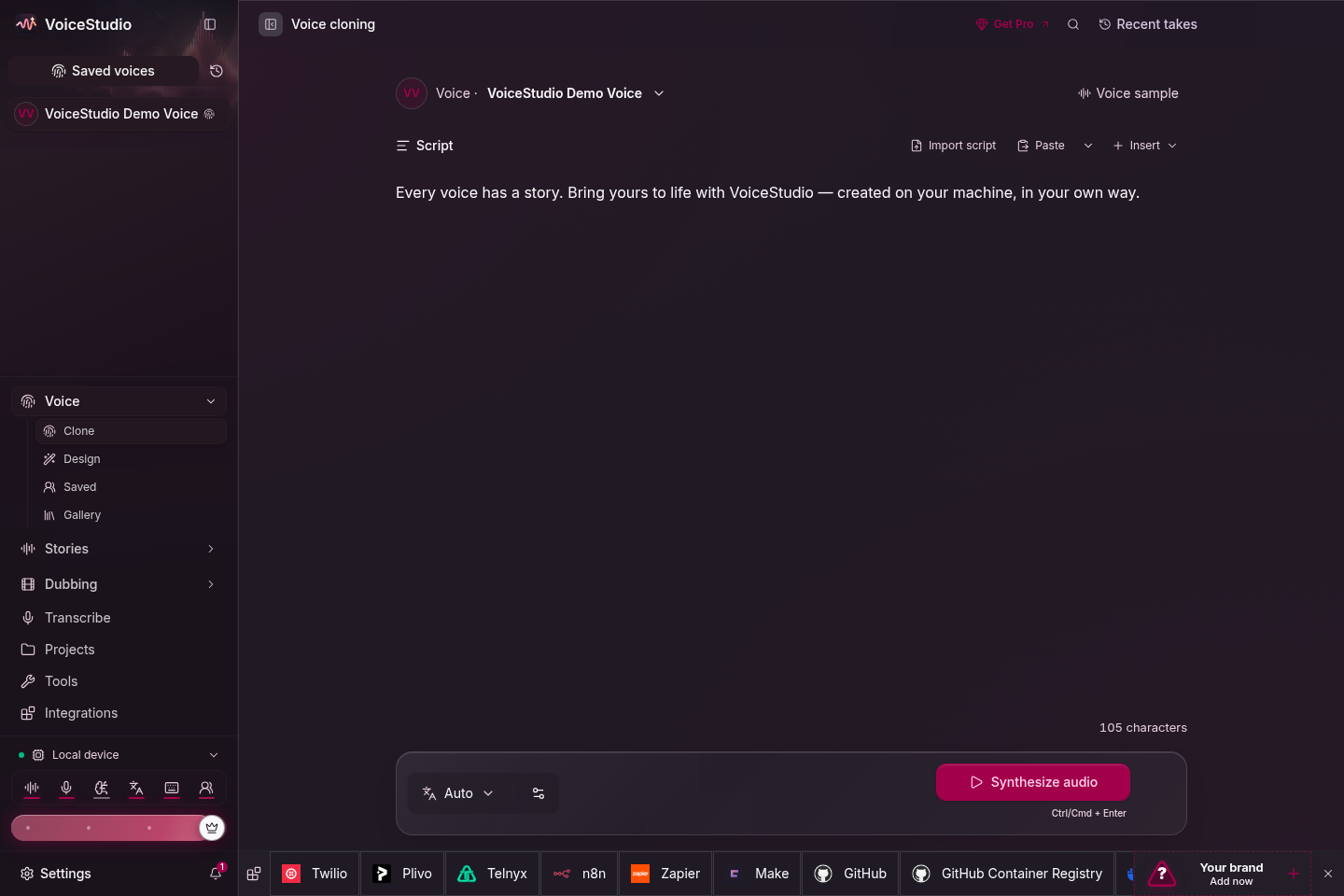
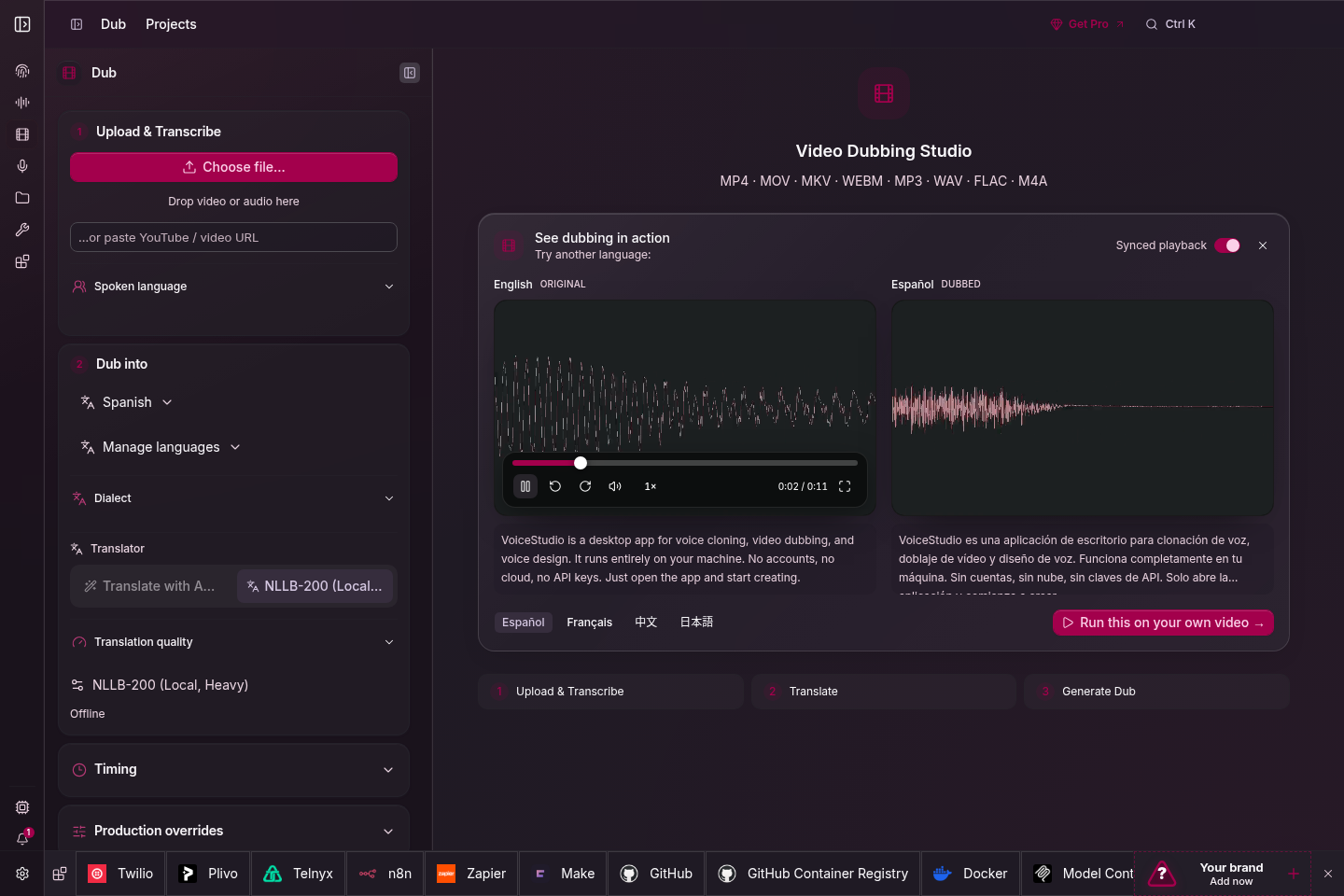
VoiceStudio v0.5.3 Release Notes:A new look. A new desktop app. Still your voices, on your machine. VoiceStudio moves to Electron with v0.5.3: a redesigned workspace for voice cloning, voice design, stories, dubbing, and transcription. Electron is now the primary desktop app on Windows, macOS, and Linux. Local voice creation still runs on your own hardware, without a required account or API key. !VoiceStudio's new Electron interface: voice cloning, saved voices, workspace navigation, and synthesis controls Highlights
Changed
Added
Fixed
CI
Contributors
Electron installer trustThese Electron installers are unsigned or ad-hoc signed and are not Apple-notarized. Windows/macOS may show trust warnings. macOS automatic updates are unverified; use manual installer updates. Tauri updater signatures remain independently verified. |
Install
Download packages from the latest release. First launch creates a managed Python environment and downloads the default model. Later launches reuse both.
Note
On macOS, first launch needs a one-time right-click → Open approval. Intel Macs cannot run the local Python backend; use a remote backend instead.
First voice
Launch VoiceStudio and open Voice Cloning.
Add a clean voice sample. Three seconds works; 5–15 seconds usually gives a better prompt.
Enter text, choose a language, then select Generate.
Run from source
Install the development prerequisites, then:
git clone https://github.com/debpalash/VoiceStudio.git
cd VoiceStudio
bun install
bun run desktop
Use bun run dev for the browser UI. See Contributing for services, tests, and platform packages.
If setup fails
Run Settings → About → Run self-check or
uv run python backend/main.py --diagnose --deep.Check install troubleshooting.
Save a scrubbed diagnostic bundle from the app when opening an issue.
For slow generation, compare measured benchmarks and performance settings.
Pros
Convenient text to speech generation
Useful for narration and content creation
Can reduce the need for manual voice recording
Voice customization options
Useful for accessibility
Potentially useful for consistent voice production
Cons
Voice quality can vary depending on the selected engine
AI voices may still sound less natural in some situations
Advanced features can require experimentation
Voice cloning requires responsible use and proper authorization
Final Verdict
VoiceStudio is a capable voice generation tool for anyone who needs to convert text into speech quickly and consistently. Its usefulness extends from simple accessibility applications to more creative projects such as video narration and digital content.
It is not a complete replacement for professional voice recording, but its convenience makes it a practical addition to an AI focused content creation workflow.
Developer:
VoiceStudio.sh
Operating System:
Windows / macOS / Linux
Date Added:
2026-09-17T14:03:53.915Z
Categories:
Post a Comment/Report Broken Link: