Plannotator is an open-source platform designed to review and validate plans and code generated by AI coding agents.
The platform provides a centralized interface where developers can:
Review AI-generated plans
Annotate proposed actions
Approve or reject tasks
Inspect code changes
Provide structured feedback
Improve agent outputs
Maintain human oversight
Rather than replacing developers, Plannotator aims to keep humans involved in critical decision-making during AI-assisted development.
As AI coding agents become increasingly capable, developers face a growing challenge: ensuring that AI-generated plans and code changes align with project requirements before they are executed. Plannotator addresses this problem by acting as a review layer between developers and AI coding agents.
Instead of generating code itself, Plannotator focuses on making AI-driven development more transparent and controllable. It allows teams to review, annotate, approve, reject, and refine agent-generated plans and code changes before they affect a project.
Download Plannotator v0.26.4 - Software Mirrors |
|---|
Plannotator v0.26.4 for Windowsplannotator-paste-win32-arm64.exe | 106.86 MB plannotator-paste-win32-x64.exe | 110.08 MB |
Plannotator v0.26.4 for macOSplannotator-darwin-arm64 | 111.09 MB plannotator-darwin-x64 | 115.5 MB |
Plannotator v0.26.4 for Linuxplannotator-linux-arm64 | 146.61 MB plannotator-linux-x64 | 147.14 MB |
Plannotator v0.26.4 Release Notes:Follow @plannotator on X for updatesMissed recent releases?
What's New in v0.26.4v0.26.4 is a same-day patch on v0.26.3: hovering a human-only skill in the new reference menu caused a constant jitter (the hover warning changed the menu's size, which moved the row out from under the pointer, which hid the warning, in a loop). The menu no longer labels human-only skills at all; since their instructions are injected into the feedback automatically, the distinction did not need surfacing at pick time. Every row now renders identically and hovering can no longer change the menu's geometry (#1236). The full v0.26.3 notes follow. This release adds skill references in comments, gives remote sessions a URL you can actually open from another device, and fixes two small UI annoyances. Nine PRs, including a first contribution from @ivgiuliani.Reference agent skills in your comments with / or $While writing a comment in plan review or annotate mode, type/ or $ and a menu of your installed agent skills appears: everything discovered under ~/.claude/skills, ~/.codex/skills, and ~/.agents/skills, including skills installed as symlinks. Arrow keys, Tab, Enter, or a click inserts the reference; a comment can carry several. Nothing is preselected, so a stray / or $ in ordinary typing never hijacks Enter, and prose like "a POST /agents endpoint" or "$5/mo" is never mistaken for a reference.
Referenced skills change what the agent receives. The exported feedback lists each one with an explicit instruction that you are asking the agent to invoke it. Skills marked disable-model-invocation: true cannot be invoked by the agent, so for those the feedback includes the skill's instructions directly, inside clearly fenced markers, labeled as included at your request. The menu shows a quiet badge on human-only skills so you know which treatment applies before you pick one.
The feature landed alongside its own hardening pass, driven by a pre-release QA sweep: a render loop triggered by human-only references was fixed, case-colliding skill names across roots resolve exactly, and the injection markers cannot be forged by a hostile skill body, even with invisible Unicode characters.
Remote sessions advertise a URL you can reachUntil now a remote session (SSH, devcontainer, Tailscale) printedhttp://localhost:19432, which is useless from the phone or laptop you actually want to review on. Set PLANNOTATOR_URL_HOST to a hostname or IP that resolves on your network (a Tailscale MagicDNS name, a tailnet IP) and every advertised session URL uses it.
The override is display-only and deliberately strict: it accepts a bare hostname, IPv4, or bracketed IPv6, and anything carrying a scheme, port, path, or credentials warns once and falls back to localhost. Binding is still governed by PLANNOTATOR_REMOTE, and local sessions ignore the override entirely (with a warning telling you why), so a tailnet-only name can never break same-machine workflows. It can also be set persistently via ~/.plannotator/config.json ({ "urlHost": "host" }).
Full branch names in the worktree switcherLong branch names in the review header's worktree switcher were truncated with no way to read the rest. Hovering an entry now shows the complete branch name as a tooltip.
Additional Changes
Install / UpdatemacOS / Linux:/plugin in Claude Code, find plannotator, and click "Update now".
OpenCode: Clear cache and restart:
opencode.json:
What's Changed
New Contributors
Community@ivgiuliani noticed truncated branch names in the worktree switcher and fixed it directly. First contribution, and a clean one. @centdix filed the original request for network-reachable session URLs (#657), and @maxim and @prvnsmpth added the deployment details (Tailscale setups, concrete environment variable shape) that the implementation followed. Full Changelog: https://github.com/backnotprop/plannotator/compare/v0.26.2...v0.26.4 |
Key Features of Plannotator
Plan Review System
One of Plannotator's core capabilities is reviewing plans generated by AI agents before execution.
Developers can examine:
Proposed tasks
Implementation strategies
Agent reasoning
Planned file modifications
Workflow sequences
This visibility helps reduce unintended changes and costly mistakes.
Annotation Tools
The platform allows users to add comments, notes, and guidance directly to AI-generated plans.
These annotations can be used to:
Clarify requirements
Correct misunderstandings
Provide context
Guide future agent actions
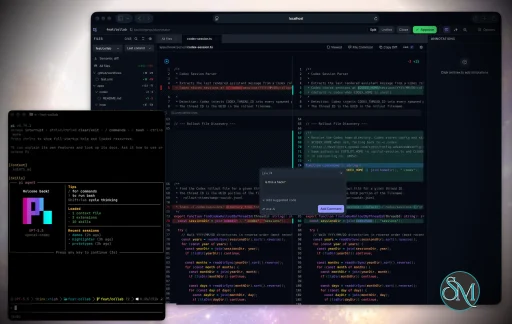
AI Code Review
Plannotator extends the review process beyond planning by supporting inspection of generated code.
Developers can:
Review modifications
Analyze diffs
Leave comments
Request revisions
Validate implementation details
This workflow resembles modern pull-request review systems.
Human-in-the-Loop Workflows
A major design goal is ensuring that AI actions remain subject to human approval.
Organizations can establish review processes where important actions require validation before execution.
Open Source Foundation
Plannotator is open source, allowing teams to inspect, modify, and self-host the platform according to their needs.
This transparency is particularly valuable for organizations adopting AI-assisted software development.
User Experience
The interface is designed around review workflows rather than direct code generation.
Instead of interacting with a chatbot, users primarily:
Receive agent-generated plans
Review proposed actions
Add feedback
Approve or reject changes
Monitor execution results
The workflow feels familiar to developers accustomed to pull requests, code reviews, and project planning tools.
Productivity Benefits
As AI coding tools become more autonomous, review processes become increasingly important.
Plannotator helps organizations:
Reduce risky AI actions
Improve code quality
Increase accountability
Preserve architectural consistency
Encourage collaboration between developers and AI agents
For teams adopting AI-driven development, these safeguards can be as valuable as the coding agents themselves.
Collaboration Features
The platform supports collaborative review workflows where multiple team members can participate in evaluating AI-generated outputs.
This allows:
Peer review
Team approval processes
Shared annotations
Collective decision-making
Such features are especially useful for larger engineering teams.
Performance
Because Plannotator focuses on workflow management and review rather than model inference, performance largely depends on the connected AI agents and integrations.
The platform itself is lightweight and primarily serves as an orchestration and review layer.
Open Source Advantages
Being open source provides several benefits:
Transparent development
Self-hosting capabilities
Custom integrations
Community contributions
Vendor independence
Organizations concerned about compliance, security, or proprietary workflows may find these advantages particularly appealing.
Limitations
Plannotator is designed as a companion tool rather than a complete AI development platform.
Common limitations include:
Requires external AI coding agents
Best suited for teams already using AI-assisted development
Smaller ecosystem than mature developer platforms
Additional review steps may slow rapid prototyping
Some users may prefer fully autonomous workflows
The software delivers the most value in environments where oversight and quality control are priorities.
Pros
Improves transparency of AI-generated plans
Supports structured review workflows
Human-in-the-loop design
Useful annotation system
Open source
Self-hosting support
Familiar review experience for developers
Helps reduce AI-generated mistakes
Cons
Not a standalone coding agent
Requires integration with AI development tools
Smaller community than established developer platforms
Adds review overhead to workflows
Best suited for teams rather than casual users
Who Should Use Plannotator?
Plannotator is ideal for:
Software development teams
Engineering managers
AI-assisted development workflows
Organizations adopting coding agents
Open-source projects
Teams prioritizing code quality and governance
It is particularly valuable for environments where AI-generated code requires oversight before reaching production systems.
Plannotator fills an increasingly important role in the AI development ecosystem by providing visibility and control over AI-generated plans and code changes. Its focus on human oversight, structured reviews, and collaborative workflows makes it a useful companion for modern coding agents. While it is not a replacement for AI coding tools themselves, it offers a practical solution for teams seeking greater confidence and accountability in AI-assisted software development.
Developer:
backnotprop
Operating System:
Windows / macOS / Linux
Date Added:
2026-08-07T23:02:06.757Z
Categories:
Post a Comment/Report Broken Link: