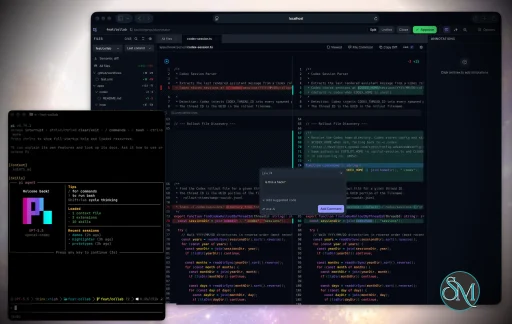
Plannotator is an open-source platform designed to review and validate plans and code generated by AI coding agents.
The platform provides a centralized interface where developers can:
Review AI-generated plans
Annotate proposed actions
Approve or reject tasks
Inspect code changes
Provide structured feedback
Improve agent outputs
Maintain human oversight
Rather than replacing developers, Plannotator aims to keep humans involved in critical decision-making during AI-assisted development.
As AI coding agents become increasingly capable, developers face a growing challenge: ensuring that AI-generated plans and code changes align with project requirements before they are executed. Plannotator addresses this problem by acting as a review layer between developers and AI coding agents.
Instead of generating code itself, Plannotator focuses on making AI-driven development more transparent and controllable. It allows teams to review, annotate, approve, reject, and refine agent-generated plans and code changes before they affect a project.
Download Plannotator v0.25.1 - Software Mirrors |
|---|
Plannotator v0.25.1 for Windowsplannotator-paste-win32-arm64.exe | 106.86 MB plannotator-paste-win32-x64.exe | 110.08 MB plannotator-win32-arm64.exe | 160.69 MB plannotator-win32-x64.exe | 163.91 MB |
Plannotator v0.25.1 for macOSplannotator-darwin-arm64 | 112.49 MB plannotator-darwin-x64 | 116.89 MB plannotator-paste-darwin-arm64 | 58.24 MB plannotator-paste-darwin-x64 | 63.07 MB |
Plannotator v0.25.1 for Linuxplannotator-linux-arm64 | 148 MB plannotator-linux-x64 | 148.53 MB plannotator-paste-linux-arm64 | 94.17 MB plannotator-paste-linux-x64 | 94.7 MB |
Plannotator v0.25.1 Release Notes: Follow @plannotator on X for updates
Missed recent releases?
- v0.25.0: Vim keyboard controls, Approve with Notes, scriptable annotate gates, persistent Guided Reviews, memory and file-watching hardening
- v0.24.2: Annotate YAML/JSON/TOML config files, XDG data directory support, Codex model catalog update, Cursor sandbox escape hatch
- v0.24.1: Annotate accepts parent-relative
../ file paths
- v0.24.0: PR/MR artifact gallery, GitButler review support, port ranges, expanded comment editor, OpenCode + Pi fixes
- v0.23.1: Startup no longer hangs on large or slow directory trees, Ask AI input stays visible after long responses
- v0.23.0: Plan approval fix for Claude Code 2.1.199+, annotate mode version diff, binary-only
--minimal install, reviews post without attribution
- v0.22.0: Git-status "All changes" default review view, Commits panel with per-commit diffs, Guided Review, Pi + GitHub Copilot CLI review engines
- v0.21.4: Markdown math rendering, PR Overview panel with annotatable description and comments, agent instructions in code review, media parsing fixes
- v0.21.3: File comments in code review, unified click-to-highlight comments, VS Code clipboard/keyboard bridge, Codex Ask AI on app-server transport, CLI subcommand help
- v0.21.2: Custom reviews as Agent Skills, Cursor + OpenCode review engines, whole-file/general findings, deleted-annotation fix, Codex Ask AI outside git repos
- v0.21.1: Annotate-last blank-page fix on multi-message sessions
What's New in v0.25.1
Eight pull requests landed since v0.25.0, six of them from community members, and four authors made their first contribution. The release stops code review from launching Codex when you never asked for it, teaches plannotator last which conversation you are actually in, adds Claude Opus 5 to the model pickers, and mirrors approved plan checklists into editable pi-todos. Two fixes came out of pre-release QA rather than a report.
Opening a review no longer launches Codex
Constructing the AI runtime ran Codex model discovery immediately, which meant that simply opening a code review spawned a codex app-server process. Users who had Codex installed but never intended to use it got a stray process, and on macOS the launch could raise a Gatekeeper prompt in front of a review they were trying to read.
Discovery is now deferred until a Codex session actually starts, or until you explicitly select Codex in the provider picker. Selecting Codex activates it and refreshes the model list on that gesture, so the real catalog and per-model reasoning-effort options still appear before you pick anything. Saved model preferences are left alone rather than being overwritten by a placeholder.
plannotator last follows the live conversation
Two separate bugs made plannotator last annotate the wrong message.
In Claude Code, /rewind does not remove anything from the session transcript. It re-parents the next message to an earlier point and leaves everything after that orphaned in the file forever. Reading the file bottom-up therefore offered messages that were no longer part of the conversation. The message picker now walks the conversation tree from the newest entry back to the root, so rewound branches stay out. On a linear session the result is identical to before, and a transcript whose structure cannot be trusted falls back to the previous behavior rather than returning nothing.
In GitHub Copilot CLI, plannotator last picked a session by file order and would silently annotate a stale transcript instead of the live one. Copilot CLI exposes no environment fingerprint, so the fix walks the process ancestry and matches it against Copilot's own session lock files, which identifies the live session deterministically even with several sessions open in the same directory.
- Transcript tree walk by @BrandonNoad in #1141
- Copilot session routing by @mararn1618 in #1150, closing #1149
Approved plan checklists mirror into pi-todos
Under Pi, an approved plan's checklist lived only in the plan and the progress widget. If you also use pi-todos, your todos and your plan were two separate lists.
On plan approval, Plannotator now detects pi-todos and mirrors the approved checklist into it, closing each todo as the agent completes the corresponding step. Sync is one-way, so reordering or rewording a todo can never desync plan execution. The mirror is additive: the existing progress widget stays exactly as it was, because pi-todos renders its list on demand rather than continuously, and replacing a live display with files behind a keystroke would be a downgrade. It is inert when no provider is present, and PLANNOTATOR_TODO_PROVIDER=off turns it off entirely.
- Authored by @jms830 in #1139, implementing the one-way half of #484
Abandoned annotate gates stop waiting forever
A structured annotate gate (--gate --json) blocks until the reviewer decides. If every review surface was closed without a decision, nothing ever settled and the calling script waited indefinitely.
Each open review surface now holds a lease over a heartbeat stream. Once at least one client has connected, closing the last one starts a 30-second reconnect window; reconnecting inside that window continues the same review, and expiry resolves the gate as the same dismissed decision an explicit Close produces. The saved annotation draft is deliberately kept, so an abandoned review can still be recovered. Page lifecycle events are not used for this, because reload and navigation fire the same events as abandonment and cannot be told apart. A session that never receives a client never auto-dismisses, so browser-launch failures still need a timeout on the caller's side, and remote sessions keep the behavior off because a tunnel disconnect would read as an abandoned review.
Claude Opus 5
Claude Opus 5 is available in the Ask AI model picker and in the review-agent model list that Review Agents, Code Tour, and Guided Review launch from. Launched review jobs now default to Opus 5 instead of Opus 4.7. Existing saved model preferences are untouched: this changes the default for anyone who has not chosen a model.
- Authored by @backnotprop in #1151
Approving with notes now reaches Amp and Droid
Approve with Notes shipped in v0.25.0, but the Amp and Droid adapters dropped the feedback field on approved decisions. Approving with annotations sent a bare "Approved." and the notes were lost. Both adapters now surface the notes, using the same wording the other runtimes already emit.
Additional Changes
- Reopening search selects the existing query. Pressing
Cmd/Ctrl+F in code review with text already in the search box now focuses the input and selects its contents, so typing replaces the old query instead of appending to it. Matches how browser find behaves. By @omederos in #1152
- Pi no longer crashes after plan approval in headless sessions. Pi 0.69 and later invalidate an extension's session context on teardown, and every call on a stale context throws. The post-approval continuation timer polled that context, so a session ending underneath it (headless plan runs, or
/new immediately after approving) killed the whole Pi process. The continuation now cancels instead, and the fire-and-forget browser open no longer crashes Pi through an unhandled rejection when a launcher fails. Closing #1140
- The pi-todos mirror stays inside the project. Found in pre-release QA: a repository shipping
.pi/todos as a symlink pointing elsewhere had the plan checklist written to the symlink target. The implicit /.pi/todos path must now resolve inside the project or the provider reads as absent. An explicitly configured PI_TODO_PATH is still honored anywhere, since that is the user's own choice.
- The abandoned-gate fix now covers OpenCode. Also found in pre-release QA: three of the four places that start an annotate server were wired for lease-based dismissal, and OpenCode's
/plannotator-last bridge was missed, so it still hung on abandonment. It is wired now, with a test that checks every call site so the next one cannot be missed the same way.
Install / Update
macOS / Linux:
bash
curl -fsSL https://plannotator.ai/install.sh | bash
Windows:
powershell
irm https://plannotator.ai/install.ps1 | iex
Claude Code Plugin: Run /plugin in Claude Code, find plannotator, and click "Update now".
OpenCode: Clear cache and restart:
bash
rm -rf ~/.bun/install/cache/@plannotator
Then in opencode.json:
json
{
  "plugin": ["@plannotator/opencode@latest"]
}
Pi: Install or update the extension:
bash
pi install npm:@plannotator/pi-extension
What's Changed
- feat(pi): mirror plan checklist to pi-todos by @jms830 in #1139
- feat(ai): add Claude Opus 5 across providers and review agents by @backnotprop in #1151
- fix(hook): read annotate-last from Claude Code's transcript tree, not file order by @BrandonNoad in #1141
- fix(amp,droid): surface Approve-with-Notes feedback instead of dropping it by @Souptik96 in #1146
- fix(hook): route annotate-last to the live Copilot CLI session by @mararn1618 in #1150
- feat(annotate): dismiss abandoned gate sessions by @rNoz in #1143
- fix(ui): focus and select existing review search text by @omederos in #1152
- fix(ai): defer Codex model discovery until a Codex session starts by @rNoz in #1145
New Contributors
- @jms830 made their first contribution in #1139
- @Souptik96 made their first contribution in #1146
- @mararn1618 made their first contribution in #1150
- @omederos made their first contribution in #1152
Contributors
@rNoz filed and fixed both of this release's runtime problems on the Pi and Codex side. #1144 identified that Codex discovery ran during AI runtime construction, which is what made opening any review launch Codex, and #1142 identified that structured annotate gates never settled once every client disconnected. Both PRs arrived tested, and the lease design in #1143 is careful work: it infers presence from a connection rather than from page lifecycle events, which is what makes reload and navigation distinguishable from abandonment.
@BrandonNoad diagnosed the /rewind behavior in Claude Code transcripts, wrote it up clearly enough that the fix was easy to reason about, and helped settle the compaction edge case during review.
@mararn1618 reported the Copilot CLI staleness in #1149 and had the fix open within the day, including the lock-file approach that makes live-session detection deterministic rather than a guess.
@jms830 implemented the pi-todos mirror as a first contribution, including a TodoProvider interface that leaves room for other providers, and traced pi-todos and oh-my-pi carefully enough to argue for an additive mirror instead of replacing the progress widget. The reasoning was recorded in the code rather than lost in the thread.
@Souptik96 fixed the Amp and Droid approve-with-notes gap, matching the wording the other runtimes already use rather than inventing a new shape for those two adapters.
@omederos fixed the review search field so reopening it selects the existing query, which is how browser find has always worked.
@JayGhiya asked for pi-todos interoperability in #484 and described why it mattered: todos in pi-todos are editable, which makes them good for steering. That request is what #1139 implements.
Full Changelog: https://github.com/backnotprop/plannotator/compare/v0.25.0...v0.25.1
|
Key Features of Plannotator
Plan Review System
One of Plannotator's core capabilities is reviewing plans generated by AI agents before execution.
Developers can examine:
This visibility helps reduce unintended changes and costly mistakes.
Annotation Tools
The platform allows users to add comments, notes, and guidance directly to AI-generated plans.
These annotations can be used to:
AI Code Review
Plannotator extends the review process beyond planning by supporting inspection of generated code.
Developers can:
This workflow resembles modern pull-request review systems.
Human-in-the-Loop Workflows
A major design goal is ensuring that AI actions remain subject to human approval.
Organizations can establish review processes where important actions require validation before execution.
Open Source Foundation
Plannotator is open source, allowing teams to inspect, modify, and self-host the platform according to their needs.
This transparency is particularly valuable for organizations adopting AI-assisted software development.
User Experience
The interface is designed around review workflows rather than direct code generation.
Instead of interacting with a chatbot, users primarily:
Receive agent-generated plans
Review proposed actions
Add feedback
Approve or reject changes
Monitor execution results
The workflow feels familiar to developers accustomed to pull requests, code reviews, and project planning tools.
Productivity Benefits
As AI coding tools become more autonomous, review processes become increasingly important.
Plannotator helps organizations:
For teams adopting AI-driven development, these safeguards can be as valuable as the coding agents themselves.
Collaboration Features
The platform supports collaborative review workflows where multiple team members can participate in evaluating AI-generated outputs.
This allows:
Such features are especially useful for larger engineering teams.
Performance
Because Plannotator focuses on workflow management and review rather than model inference, performance largely depends on the connected AI agents and integrations.
The platform itself is lightweight and primarily serves as an orchestration and review layer.
Open Source Advantages
Being open source provides several benefits:
Organizations concerned about compliance, security, or proprietary workflows may find these advantages particularly appealing.
Limitations
Plannotator is designed as a companion tool rather than a complete AI development platform.
Common limitations include:
Requires external AI coding agents
Best suited for teams already using AI-assisted development
Smaller ecosystem than mature developer platforms
Additional review steps may slow rapid prototyping
Some users may prefer fully autonomous workflows
The software delivers the most value in environments where oversight and quality control are priorities.
Pros
Improves transparency of AI-generated plans
Supports structured review workflows
Human-in-the-loop design
Useful annotation system
Open source
Self-hosting support
Familiar review experience for developers
Helps reduce AI-generated mistakes
Cons
Not a standalone coding agent
Requires integration with AI development tools
Smaller community than established developer platforms
Adds review overhead to workflows
Best suited for teams rather than casual users
Who Should Use Plannotator?
Plannotator is ideal for:
Software development teams
Engineering managers
AI-assisted development workflows
Organizations adopting coding agents
Open-source projects
Teams prioritizing code quality and governance
It is particularly valuable for environments where AI-generated code requires oversight before reaching production systems.
Plannotator fills an increasingly important role in the AI development ecosystem by providing visibility and control over AI-generated plans and code changes. Its focus on human oversight, structured reviews, and collaborative workflows makes it a useful companion for modern coding agents. While it is not a replacement for AI coding tools themselves, it offers a practical solution for teams seeking greater confidence and accountability in AI-assisted software development.
Post a Comment/Report Broken Link: