DeepSeek TUI v0.8.67

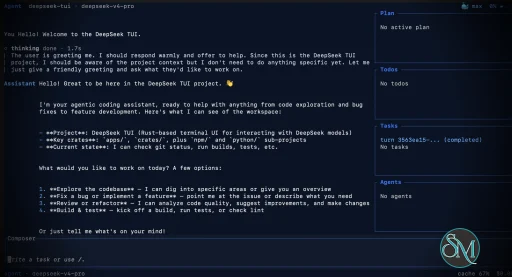
DeepSeek TUI is an open source terminal based coding agent designed for DeepSeek AI models. Unlike a simple chatbot, it can interact with your local workspace, execute shell commands, manage git operations, and assist with software development tasks directly from the command line.

The project is written in Rust and focuses on speed, low resource usage, and keyboard driven workflows. It is especially appealing for developers who spend most of their time in the terminal.

DeepSeek TUI is gaining attention among developers who prefer terminal based workflows and want direct access to AI powered coding tools without relying on heavy IDE integrations. Built around DeepSeek models, it transforms the terminal into an interactive coding assistant capable of editing files, running commands, and managing development workflows.

Download DeepSeek TUI v0.8.67 - Software Mirrors

Download DeepSeek TUI v0.8.67 Windows 64bit
codew-windows-x64.exe | 214.5 kB

Download DeepSeek TUI v0.8.67 Windows 64bit
codewhale-tui-windows-x64.exe | 48.06 MB

Download DeepSeek TUI v0.8.67 Windows 64bit
codewhale-windows-x64-portable.zip | 22.02 MB

Download DeepSeek TUI v0.8.67 Windows 64bit
codewhale-windows-x64.exe | 11.82 MB

Download DeepSeek TUI v0.8.67 Windows 64bit
codewhale-windows-x64.zip | 22.02 MB

Download DeepSeek TUI v0.8.67 macOS arm64
codew-macos-arm64 | 329.75 kB

Download DeepSeek TUI v0.8.67 macOS arm64
codewhale-macos-arm64 | 8.57 MB

Download DeepSeek TUI v0.8.67 macOS arm64
codewhale-macos-arm64.tar.gz | 19.2 MB

Download DeepSeek TUI v0.8.67 macOS arm64
codewhale-tui-macos-arm64 | 32.55 MB

Download DeepSeek TUI v0.8.67 macOS x64
codew-macos-x64 | 331.35 kB

Download DeepSeek TUI v0.8.67 macOS x64
codewhale-macos-x64 | 9.46 MB

Download DeepSeek TUI v0.8.67 macOS x64
codewhale-macos-x64.tar.gz | 20.73 MB

Download DeepSeek TUI v0.8.67 macOS x64
codewhale-tui-macos-x64 | 36.23 MB

Download DeepSeek TUI v0.8.67 macOS arm64
codew-macos-arm64 | 329.75 kB

Download DeepSeek TUI v0.8.67 macOS arm64
codewhale-macos-arm64 | 8.57 MB

Download DeepSeek TUI v0.8.67 macOS arm64
codewhale-macos-arm64.tar.gz | 19.2 MB

Download DeepSeek TUI v0.8.67 macOS arm64
codewhale-tui-macos-arm64 | 32.55 MB

Download DeepSeek TUI v0.8.67 Linux x64
codew-linux-x64 | 444.55 kB

Download DeepSeek TUI v0.8.67 Linux x64
codewhale-linux-x64 | 10.41 MB

Download DeepSeek TUI v0.8.67 Linux x64
codewhale-linux-x64.tar.gz | 21.69 MB

Download DeepSeek TUI v0.8.67 Linux x64
codewhale-tui-linux-x64 | 39.68 MB

Download DeepSeek TUI v0.8.67 Linux arm64
codew-linux-arm64 | 324.6 kB

Download DeepSeek TUI v0.8.67 Linux arm64
codewhale-linux-arm64 | 9.46 MB

Download DeepSeek TUI v0.8.67 Linux arm64
codewhale-linux-arm64.tar.gz | 20.4 MB

Download DeepSeek TUI v0.8.67 Linux arm64
codewhale-tui-linux-arm64 | 34.42 MB

DeepSeek TUI v0.8.67 Release Notes:

CodeWhale is the canonical project, command, npm package, and
release-asset name. The legacy npm package deepseek-tui is
deprecated and receives no further releases. Users coming from
v0.8.x legacy deepseek / deepseek-tui names should migrate
with docs/REBRAND.md.

Install

Recommended — npm (one command, both binaries)

bash
npm install -g codewhale
The wrapper downloads the matched runtime binaries from this Release and places them in the same directory.

Docker / GHCR

bash
docker run --rm -it \
  -e DEEPSEEK_API_KEY="$DEEPSEEK_API_KEY" \
  -v ~/.deepseek:/home/codewhale/.deepseek \
  ghcr.io/hmbown/codewhale:v0.8.67
The image ships the codewhale dispatcher, codew shim, and codewhale-tui runtime. The latest tag is also updated on release.

Cargo (Linux / macOS)

bash
cargo install codewhale-cli codewhale-tui --locked
Both crates are required — codewhale-cli produces the codewhale dispatcher and codew shim, while codewhale-tui produces the interactive runtime that the dispatcher delegates to. Installing only one crate will fail at runtime with a MISSING_COMPANION_BINARY error.

Manual download — platform archives (recommended)

Each archive below contains the codewhale dispatcher, codew shim, and codewhale-tui runtime, plus an install script:
  • Linux x64: codewhale-linux-x64.tar.gz | install.sh
  • Linux ARM64: codewhale-linux-arm64.tar.gz | install.sh
  • macOS x64: codewhale-macos-x64.tar.gz | install.sh
  • macOS ARM: codewhale-macos-arm64.tar.gz | install.sh
  • Windows x64 (installer): CodeWhaleSetup.exe | NSIS setup
  • Windows x64: codewhale-windows-x64.zip | install.bat
  • Windows x64 (portable): codewhale-windows-x64-portable.zip | —
Unix (Linux / macOS):
bash
tar xzf codewhale-.tar.gz
cd codewhale-
./install.sh
Windows:
  • For the installer path, run CodeWhaleSetup.exe; it installs codewhale.exe, codew.exe, and codewhale-tui.exe under %LOCALAPPDATA%\Programs\CodeWhale\bin and adds that directory to the current-user PATH.
  • Extract codewhale-windows-x64.zip
  • Run install.bat (copies to %USERPROFILE%\bin)
  • Add %USERPROFILE%\bin to your PATH
The portable Windows archive skips the install script — extract and run from any directory. The NSIS installer is currently unsigned and may trigger Windows SmartScreen until a signing certificate is wired into the release pipeline. Each platform also has bare, unarchived binaries attached below (codewhale-, codew-, and codewhale-tui-) — the npm wrapper and the in-app codewhale update download the matched runtime binaries, whereas the .tar.gz / .zip archives above are the recommended manual download and additionally bundle an install script. The legacy npm package deepseek-tui is deprecated and is not republished. For migration from v0.8.x legacy binary names, see docs/REBRAND.md.

Verify (recommended)

Download the checksum manifests from this Release and verify:
bash

Linux — archive bundles

sha256sum -c codewhale-bundles-sha256.txt

Linux — individual binaries

sha256sum -c codewhale-artifacts-sha256.txt

macOS

shasum -a 256 -c codewhale-bundles-sha256.txt shasum -a 256 -c codewhale-artifacts-sha256.txt

What's in v0.8.67

Added

  • The model you select in /model is now the operator: fleet workers whose
task spec and roster profile pin no model inherit the active session route instead of a hardcoded auto sentinel, matching the pinned operator row in /fleet roster. Task-level and profile model overrides still win, and route receipts record which source applied (task.model, agent_profile.model, or run.model).
  • Added the /workflow command (aliases /workflows, /wf) as the user
opt-in to workflow orchestration. Bare /workflow orchestrates the current work — the model synthesizes the objective from the conversation context; /workflow narrows the run; /workflow status [run_id] and /workflow cancel relay typed run receipts without starting new runs.
  • Bare /goal with no active goal now declares a goal from the conversation
context via create_goal instead of printing usage; with an active goal it remains the status readout, and explicit /goal is unchanged.
  • Added the constitution-first setup wizard: a unified /setup shell with
resume, back navigation, and skip-retry state; provider/model readiness cards with a custom-provider form and provider-picker detail layout; a runtime posture card with preset application and project-override warnings; a setup verification report; and transactional setup persistence with secret redaction and rollback (#3402, #3403, #3404, #3405, #3406, #3410, #3411).
  • Added a structured user-global constitution with a deterministic renderer,
prompt-block injection, guided principle authoring with preview and preset save, and a /constitution manager command as the primary constitution management surface, with file state shown in setup and actions surfaced in diagnostics (#3793, #3806, #3811).
  • Added model-assisted constitution and fleet-profile drafting behind an
explicit ratify gate, with untrusted-draft provenance recorded so model-authored text is never applied silently. Updating users keep their existing constitution unchanged, and a localized constitution checkpoint is required after update (#3794).
  • Added the Hotbar route editor v1 with route-switch slot actions and support
for custom model routes, plus a configured-provider route manager for /provider and /model with a missing-auth handoff into provider key entry (#2066, #3830, #3831).
  • Added auto-discovery of .codewhale/rules/ and .claude/rules/
directories as project context, with a total byte-budget cap on the assembled rules block. Contributed by maple (@yekern).
  • Exposed context_input_budget_for_route from the engine so external
integrations can reuse route budget math. Contributed by hexin (@h3c-hexin).
  • Added GUI config persistence to the runtime API. Contributed by @gaord.
  • Added a website localization matrix with a locale registry and drift
checks. Harvested from #3763 by @idling11 (#3090).
  • Added doctor detection of half-applied setup state, and startup milestone
tracing for boot-performance diagnosis.
  • Added a v0.8.67 computer-use dogfood prompt that covers the Cursor-terminal
QA flow, headless gates, setup, sub-agent completion, Fleet, Workflow, model pricing, and release evidence collection.
  • Fleet: local worker memory usage is now reported, including retained memory
while a task is in Running status. Contributed by @cyq1017 (#3901).
  • Website: community hub, constitution thesis page and constitution-centered
homepage, models page generated from the provider registry, docs dark mode and full SEO metadata/sitemap coverage, terminal player for real constitution traces, and a live star badge and version.
  • Added Meituan LongCat as a first-class OpenAI-compatible provider
(longcat, with long-cat, meituan-longcat, and meituan aliases), LONGCAT_API_KEY discovery, the LongCat-2.0 default model, provider picker wiring, model completions, provider docs, and web provider facts.
  • Fleet: added per-provider setup cards (Persistence, Constitution, Hotbar,
Tools/MCP, Remote Runtime) with a unified setup catalog and provider-specific credential links. Provider setup progress is persisted transactionally with rollback guards, Codex OAuth is kept out of provider key storage, and a headless QA contract verifies setup readiness across providers.
  • Fleet: added Fleet starter profiles with role-aware loadouts (scout→Fast,
manager→Inherit, etc.), /fleet setup profile-authoring wizard, Fleet effective-permission recording, and route intent-source tracking.
  • Fleet: added 'operator' as a built-in Fleet roster member — the preferred
helm Fleet slot for workflow coordination. Operator plans, routes, reviews outputs, and calls other Fleet slots as needed. This is a roster role, not a separate app mode. The full Operation/Operate-mode architecture is deferred to 0.9.0.
  • Workflow: declarative workflows now run through the production driver, the
workflow tool is wired to sub-agent dispatch, public Workflow surfaces are renamed, and typed workflow-run and status receipts are emitted for debugging and verification.
  • Added provider-agnostic Fleet rosters and loadouts: provider-specific
subagent limits, launch concurrency, and admission caps are derived from config without hardcoding any single provider.
  • Added Workflow runtime foundations: the internal JS authoring/runtime crates
compile and replay example workflows. 0.8.67 ships the /workflow opt-in, production-driver dispatch path, sub-agent task handoff, and typed run/status receipts; richer authoring UX and the full TUI run view remain tracked for v0.8.68 (#2974, #4038).

Changed

  • Clarified the Fleet coordination hierarchy and made roles carry real
doctrine: the operator (the session's /model selection) runs the operation and assigns managers to workflows; a manager is the middle manager of exactly one workflow. The built-in reviewer is now explicitly adversarial (assume the change is broken, try to refute it), and the review sub-agent intro adopts the same framing. Built-in manager/operator/ reviewer roster members now ship role instructions that flow into worker prompts on both the Fleet task-spec and agent/workflow profile: spawn paths; custom profiles override them via the same instructions field.
  • Removed the decorative Fleet vocabulary that never routed differently:
the tool-heavy slot and the strong/balanced/deep-reasoning/code/ review/tool-heavy loadout tiers. inherit (the operator's route) and fast (the provider's faster class) remain; retired names in existing configs keep parsing (as custom labels) with identical auto routing, and the /fleet setup model-class step now offers only the real choices.
  • Raised the default subagent concurrency for high-throughput fanout:
max_subagents default 20 → 64 (config ceiling 128) and the queued+running admission cap 200 → 1024. Users on metered plans who want the old behavior can set max_subagents = 20 in config.toml.
  • Renamed the internal whaleflow subsystem to workflow across the
workspace: the codewhale-whaleflow/codewhale-whaleflow-js crates become codewhale-workflow/codewhale-workflow-js, Rust identifiers and JS bridge symbols are renamed, the CODEWHALE_WHALEFLOW_JS_* environment variables become CODEWHALE_WORKFLOW_JS_*, and the authoring/RFC docs move to WORKFLOW_AUTHORING.md and WORKFLOW_EXTERNAL_MEMORY.md. Historical changelog and retro-ledger entries keep the old name as a record.
  • Documented the Homebrew rollout strategy and added a distribution-channel
check to the release checklist. Harvested from #3760 by @idling11 (#3489).
  • Paused Linux RISC-V prebuilt release and nightly artifacts because
rquickjs-sys 0.12.0 does not ship riscv64gc-unknown-linux-gnu bindings; installers, docs, and update paths now treat RISC-V as unsupported until upstream bindings or a bindgen-enabled build lands.
  • Made the approval prompt calm, compact, and honest, and centered the
first-run follow-up on the constitution; first-run onboarding now hands off into the setup wizard, and the language picker offers every shipped locale (#3929).
  • Startup performance: boot janitors and store scans no longer block the
first frame, @mention completion no longer re-walks the workspace per keystroke, and idle offline-queue clones and duplicate tool-output hashing were eliminated.
  • Clarified the misleading "Ctrl+B backgrounds this command" shell wording
(#3859) and the hotbar help shortcuts. Docs contribution by Chanhyo Jung (@roian6).
  • Documented the enforced repo-law invariants, the constitution flow, and the
/fleet setup profile-authoring wizard; aligned permissions.toml action docs. Docs contribution by @greyfreedom.
  • Bumped web dependencies: wrangler 4.103.0 → 4.107.0, mermaid 11.15.0 →
11.16.0, vitest 4.1.8 → 4.1.9 (@dependabot).
  • Backfilled v0.8.67 regression coverage across sub-agent completion, budget
exhaustion, delegate ordering, provider onboarding, setup scroll, model catalog pricing, Fleet routing, and Workflow gates (#4076).
  • Split the large TUI debug command group and palette/theme internals into
smaller modules without changing user-visible behavior (#4078, #4081).

Fixed

  • Fixed the goal sidebar elapsed timer so completed and blocked goals freeze
their "completed in {elapsed}" readout instead of ticking forever. Goal state now records a finished_at instant that both sidebar render paths and the engine snapshot clamp elapsed against; /goal resume clears the freeze and the timer ticks again.
  • Fixed paused goals silently un-freezing their sidebar timer: usage keeps
accruing while paused, and the next goal snapshot used to clear the frozen instant. Paused goals now stay frozen until an explicit resume.
  • Fixed durable /goal progress accounting so usage and continuation updates
release the shared SQLite connection before re-reading the updated goal, unblocking resumed goal loops and full workspace release tests.
  • Fixed a scheduled-automation race where deleting an automation while its
run was being enqueued left the already-created task running untracked; the run record is now persisted unconditionally.
  • Removed panic = "abort" from the release profile: it disabled unwinding
and broke the panic supervision that keeps one failing tool call from taking down the whole session. The lto/strip/codegen-units size and speed tuning is unchanged.
  • Fixed session save/load to persist and restore the active model provider
across restarts. Previously sessions created under one provider (e.g. DeepSeek) would silently load under a different active provider. Provider, subagent limits, fallback chain, context window, and reasoning effort are now restored from saved session metadata, with "deepseek" as the default for legacy sessions.
  • Raised the streamed model-response idle timeout and matched the TUI stall
watchdog to the configured stream budget so long reasoning pauses are not recovered as stalled turns (#2487, #3998).
  • Fixed Codex OAuth/sub-agent release diagnostics so auth list reports an
active Codex OAuth file, Responses API child requests encode inherited tool names safely, rate-limited child requests checkpoint as resumable provider interruptions, and failure records surface the real Responses API error (#3884).
  • Fixed fresh launch/setup testing with an explicit CODEWHALE_HOME so
config, settings, theme prefs, and doctor legacy-state diagnostics do not inherit unrelated ambient ~/.deepseek files (#4001, #4002).
  • Sub-agent state now persists to .codewhale/ instead of the lingering
pre-rebrand .deepseek/ path (#3864). Contributed by Stime (@yekern).
  • /plugin enable|disable now persists across restarts (#3918), and the
plugin command is hidden from the root slash menu and kept canonical after the scanner merge. Contributed by Nightt (@nightt5879).
  • /config ask-rules now shows ask rule actions with improved diagnostics,
with file-rule action precedence under test. Contributed by @greyfreedom.
  • Fleet/sub-agents: enforced an absolute recursion-depth ceiling and widened
task-id entropy, gave each atomic state write a unique temp path, kept sub-agent tool catalogs in parent parity (#3836), and made the Agents sidebar reconcile sub-agent completion and cancellation live (#3837).
  • Fixed apply_patch mangling newlines, defaulted fuzz to 3, and made writes
atomic; fixed compaction to preserve pins on emergency compaction, harden the summary fallback, and count image tokens; corrected backtrack boundary, checkpoint clear ordering, prune guard, and durable rename.
  • Fixed the SSE client to flush the final frame, join multi-line data fields,
and stop corrupting multibyte UTF-8 split across network reads.
  • Kept review-only turns read-only, aliased auto mode to the agent policy,
showed the mode-derived safety policy in status (contributed by @cyq1017), and stopped the durable-review floor from holding routine YOLO work (#3883).
  • Fixed self-update to prefer exact binary release assets. Contributed by
@LI-Jialu.
  • UI polish: stopped constitution and fleet-profile model drafts from
freezing the event loop, scoped the context-menu backdrop to the popup rect, stacked model-picker panes on narrow modals, unified display-width helpers on one contract (#3924), removed misleading success toasts, issue-number leaks, and dead-end empty states, and repaired the onboarding trust and api-key keys.
  • Fixed the onboarding Trust step so plain Enter no longer silently grants
workspace trust; users must choose the explicit trust or exit keys.
  • Fixed same-root skill-name collisions being silently shadowed; duplicate
normalized skill names now warn while keeping discovery deterministic (#3919).
  • Normalized discovered skill names, removed unenforced trust copy, and
surfaced the gated constitution override in prompts.
  • Fixed a parallel subagent:: suite flake where one test's process-wide
Retry-After pause could strand unrelated budget-capped workers for the full stale window; requests now re-poll the global pause in bounded slices and the rate-limit test clears the window on drop.
  • Sub-agent and Fleet reliability now fail empty, step-limited, and
budget-exhausted children with explicit diagnostics instead of silent Completed (no output) success; budget exhaustion preserves partial output, worktree: true discovers one-level nested repos from harness directories, and completion-before-start delegate events recover into named rows instead of ellipsis-only identities (#4050, #4051, #4052, #4053).
  • Goal-mode writing and research tasks can complete with
verification.status = "not_applicable" without triggering continuation loops (#4054).
  • First-run onboarding routes API keys through the selected provider, setup
wizard bodies scroll with PageUp/PageDown, shipped locale packs are back to en.json parity with zh-Hant explicitly partial, stable feature flags stay out of Experimental, and model/provider rows include current LongCat and sourced-pricing hints (#4056, #4057, #4058, #4062, #4063).
  • Running tool rows animate while a lone foreground tool is active, and
workflow receipts render run/status/failure cards instead of one-line or null-success output (#4059).
  • Model-facing turn metadata now includes a compact git workspace snapshot and
escalates context pressure at the same thresholds as the TUI, helping agents narrow scope or compact before truncation (#4071, #4073).
  • Successful child sub-agent completions inline the child's EVIDENCE block
before the completion sentinel, so parents can cite child findings without re-running tools (#4072).
  • Deferred tools hydrate and execute in the same batch when the original
arguments are valid, and [tools].always_load now keeps configured MCP tools active instead of forcing the first-call retry. Thanks @SparkofSpike for the hot-path MCP report (#4074, #4027).
  • New commit-range co-author checks reject bot/tool trailers on newly pushed
commits; historical release-range cleanup remains a separate maintenance concern (#4075).
  • Fixed fuzzy edit_file matching so matches that begin with multibyte UTF-8
characters, including CJK text, advance on character boundaries instead of panicking. Contributed by Nightt (@nightt5879), reported by Taixin Guo (@taixinguo) (#3971, #4045).
  • Fixed Unix dispatcher/TUI output under early-closing pipes such as
codewhale doctor | head by restoring the default SIGPIPE handler before printing and propagating signal exits quietly. Contributed by @aznikline, reported by @BrathonBai (#4030, #4043).
  • Suppressed dead_code warnings in the unused plugin registry module and
fixed formatting across the command-group files. Contributed by Paulo Aboim Pinto (@aboimpinto).
  • Pointed the website Community nav link at the community hub.

Security

  • MCP client hardening: closed an SSE-endpoint SSRF, bounded the HTTP
response body via Content-Length instead of a streaming read, bounded stdio line reads to prevent OOM denial of service, fixed a dead timeout, and removed an unbounded buffer.
  • Made execpolicy deny/trust rules segment-aware, closing a command-chaining
bypass.
  • Closed repo-law and safety-floor bypasses found by adversarial review:
protected invariants are now enforced as mechanism, the destroyer gap in the safety floor is closed, a catalog-present tool with no execution path now fails closed, web_run open/click is classified as destructive, and the allow-list gained wildcard and case handling.
  • Refused symlinked rules directories to prevent workspace escape via
discovered rules. Contributed by maple (@yekern).
  • Bounded Fleet sub-agent worker output so fanout cannot exhaust TUI memory
(#3882), and preserved event headroom for progress. Contributed in part by @cyq1017.
  • Added an untrusted constitution-draft gate with authoring provenance so
model-drafted constitutions require explicit human ratification.

Removed

  • Removed unused model-registry helpers. Harvested from #3872 by @cyq1017.
  • Removed unused request-tuning metadata. Harvested from #3871 by @cyq1017.
  • Removed dead fleet task helpers (#3894 by @cyq1017), the unused
approval-cache container (#3845) and localization QA metadata (both by @nightt5879), the dormant tab collaboration subsystem (#3838), the legacy flash auto-router (#3839), the stale project_doc loader (#3840), ignored mock LLM placeholders (#3841), dead model-catalog helpers (#3842), the unused execpolicy amend module, and dead MCP/client retry helpers.
  • Retired the deprecated WHALE.md context fallback (#3798).
Contributor credits for this release live in the changelog entry above — thank you to everyone whose reports, PRs, reviews, and reproductions shaped it. See CHANGELOG.md for full notes and docs/CHANGELOG_ARCHIVE.md for older releases.

Key Features of DeepSeek TUI

  • Terminal Native Workflow
    DeepSeek TUI operates entirely within the terminal, allowing developers to work without switching between browser windows or external interfaces.

  • AI Assisted Coding
    The assistant can read and edit files, generate code, explain logic, and help automate development tasks.

  • Shell Command Execution
    It supports running terminal commands directly through the interface, streamlining development workflows.

  • Git Integration
    Developers can manage repositories, review changes, and handle version control related tasks from inside the tool.

  • Multiple Work Modes
    DeepSeek TUI includes modes like Plan, Agent, and YOLO, offering different levels of automation and approval control.

  • Large Context Handling
    The tool is built around DeepSeek V4 capabilities, including support for extremely large context windows that help with understanding bigger codebases.

User Experience

DeepSeek TUI is designed for developers comfortable with terminal environments. The interface is keyboard focused and efficient, though beginners may need time to adapt.

The workflow feels closer to tools like Claude Code or Codex style assistants rather than traditional chat applications. Community feedback on Reddit and GitHub discussions highlights its speed and practical coding workflow.

Performance and Compatibility

Because it is written in Rust, DeepSeek TUI is lightweight and responsive. It supports Linux, macOS, and Windows, with installation available through npm, Cargo, or direct binaries.

Performance depends heavily on the connected DeepSeek models and API configuration, but the local interface itself remains fast and efficient.

Pros

  • Fast terminal native workflow

  • AI powered coding and automation

  • Lightweight Rust based architecture

  • Supports file editing and shell execution

  • Open source and actively developed

Cons

  • Requires familiarity with terminal workflows

  • Depends on external AI APIs

  • Advanced automation modes may feel risky for inexperienced users

DeepSeek TUI is ideal for developers, DevOps engineers, and terminal focused power users who want AI assistance integrated directly into their command line workflow. It is especially attractive for users seeking a lightweight alternative to browser based AI coding tools.

DeepSeek TUI combines AI coding assistance with the efficiency of terminal workflows. Its fast performance, flexible automation, and developer focused design make it one of the most interesting open source AI terminal tools currently gaining traction.
DeepSeek TUI v0.8.67
Free
Software Informations:
Developer:

Operating System:
Windows / macOS / Linux
Date Added:
2026-07-07T16:55:15.124Z
Categories:

Post a Comment/Report Broken Link: