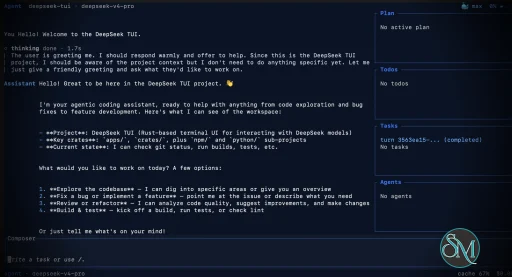
DeepSeek TUI is an open source terminal based coding agent designed for DeepSeek AI models. Unlike a simple chatbot, it can interact with your local workspace, execute shell commands, manage git operations, and assist with software development tasks directly from the command line.
The project is written in Rust and focuses on speed, low resource usage, and keyboard driven workflows. It is especially appealing for developers who spend most of their time in the terminal.
DeepSeek TUI is gaining attention among developers who prefer terminal based workflows and want direct access to AI powered coding tools without relying on heavy IDE integrations. Built around DeepSeek models, it transforms the terminal into an interactive coding assistant capable of editing files, running commands, and managing development workflows.
Download DeepSeek TUI v0.8.65 - Software Mirrors |
|---|
Download DeepSeek TUI v0.8.65 Windows 64bit Download DeepSeek TUI v0.8.65 Windows 64bit Download DeepSeek TUI v0.8.65 Windows 64bit Download DeepSeek TUI v0.8.65 Windows 64bit Download DeepSeek TUI v0.8.65 Windows 64bit |
Download DeepSeek TUI v0.8.65 macOS arm64 Download DeepSeek TUI v0.8.65 macOS arm64 Download DeepSeek TUI v0.8.65 macOS arm64 Download DeepSeek TUI v0.8.65 macOS arm64 |
Download DeepSeek TUI v0.8.65 macOS x64 Download DeepSeek TUI v0.8.65 macOS x64 Download DeepSeek TUI v0.8.65 macOS x64 Download DeepSeek TUI v0.8.65 macOS x64 |
Download DeepSeek TUI v0.8.65 macOS arm64 Download DeepSeek TUI v0.8.65 macOS arm64 Download DeepSeek TUI v0.8.65 macOS arm64 Download DeepSeek TUI v0.8.65 macOS arm64 |
Download DeepSeek TUI v0.8.65 Linux x64 Download DeepSeek TUI v0.8.65 Linux x64 Download DeepSeek TUI v0.8.65 Linux x64 Download DeepSeek TUI v0.8.65 Linux x64 |
Download DeepSeek TUI v0.8.65 Linux arm64 Download DeepSeek TUI v0.8.65 Linux arm64 Download DeepSeek TUI v0.8.65 Linux arm64 Download DeepSeek TUI v0.8.65 Linux arm64 |
DeepSeek TUI v0.8.65 Release Notes:CodeWhale is the canonical project, command, npm package, and release-asset name. The legacy npm package
deprecated and receives no further releases. Users coming from v0.8.x legacy with
InstallRecommended — npm (one command, both binaries)Docker / GHCRcodewhale dispatcher, codew shim, and codewhale-tui runtime. The latest tag is also updated on release.
Cargo (Linux / macOS)codewhale-cli produces the codewhale dispatcher and codew shim, while codewhale-tui produces the interactive runtime that the dispatcher delegates to. Installing only one crate will fail at runtime with a MISSING_COMPANION_BINARY error.
Manual download — platform archives (recommended)Each archive below contains thecodewhale dispatcher, codew shim, and codewhale-tui runtime, plus an install script:
codewhale-, codew-, and codewhale-tui-) — the npm wrapper and the in-app codewhale update download the matched runtime binaries, whereas the .tar.gz / .zip archives above are the recommended manual download and additionally bundle an install script. The legacy npm package deepseek-tui is deprecated and is not republished. For migration from v0.8.x legacy binary names, see docs/REBRAND.md.
Verify (recommended)Download the checksum manifests from this Release and verify:What's in v0.8.65Added
RouteResolver that produces a
resolved ReadyRouteCandidate (endpoint, wire protocol, model id, context
limit, price) for every switch (#3458, #3084, #3384). The executing client is
now constructed from the resolved candidate rather than re-derived from config
(#3384). A committed, network-free Models.dev-shaped catalog gives models real
context windows and pricing, with a secret-free live cache (#3497, #3498,
#3385). Offering pricing with provenance is projected onto candidates (#3501,
#3085), and route limits feed a route-aware context-budget service (#3508,
#3523, #3086).
/fleet surface and exposed through the
Runtime API.
/model search
with scroll and provider type-ahead (#3484, #3075); inline
[providers. (#1519); a DeepSeek Anthropic-compatible route (#2963,
#3449); a Qianfan route (#3425); Zhipu folded into Z.ai with equal-treatment
model normalization (#3539); DashScope/Together fixtures.
model-reference, modelref) opens a pager over the bundled catalog — every
model's factual context window, max output, modality, and price, grouped by
provider/kind. Labels only: it never selects, routes, or tiers a model
(#3205, #2300).
calm preset — calm mode, calm tool collapse, comfortable spacing, and
low motion — presentation-only and evidence-preserving (#3478).
Changed
config.rs monolith split into clean leaf modules (paths, search,
model/base-URL constants, sub-agent limits) behind a pub use facade.
AppMode helpers were centralized (#3510), and mode-vs-permission policy is
now derived through a single base_policy_for_mode resolver instead of
scattered mutation (#3386, advisory review-intent behavior preserved).
tool_search_* (#3463); ablated the in-turn loop_guard and encoded reasoning
dispositions (#3462); added the Orchestration disposition to the constitution.
RouteResolver; reasoning effort is normalized for the
resolved provider; the fallback chain now skips providers that lack auth
(#2574); and context window and memory-pressure come from the resolved route
(#3086).
/fleet is the product surface, while /subagents remains a
compatibility shortcut to worker status.
docs/CONTRIBUTORS.md + .github/AUTHOR_MAP) for earlier merged work that
shipped without it, including the /jobs cancel-all action and the npm
retry-timeout hint (#1538) by @jieshu666, and the community ACP adapter
reference by @rockeverm3m.
Fixed
gate passes; npm run build` no longer dirties the generated
web facts; the site sets metadataBase; the community digest page parses each
record independently and localizes its chrome; and cargo audit is clean with
the starlark-transitive unmaintained advisories documented.
http:// custom endpoints raise an advisory warning (#1519); and the Fleet
setup planner's role/model selection now drives the generated profile.
classify_risk marks all shell commands
destructive, so the auto-review safety floor held every background shell for
review, and the ForcePrompt site never checked auto_approve — only
background commands surfaced it, since foreground shells take the
Interactive origin and skip that branch.
/v1/apps/mcp/tools requests; live discovery
remains available through ?connect=true. doctor now warns on relative-path
stdio MCP commands without cwd.
CreditsContributor credits for this release live in the changelog entry above — thank you to everyone whose reports, PRs, reviews, and reproductions shaped it. See CHANGELOG.md for full notes and docs/CHANGELOG_ARCHIVE.md for older releases. |
Key Features of DeepSeek TUI
Terminal Native Workflow
DeepSeek TUI operates entirely within the terminal, allowing developers to work without switching between browser windows or external interfaces.AI Assisted Coding
The assistant can read and edit files, generate code, explain logic, and help automate development tasks.Shell Command Execution
It supports running terminal commands directly through the interface, streamlining development workflows.Git Integration
Developers can manage repositories, review changes, and handle version control related tasks from inside the tool.Multiple Work Modes
DeepSeek TUI includes modes like Plan, Agent, and YOLO, offering different levels of automation and approval control.Large Context Handling
The tool is built around DeepSeek V4 capabilities, including support for extremely large context windows that help with understanding bigger codebases.
User Experience
DeepSeek TUI is designed for developers comfortable with terminal environments. The interface is keyboard focused and efficient, though beginners may need time to adapt.
The workflow feels closer to tools like Claude Code or Codex style assistants rather than traditional chat applications. Community feedback on Reddit and GitHub discussions highlights its speed and practical coding workflow.
Performance and Compatibility
Because it is written in Rust, DeepSeek TUI is lightweight and responsive. It supports Linux, macOS, and Windows, with installation available through npm, Cargo, or direct binaries.
Performance depends heavily on the connected DeepSeek models and API configuration, but the local interface itself remains fast and efficient.
Pros
Fast terminal native workflow
AI powered coding and automation
Lightweight Rust based architecture
Supports file editing and shell execution
Open source and actively developed
Cons
Requires familiarity with terminal workflows
Depends on external AI APIs
Advanced automation modes may feel risky for inexperienced users
DeepSeek TUI is ideal for developers, DevOps engineers, and terminal focused power users who want AI assistance integrated directly into their command line workflow. It is especially attractive for users seeking a lightweight alternative to browser based AI coding tools.
DeepSeek TUI combines AI coding assistance with the efficiency of terminal workflows. Its fast performance, flexible automation, and developer focused design make it one of the most interesting open source AI terminal tools currently gaining traction.
Developer:
Hunter Bown
Operating System:
Windows / macOS / Linux
Date Added:
2026-06-26T16:01:33.855Z
Categories:
Post a Comment/Report Broken Link: