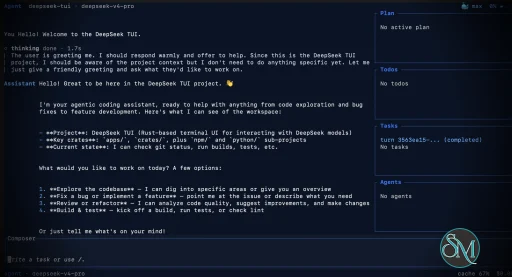
DeepSeek TUI is an open source terminal based coding agent designed for DeepSeek AI models. Unlike a simple chatbot, it can interact with your local workspace, execute shell commands, manage git operations, and assist with software development tasks directly from the command line.
The project is written in Rust and focuses on speed, low resource usage, and keyboard driven workflows. It is especially appealing for developers who spend most of their time in the terminal.
DeepSeek TUI is gaining attention among developers who prefer terminal based workflows and want direct access to AI powered coding tools without relying on heavy IDE integrations. Built around DeepSeek models, it transforms the terminal into an interactive coding assistant capable of editing files, running commands, and managing development workflows.
Download DeepSeek TUI v0.8.62 - Software Mirrors |
|---|
Download DeepSeek TUI v0.8.62 Windows 64bit Download DeepSeek TUI v0.8.62 Windows 64bit Download DeepSeek TUI v0.8.62 Windows 64bit Download DeepSeek TUI v0.8.62 Windows 64bit |
Download DeepSeek TUI v0.8.62 macOS arm64 Download DeepSeek TUI v0.8.62 macOS arm64 Download DeepSeek TUI v0.8.62 macOS arm64 |
Download DeepSeek TUI v0.8.62 macOS x64 Download DeepSeek TUI v0.8.62 macOS x64 Download DeepSeek TUI v0.8.62 macOS x64 |
Download DeepSeek TUI v0.8.62 macOS arm64 Download DeepSeek TUI v0.8.62 macOS arm64 Download DeepSeek TUI v0.8.62 macOS arm64 |
Download DeepSeek TUI v0.8.62 Linux x64 Download DeepSeek TUI v0.8.62 Linux x64 Download DeepSeek TUI v0.8.62 Linux x64 |
Download DeepSeek TUI v0.8.62 Linux arm64 Download DeepSeek TUI v0.8.62 Linux arm64 Download DeepSeek TUI v0.8.62 Linux arm64 |
DeepSeek TUI v0.8.62 Release Notes:CodeWhale is the canonical project, command, npm package, and release-asset name. The legacy npm package
deprecated and receives no further releases. Users coming from v0.8.x legacy with
InstallRecommended — npm (one command, both binaries)Docker / GHCRcodewhale dispatcher and codewhale-tui runtime. The latest tag is also updated on release.
Cargo (Linux / macOS)codewhale-cli produces the codewhale dispatcher and codewhale-tui produces the interactive runtime that the dispatcher delegates to. Installing only one binary will fail at runtime with a MISSING_COMPANION_BINARY error.
Manual download — platform archives (recommended)Each archive below contains both thecodewhale dispatcher and codewhale-tui runtime, plus an install script:
codewhale- and codewhale-tui-) — these are what the npm wrapper and the in-app codewhale update download, whereas the .tar.gz / .zip archives above are the recommended manual download and additionally bundle an install script. The legacy npm package deepseek-tui is deprecated and is not republished. For migration from v0.8.x legacy binary names, see docs/REBRAND.md.
Verify (recommended)Download the checksum manifests from this Release and verify:What's in v0.8.62Changed
GLM-5.2 in both codewhale-tui and codewhale-config; the glm-5.1
alias still resolves to GLM-5.1 (the defaulting was decoupled from the alias
arm so it no longer tracks the default). Docs and config.example.toml no
longer describe GLM-5.2 as an opt-in preview.
GLM-5.2 parent routes
faster/explore children to GLM-5-Turbo (direct Z.ai) and z-ai/glm-5-turbo
(OpenRouter), instead of down to GLM-5.1. GLM-5.1 and GLM-5-Turbo themselves
have no cheaper tier and keep children on the parent.
model or model_strength: "same" is
supplied. Non-explore roles keep the conservative same default.
low (the Codex Responses API has no true off, so the resolved
effort is now honest low rather than off silently rewritten). No
DeepSeek/GLM fallback is fabricated when no cheaper same-provider sibling
exists. DeepSeek Pro→Flash routing and its no-thinking faster lane are
unchanged.
type: "explore" sub-agents) for broad repo,
version, branch, benchmark, and API-surface investigations, while keeping
architecture, integration, and final verification in the parent. The
delegate skill examples now use provider-neutral model_strength instead of
hardcoded DeepSeek model ids.
identical_tool_call) from no-progress loops (no_progress_tool_loop).
agent_id and the child's EVIDENCE line(s), and
do not present child findings as directly verified facts. The sidebar orders
sub-agents as a parent/child tree and annotates nested rows with parent and
depth information in hover text.
summary_kind: complete | truncated
so the parent model can branch on whether it saw the full report or a clipped
excerpt. Short summaries (≤ 12,000 chars) get a soft "re-verify material
claims" suffix; longer ones are head+tail truncated with an honest marker
stating the elided middle is not retrievable via retrieve_tool_result.
Every summary therefore carries exactly one boundary marker, never both.
ProviderMetadata registry
across codewhale-config, codewhale-tui, and codewhale-cli, reducing drift
between the provider picker, codewhale auth, doctor --json, and setup
hints.
Added
request_user_input tool to ask the user structured clarifying questions
through a modal UI surface instead of only emitting a chat message and hoping
the user notices. Mirrors the approval/secret-request flow the harness
already used for permissions. The tool accepts 1-3 questions, each with a
header, an id, 2-4 selectable options (label + description), and
allow_free_text / multi_select flags (both default to false for
back-compat). Input is validated up front with actionable errors. Wired
across all layers: the request_user_input tool, engine handling
(turn_loop → approval), an interactive TUI modal (UserInputView) with
full keyboard navigation, and the runtime protocol
(EventFrame::UserInputRequest + AppRequest::SubmitUserInput) so headless
/ app-server clients can answer programmatically. Parity tests cover the
wire round-trip and the omitted-flags default.
ColorCompatBackend — so the ESC bytes never occupy display columns or
corrupt selection. Supporting terminals get live hyperlinks; others see the
label text unchanged. Clipboard/selection extraction strips residual codes as
defense-in-depth.
[skills].scan_codewhale_only = true limits session-time skill discovery to
CodeWhale-owned roots (~/.codewhale/skills,
and any explicit skills_dir) while ignoring cross-tool directories such as
.claude/skills, .opencode/skills, .cursor/skills, and ~/.agents/skills.
The default remains the broad compatibility scan.
exec_shell before
Auto/session approval shortcuts. Matching ask rules force an approval prompt
in otherwise auto-approved flows and are rejected under
approval_mode = "never".
codewhale app-server --insecure-no-auth for loopback-only testing and warns
against combining it with --mobile on 0.0.0.0.
Fixed
tui.toml now merges user comments and formatting back into the serialized
document; if comment merge fails, the write falls back to plain serialized
output rather than failing.
[snapshots].enabled before writing, matching the existing
session-level gate.
pdftotext -v instead of --version, because Poppler treats --version as
an input filename. Fixes detection on systems where only Poppler is installed.
checklist_write work breakdown before accepting or revising a plan.
Retroactive creditsA credit-reconciliation pass found shipped community fixes that were never recorded in this changelog. Crediting them now, with the version they shipped in:
|
Key Features of DeepSeek TUI
Terminal Native Workflow
DeepSeek TUI operates entirely within the terminal, allowing developers to work without switching between browser windows or external interfaces.AI Assisted Coding
The assistant can read and edit files, generate code, explain logic, and help automate development tasks.Shell Command Execution
It supports running terminal commands directly through the interface, streamlining development workflows.Git Integration
Developers can manage repositories, review changes, and handle version control related tasks from inside the tool.Multiple Work Modes
DeepSeek TUI includes modes like Plan, Agent, and YOLO, offering different levels of automation and approval control.Large Context Handling
The tool is built around DeepSeek V4 capabilities, including support for extremely large context windows that help with understanding bigger codebases.
User Experience
DeepSeek TUI is designed for developers comfortable with terminal environments. The interface is keyboard focused and efficient, though beginners may need time to adapt.
The workflow feels closer to tools like Claude Code or Codex style assistants rather than traditional chat applications. Community feedback on Reddit and GitHub discussions highlights its speed and practical coding workflow.
Performance and Compatibility
Because it is written in Rust, DeepSeek TUI is lightweight and responsive. It supports Linux, macOS, and Windows, with installation available through npm, Cargo, or direct binaries.
Performance depends heavily on the connected DeepSeek models and API configuration, but the local interface itself remains fast and efficient.
Pros
Fast terminal native workflow
AI powered coding and automation
Lightweight Rust based architecture
Supports file editing and shell execution
Open source and actively developed
Cons
Requires familiarity with terminal workflows
Depends on external AI APIs
Advanced automation modes may feel risky for inexperienced users
DeepSeek TUI is ideal for developers, DevOps engineers, and terminal focused power users who want AI assistance integrated directly into their command line workflow. It is especially attractive for users seeking a lightweight alternative to browser based AI coding tools.
DeepSeek TUI combines AI coding assistance with the efficiency of terminal workflows. Its fast performance, flexible automation, and developer focused design make it one of the most interesting open source AI terminal tools currently gaining traction.
Developer:
Hunter Bown
Operating System:
Windows / macOS / Linux
Date Added:
2026-06-18T16:01:46.403Z
Categories:
Post a Comment/Report Broken Link: