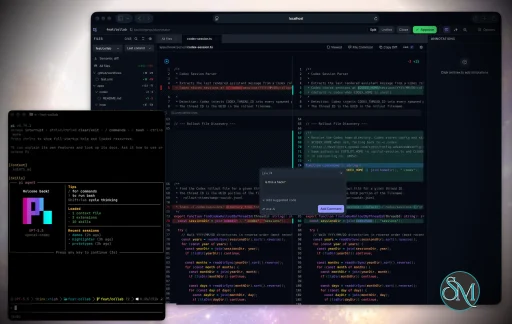
Plannotator is an open-source platform designed to review and validate plans and code generated by AI coding agents.
The platform provides a centralized interface where developers can:
Review AI-generated plans
Annotate proposed actions
Approve or reject tasks
Inspect code changes
Provide structured feedback
Improve agent outputs
Maintain human oversight
Rather than replacing developers, Plannotator aims to keep humans involved in critical decision-making during AI-assisted development.
As AI coding agents become increasingly capable, developers face a growing challenge: ensuring that AI-generated plans and code changes align with project requirements before they are executed. Plannotator addresses this problem by acting as a review layer between developers and AI coding agents.
Instead of generating code itself, Plannotator focuses on making AI-driven development more transparent and controllable. It allows teams to review, annotate, approve, reject, and refine agent-generated plans and code changes before they affect a project.
Download Plannotator v0.27.21 - Software Mirrors |
|---|
Plannotator v0.27.21 for Windowsplannotator-win32-x64.exe | 149.26 MB plannotator-win32-arm64.exe | 146.23 MB |
Plannotator v0.27.21 for macOSplannotator-paste-darwin-x64 | 65.97 MB plannotator-paste-darwin-arm64 | 60.51 MB |
Plannotator v0.27.21 for Linuxplannotator-paste-linux-x64 | 89.3 MB plannotator-paste-linux-arm64 | 89.35 MB |
Plannotator v0.27.21 Source Code |
Plannotator v0.27.21 Release Notes:Follow @plannotator on X for updatesMissed recent releases?
What's New in v0.27.21A fix release built mostly from community reports. Remote and phone sessions load several times faster, code review can request changes on GitHub for real, model pickers show readable names and say where their list came from, and several OpenCode rough edges are gone. Seven pull requests, answering issues from four people.Remote and phone sessions load several times fasterEvery session sent the whole app to the browser as one uncompressed file, about 25 MB for plan review and 18 MB for code review, on a fresh port each time, so nothing could be cached. On a fast local connection that goes unnoticed. Over a slow tunnel, such as a phone reaching a Mac through Tailscale, it meant waiting up to two minutes before anything appeared. Remote-mode and--tailscale sessions now send the page compressed: brotli over --tailscale's HTTPS, gzip over plain http. Measured cold loads at 206 KB/s and 159 ms, the connection from the report:
Request changes on GitHub pull requestsIn a pull request review, Post comments, then… promised a choice between requesting changes and staying neutral, and Request changes… promised the same. Neither existed: every review posted as a plain comment. The submission dialog now offers Comment or Request changes, and a Request changes review posts asREQUEST_CHANGES on GitHub, including reviews with file-level comment threads. On your own pull request the option is disabled with the reason, since GitHub refuses it. GitLab has no equivalent, so the option is disabled there and posting is unchanged.
(#1613, closing #1611, reported by @RobertoArtiles)
Model pickers show real names and where the list came fromClaude Code 2.1.282 changed how it describes its models, and Plannotator started labeling specific Claude versions with their marketing tagline instead of their name: several rows read "Best for everyday, complex tasks" and could not be told apart. Every Claude picker now shows the model's name again, and older Claude Code versions keep working. Each Claude and Codex model picker (code review agents, Code Tour, Guided Review, Ask AI) also shows where its list came from, such as "From your installed Codex 0.155.1", or says it is using the built-in list and suggests updating or signing in to the tool. The built-in list, used only when Plannotator cannot read your installed tool's models, now includes the GPT-6 models. Guided Review defaults to GPT-6 Luna for Codex when your Codex offers it, since guides generate faster on a lighter model; a model you already picked always wins. If a newer model is missing from your picker, update the tool itself (codex update, or update Claude Code) and restart the review. The picker shows whatever your installed tool reports.
(#1615, #1616)
OpenCode fixes
Additional Changes
Install / UpdatemacOS / Linux:/plugin in Claude Code, find plannotator, and click "Update now".
Pi: Update @plannotator/pi-extension to 0.27.21 and restart Pi.
OpenCode: Clear cache and restart:
What's Changed
CommunityThis release is mostly answers to reports:
|
Key Features of Plannotator
Plan Review System
One of Plannotator's core capabilities is reviewing plans generated by AI agents before execution.
Developers can examine:
Proposed tasks
Implementation strategies
Agent reasoning
Planned file modifications
Workflow sequences
This visibility helps reduce unintended changes and costly mistakes.
Annotation Tools
The platform allows users to add comments, notes, and guidance directly to AI-generated plans.
These annotations can be used to:
Clarify requirements
Correct misunderstandings
Provide context
Guide future agent actions
AI Code Review
Plannotator extends the review process beyond planning by supporting inspection of generated code.
Developers can:
Review modifications
Analyze diffs
Leave comments
Request revisions
Validate implementation details
This workflow resembles modern pull-request review systems.
Human-in-the-Loop Workflows
A major design goal is ensuring that AI actions remain subject to human approval.
Organizations can establish review processes where important actions require validation before execution.
Open Source Foundation
Plannotator is open source, allowing teams to inspect, modify, and self-host the platform according to their needs.
This transparency is particularly valuable for organizations adopting AI-assisted software development.
User Experience
The interface is designed around review workflows rather than direct code generation.
Instead of interacting with a chatbot, users primarily:
Receive agent-generated plans
Review proposed actions
Add feedback
Approve or reject changes
Monitor execution results
The workflow feels familiar to developers accustomed to pull requests, code reviews, and project planning tools.
Productivity Benefits
As AI coding tools become more autonomous, review processes become increasingly important.
Plannotator helps organizations:
Reduce risky AI actions
Improve code quality
Increase accountability
Preserve architectural consistency
Encourage collaboration between developers and AI agents
For teams adopting AI-driven development, these safeguards can be as valuable as the coding agents themselves.
Collaboration Features
The platform supports collaborative review workflows where multiple team members can participate in evaluating AI-generated outputs.
This allows:
Peer review
Team approval processes
Shared annotations
Collective decision-making
Such features are especially useful for larger engineering teams.
Performance
Because Plannotator focuses on workflow management and review rather than model inference, performance largely depends on the connected AI agents and integrations.
The platform itself is lightweight and primarily serves as an orchestration and review layer.
Open Source Advantages
Being open source provides several benefits:
Transparent development
Self-hosting capabilities
Custom integrations
Community contributions
Vendor independence
Organizations concerned about compliance, security, or proprietary workflows may find these advantages particularly appealing.
Limitations
Plannotator is designed as a companion tool rather than a complete AI development platform.
Common limitations include:
Requires external AI coding agents
Best suited for teams already using AI-assisted development
Smaller ecosystem than mature developer platforms
Additional review steps may slow rapid prototyping
Some users may prefer fully autonomous workflows
The software delivers the most value in environments where oversight and quality control are priorities.
Pros
Improves transparency of AI-generated plans
Supports structured review workflows
Human-in-the-loop design
Useful annotation system
Open source
Self-hosting support
Familiar review experience for developers
Helps reduce AI-generated mistakes
Cons
Not a standalone coding agent
Requires integration with AI development tools
Smaller community than established developer platforms
Adds review overhead to workflows
Best suited for teams rather than casual users
Who Should Use Plannotator?
Plannotator is ideal for:
Software development teams
Engineering managers
AI-assisted development workflows
Organizations adopting coding agents
Open-source projects
Teams prioritizing code quality and governance
It is particularly valuable for environments where AI-generated code requires oversight before reaching production systems.
Plannotator fills an increasingly important role in the AI development ecosystem by providing visibility and control over AI-generated plans and code changes. Its focus on human oversight, structured reviews, and collaborative workflows makes it a useful companion for modern coding agents. While it is not a replacement for AI coding tools themselves, it offers a practical solution for teams seeking greater confidence and accountability in AI-assisted software development.
Developer:
backnotprop
Operating System:
Windows / macOS / Linux
Date Added:
2026-09-26T23:04:10.144Z
Categories:
Post a Comment/Report Broken Link: